Urethane vs Rubber Hex: Space Layouts for Heavy Dumbbell Rows
Optimize your home gym layout for heavy dumbbell rows. Compare rubber hex vs urethane density, rack footprints, drop zones, and spatial design.

The Spatial Reality of Heavy Dumbbell Rows
When designing a home gym, most lifters focus on the footprint of their power rack or cardio equipment. However, if your programming includes heavy dumbbell rows—unilateral pulling movements utilizing 80 to 150+ lb dumbbells—your spatial layout and equipment material choices become critical safety and efficiency factors. Executing a heavy row requires significant vertical clearance, a wide staggered stance, and a designated 'drop zone' for when grip failure inevitably occurs.
The debate between rubber hex dumbbells and urethane dumbbells is often reduced to aesthetics and odor. But from a space optimization perspective, the difference in material density, head profile, and kinetic bounce drastically alters how you must design your rowing station. As of 2026, with home gym square footage remaining at a premium, understanding the volumetric differences between these two materials is essential for building a functional, high-performance layout.
The 48-Inch Clearance Rule
According to biomechanical guidelines for unilateral back training, the latissimus dorsi requires a full stretch and contraction. When performing heavy dumbbell rows, the weight must travel 30 to 40 inches vertically. To accommodate this, plus the lifter's staggered stance and torso hinge, you must allocate a minimum 48-inch clearance radius from the edge of your dumbbell rack to your rowing bench. Failing to account for this spatial requirement forces compromised mechanics and increases the risk of dropping the weight onto your rack.
Volumetric Density and Rack Footprint
The primary spatial advantage of urethane over rubber hex lies in material density. Urethane is significantly denser than standard rubber, meaning a 100 lb urethane dumbbell has a noticeably smaller physical footprint than a 100 lb rubber hex dumbbell. This density directly impacts your storage layout.
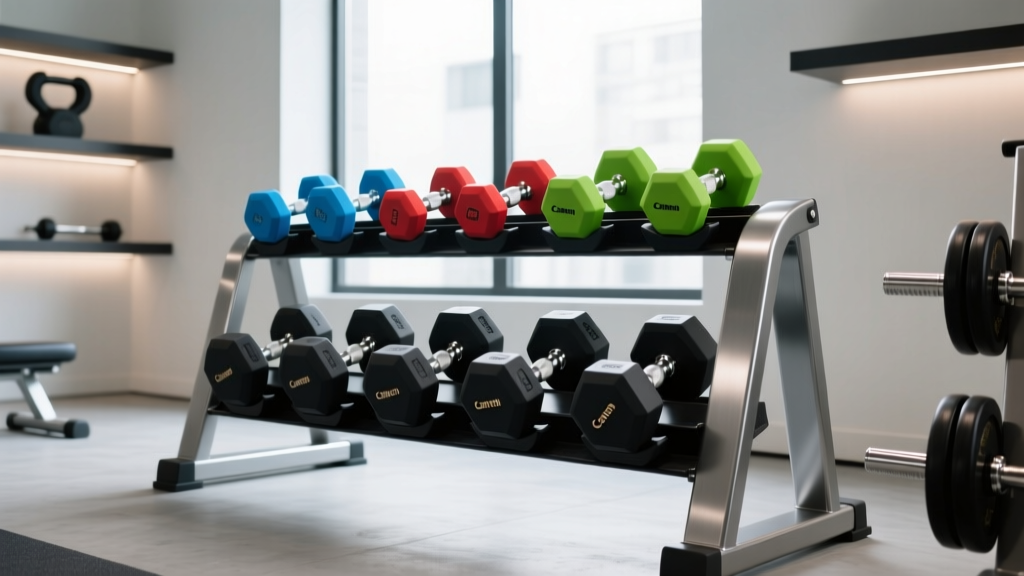
For heavy dumbbell rows, horizontal 3-tier racks are vastly superior to vertical A-frames. Bending down to pick up a 120 lb dumbbell from the bottom tier of an A-frame places immense, unsafe shear force on the lumbar spine before the set even begins. Horizontal racks allow for a safe, hinged pickup. However, horizontal racks consume valuable lateral wall space. Because urethane dumbbell heads are more compact, you can fit a complete 50-120 lb set on a standard 3-tier horizontal rack, whereas rubber hex dumbbells often require a wider 4-tier or 5-tier rack to accommodate their bulkier heads.
| Metric (100 lb Model) | Rubber Hex Dumbbell | Urethane Dumbbell | Spatial Impact |
|---|---|---|---|
| Head Width / Profile | ~6.5 inches | ~5.8 inches | Urethane saves ~12-18 inches of lateral rack space per set. |
| Material Density | Lower (Bulkier) | Higher (Compact) | Allows for 3-tier horizontal storage instead of 4-tier. |
| Edge Degradation | High (Edges round off) | Very Low | Degraded hex edges roll, requiring wider floor drop-zones. |
| Average Cost (2026) | $2.05 - $2.50 / lb | $3.25 - $3.80 / lb | Urethane commands a premium but maximizes cost-per-sq-ft. |
The Drop Zone: Bounce Kinetics in Tight Spaces
When executing high-rep, heavy sets like the infamous Kroc Rows—a technique detailed in T-Nation's comprehensive guide to Kroc Rows—grip failure is the limiting factor. When your grip gives out with a 120 lb dumbbell in hand, you do not gently lower it; you drop it. The material of the dumbbell dictates how much floor space you must allocate for the 'drop zone' to prevent damage to your walls, mirrors, or adjacent equipment.
Rubber Hex Failure Modes
Standard rubber hex dumbbells are notorious for their high kinetic bounce. Furthermore, after a year of heavy use, the sharp hexagonal edges that prevent rolling begin to compress, tear, and round off. Once a 100 lb rubber hex dumbbell loses its geometric integrity, it becomes a unpredictable, heavy bowling ball. If you drop it after a heavy row in a tight space, the bounce and subsequent roll can easily bridge a 24-inch gap and shatter a drywall partition or mirror.
Urethane's Dead-Bounce Advantage
Urethane possesses a high hysteresis, meaning it absorbs and dissipates kinetic energy rather than returning it as bounce. When dropped from a standing or hinged rowing position, a urethane dumbbell exhibits a 'dead bounce.' It hits the floor and stays virtually exactly where it landed. For space-constrained home gyms where your rowing bench is situated just 3 feet from a wall or a loaded barbell, urethane's dead-bounce profile shrinks your required safety clearance by up to 40%, allowing for a much tighter, more efficient room layout.
Designing the Optimal Heavy Rowing Station
To integrate heavy dumbbell rows into a space-optimized home gym, follow this specific layout protocol. This setup assumes the use of compact urethane dumbbells on a horizontal rack, paired with an adjustable bench.
- Anchor the Horizontal Rack: Mount a 3-tier horizontal dumbbell rack against your longest uninterrupted wall. Because urethane heads are compact, a 50-120 lb set will occupy roughly 48 inches of wall space. Ensure the bottom tier is at least 8 inches off the floor to allow for easy plate loading on adjacent barbells if needed.
- Establish the 48-Inch Pull Path: Measure exactly 48 inches outward from the front edge of the dumbbell rack. This is the boundary line for your rowing bench. Do not place any other equipment (kettlebells, plyo boxes) inside this radius.
- Position the Adjustable Bench: Set your bench to a 15-to-30-degree incline for chest-supported heavy rows, or keep it flat for traditional unilateral rows. Place the bench parallel to the rack, ensuring the lifter faces away from the rack during the pull to avoid elbow strikes against the steel frame.
- Integrate High-Density Flooring: The drop zone directly beside the bench must feature 3/4-inch thick vulcanized rubber mats (like horse stall mats). While urethane doesn't bounce, the sheer force of a 120 lb drop will crack standard concrete or shatter cheap interlocking EVA foam tiles.
'In commercial and high-end home facility design, the space between the storage rack and the active lifting zone is where most injuries occur. Minimizing the lateral footprint of your dumbbell heads via urethane allows you to widen the lifter's operational corridor without expanding the room's physical dimensions.'
— Facility Layout Guidelines, National Strength and Conditioning Association (NSCA)
Cost vs. Space Efficiency Matrix
Upgrading to urethane represents a significant capital expenditure. A full 5-100 lb set of premium urethane dumbbells (like those from Rogue Fitness) can cost upwards of $2,800, whereas the rubber hex equivalent hovers around $1,600. However, when evaluating space optimization, you must factor in the 'cost of square footage.'
If you are building a gym in a finished basement, a spare bedroom, or a garage where every square foot is contested by household storage, the ability to use a narrower 3-tier rack and shrink your drop-zone clearance can save you 15 to 25 square feet of total floor space. In urban environments where real estate costs $200+ per square foot, the spatial efficiency of urethane effectively pays for its own premium by allowing you to retain more usable room for other equipment, like a cable crossover or a dedicated cardio zone.
Final Verdict for the Space-Conscious Lifter
If your programming heavily features heavy dumbbell rows, Kroc rows, or high-volume unilateral back work, the spatial and kinetic advantages of urethane vastly outweigh the upfront cost. The compact head profile allows for safer, horizontal 3-tier storage that preserves your lower back during the pickup phase. Furthermore, the dead-bounce nature of urethane eliminates the need for massive, sprawling drop zones, allowing you to push your rowing station closer to walls and adjacent equipment. Rubber hex remains a fine choice for budget-conscious lifters with sprawling garage gyms, but for true space optimization and layout precision, urethane is the undisputed champion of the modern home gym.
More gear to consider
All reviews
Barbell Collar Setup & Stiff Leg Deadlift with Dumbbells

Barbell Collar Clamp Types: Safety Beyond Dumbbell Curls Form

Bumper vs Iron Plates: Gym Layouts & Dumbbell Shoulder Raises

Barbell Curl vs Dumbbell Curl: Dumbbell Rack Storage & Care
Best Dumbbell Racks for All Dumbbell Exercises: 2026 Review