Free Weight Setup: Barbell Collar Types & Alternate Dumbbell Press
Complete setup walkthrough comparing barbell collar types and securing loadable dumbbells for a safe, effective alternate dumbbell press.

Introduction: The Hybrid Free Weight Station
Designing a comprehensive home or commercial gym in 2026 requires more than just buying equipment; it demands a meticulous setup and installation walkthrough to ensure seamless transitions between heavy bilateral lifts and targeted unilateral accessory work. A prime example of this hybrid workflow is moving from heavy barbell bench pressing to the alternate dumbbell press. This transition requires two completely different approaches to weight security. While your barbell requires robust collars to handle eccentric drops and sleeve rotation, your loadable dumbbells demand ultra-secure, low-profile clamps to prevent catastrophic shifts in the center of mass during unilateral movements.
This guide provides a complete, step-by-step installation and setup walkthrough. We will break down the barbell collar and clamp types comparison, transition into loadable dumbbell assembly, and detail the exact biomechanical setup required to execute the alternate dumbbell press safely and effectively.
Phase 1: Barbell Station Preparation and Loading
Before addressing collars, your foundational setup must be exact. Install your J-cups on the power rack or squat stand at a height where your elbows are at a 90-degree angle when lying on the bench, allowing you to unrack without excessive shoulder extension. Once the barbell is loaded with your primary working plates, the sleeve is ready for collar installation. The collar you choose dictates not only the safety of your lift but also the calibrated weight of the system.
Phase 2: Barbell Collar and Clamp Types Comparison
Not all collars are created equal. The market has evolved significantly from the traditional spring clips of the early 2000s. Below is a deep dive into the three primary collar categories you will encounter when setting up your barbell station.
1. Traditional Spring Collars
Spring collars rely on steel tension to grip the barbell sleeve. While they are lightweight and inexpensive (typically $8 to $15 per pair), they are fundamentally flawed for heavy or dynamic lifting. They exert roughly 15 to 20 pounds of lateral clamping force. If you are dropping the bar from overhead or performing heavy negative reps, the inertia of the bumper plates will easily overcome the spring tension, causing the plates to slide outward and potentially unbalance the bar.
2. Polymer Cam-Lock Clamps
Polymer clamps, such as the widely adopted Rogue HG2 or Lock-Jaw Pro models ($25 to $35 per pair), utilize a cam-lever mechanism lined with high-durometer rubber. When the lever is snapped shut, it generates over 150 pounds of lateral clamping force. Weighing in at roughly 350 grams each, they are the modern workhorse for 90% of gym-goers. They absorb shock exceptionally well and will not slip, even during aggressive barbell drops.
3. Forged Aluminum Competition Collars
For powerlifters and Olympic weightlifters, precision is paramount. According to the USA Powerlifting Technical Rules, competition collars must weigh exactly 2.5 kg (5.51 lbs) each to ensure standardized loading. Forged aluminum collars (ranging from $75 to $120 per pair) use a threaded screw or heavy-duty latch to lock onto the sleeve. They add measurable weight to the bar and prevent any micro-movements of calibrated steel plates.
Collar Comparison Matrix
| Collar Type | Avg. Price (Pair) | Weight per Collar | Clamping Force | Best Application |
|---|---|---|---|---|
| Spring Clip | $8 - $15 | ~110g | Low (15-20 lbs) | Light warm-ups, storage |
| Polymer Cam-Lock | $25 - $35 | ~350g | High (150+ lbs) | CrossFit, hypertrophy, drops |
| Aluminum Competition | $75 - $120 | 2.5 kg (5.51 lbs) | Maximum (Threaded) | Powerlifting, calibrated plates |
Source: Pricing and specifications aggregated from Rogue Fitness Barbell Collars and current 2026 market data.
Phase 3: Transitioning to Loadable Dumbbells
Once your heavy barbell work is complete, strip the bar and transition to your loadable dumbbell handles (such as the Titan Fitness or Rogue Loadable Dumbbell Handles). This is where equipment setup becomes highly specialized. Loadable dumbbells typically use 1-inch or 2-inch sleeves. For the 2-inch Olympic handles, you cannot use standard barbell cam-locks; the lever will hit your wrists or legs during movement.
Installation Step: You must install low-profile micro-collars or secure O-ring spin-lock nuts. If using spin-locks, ensure the rubber O-rings are intact and placed between the weight plate and the metal nut. This creates friction that prevents the nut from vibrating loose during repetitive pressing movements.
Phase 4: Executing the Alternate Dumbbell Press Safely
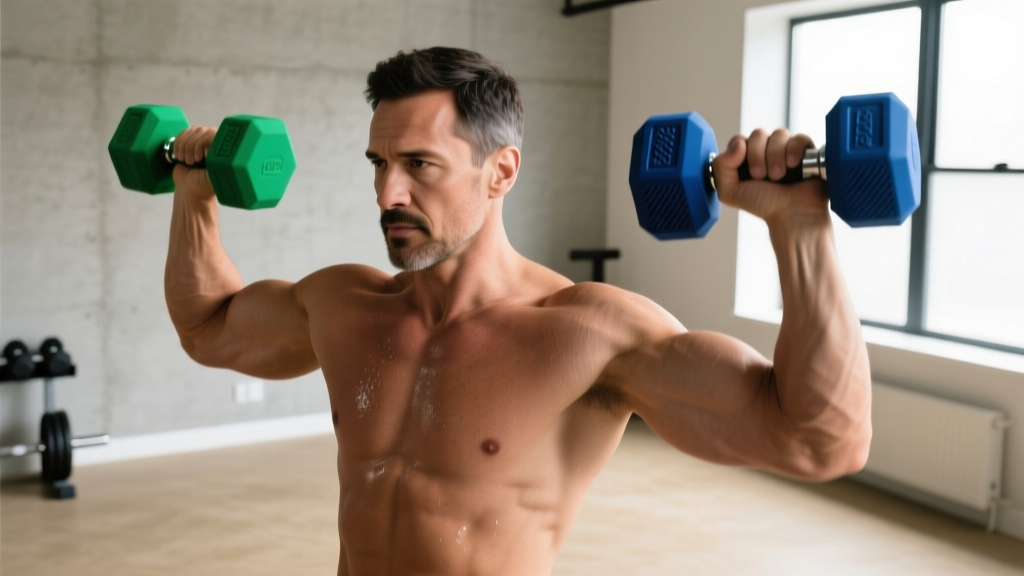
The alternate dumbbell press is a highly effective unilateral movement that challenges the pectorals, anterior deltoids, and triceps while demanding immense core anti-rotation stability. According to the ACE Fitness Exercise Library, alternating the press forces the contralateral side of the core to fire aggressively to prevent the torso from rolling off the bench.
The Physics of Plate Shift (Why Collars Matter Here)
⚠️ CRITICAL SAFETY INSIGHT: During the alternate dumbbell press, one arm is pressing dynamically while the other holds a heavy dumbbell isometrically in the air. If your dumbbell collar is loose and a 2.5 lb plate slides just 1.5 inches outward, the moment of inertia increases exponentially. This sudden shift in the center of mass mid-rep places severe, unanticipated eccentric torque on the wrist stabilizers and rotator cuff, frequently leading to acute strains.Step-by-Step Setup and Execution
- Collar Verification: Before lying down, physically pull on the outermost plate of each loadable dumbbell. If there is any lateral play exceeding 1 millimeter, tighten the spin-lock or replace the micro-collar.
- Bench Positioning: Lie flat with your feet planted firmly. Retract your scapulae to create a stable shelf on the bench pad.
- The Isometric Hold: Kick both dumbbells up to the starting position. The non-working arm must remain perfectly vertical, locking the weight over the shoulder joint to minimize muscular fatigue while the working arm moves.
- The Alternating Press: Lower the right dumbbell with a 2-second eccentric phase until a deep stretch is felt in the pec. Press explosively back to the top. Only once the right arm is locked out should the left arm begin its descent.
- Core Bracing: Exhale sharply through the sticking point of the press to engage the transverse abdominis and prevent spinal rotation.
Phase 5: Post-Workout Equipment Maintenance
Proper installation is only half the battle; maintaining your collars and clamps ensures longevity and continued safety.
- Cam-Lock Hinges: Wipe down polymer clamp hinges with a dry microfiber cloth weekly. Chalk and sweat buildup in the cam mechanism will reduce clamping force by up to 40% over time.
- Spin-Lock Threads: Apply a single drop of 3-in-One oil to the threaded shafts of your loadable dumbbell handles monthly to prevent cross-threading and rust.
- Spring Collar Retirement: If the steel coils on your spring collars show any visible deformation or if the plastic tips are cracked, discard them immediately. They are no longer safe for any dynamic movement.
Final Thoughts on Gym Setup
A professional-grade free weight station is defined by the details. By understanding the distinct mechanical advantages of polymer clamps versus competition aluminum collars, you ensure your barbell work is both safe and accurately calibrated. Furthermore, by respecting the biomechanical demands of the alternate dumbbell press and securing your loadable dumbbells with low-profile, high-friction locks, you eliminate the hidden variables that lead to joint injury. Take the time to install, inspect, and maintain your clamping hardware—it is the unsung hero of your training longevity.
More gear to consider
All reviews
Cast Iron vs Competition: Value & the Kettlebell Swing with Dumbbell

Rogue vs Titan Barbells: Upgrading Your Chest Dumbbell Home Workout

Budget Racks for Good Back Workouts With Dumbbells 2026

Power Rack vs Squat Rack for Seated Dumbbell Shoulder Press Setup

Beyond the 30 Minute Full Body Dumbbell Workout: Barbell Buying Guide