Power Rack vs Squat Rack vs Stand for Overhead Dumbbell Tricep Press
Compare power racks, squat racks, and squat stands for heavy lifts and the overhead dumbbell tricep press. A step-by-step 2026 home gym buying guide.

Building a home gym in 2026 requires balancing budget, square footage, and uncompromising safety. When beginners start researching equipment, the debate almost always narrows down to three main structures: the power rack, the squat rack, and the squat stand. While most buying guides focus exclusively on heavy barbell squats and bench presses, very few address how these structures handle heavy, isolated dumbbell movements. Specifically, if you plan to progressively overload your arms, you need to understand how your rack choice impacts the safety and execution of the overhead dumbbell tricep press.
This step-by-step guide will break down the structural differences, safety profiles, and spatial footprints of each option, giving you a concrete framework to choose the right steel for your garage gym.
Step 1: Define the Contenders and Their Specs
Before comparing safety features, we must establish the baseline engineering of each rack type. In the current fitness equipment market, most reputable brands utilize 11-gauge steel for heavy-duty racks, but the configuration changes everything.
1. The Power Rack (Full Cage)
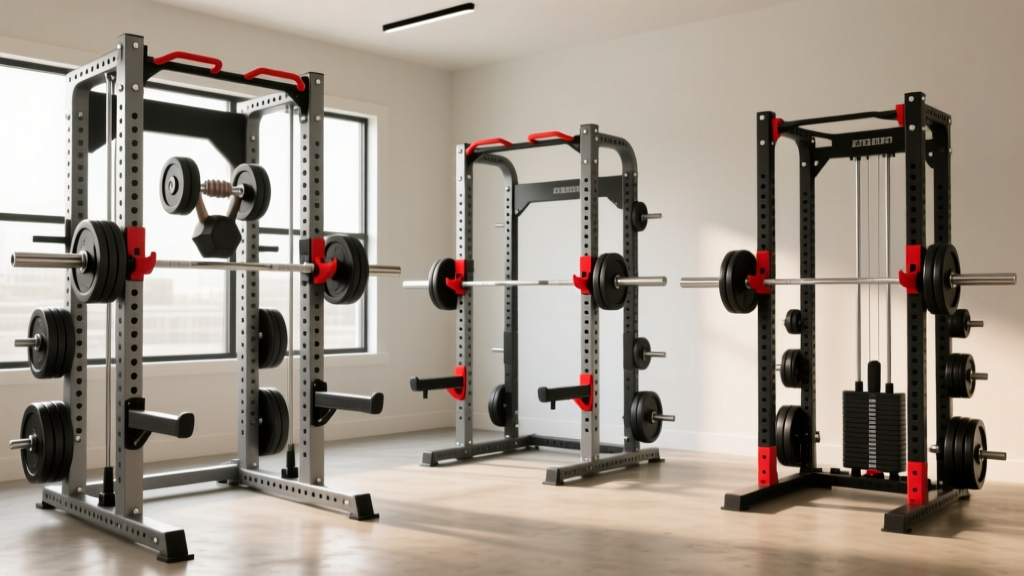
A power rack consists of four (sometimes six) vertical uprights connected by crossmembers, creating an enclosed 'cage.' Models like the REP Fitness PR-4000 (retailing around $699) feature 3x3-inch uprights with 1-inch holes and Westside spacing in the bench press zone. The defining feature is the ability to install safety spotter arms or safety straps on all four sides, creating a fully enclosed safe zone.
2. The Squat Rack (Open Face / Half Rack)
Often confused with power racks, true squat racks (or half racks) typically feature four uprights but lack the full rear crossmembers, or they feature an open-front design with extended spotter arms protruding forward. The Titan Fitness T-3 Short Power Rack (~$449) is a popular hybrid that offers an open face for easy barbell racking but retains rear uprights for weight storage and basic lateral stability.
3. The Squat Stand (Independent Uprights)
Squat stands are two independent, freestanding vertical posts with adjustable J-cups and spotter arms. The Rogue SML-1 Monster Lite Squat Stand (~$355) is a benchmark model. They are lightweight, highly portable, and easily disassembled, but they lack any overhead or lateral catchment system.
Step 2: The Overhead Dumbbell Tricep Press Safety Factor
Why does an isolation exercise matter when buying a massive piece of steel? Because joint failure during heavy dumbbell work is a leading cause of home gym injuries. According to weight training safety guidelines published by the Mayo Clinic, utilizing proper spotting mechanisms and controlled environments is critical when lifting free weights near the head and cervical spine.
⚠️ Biomechanical Warning: When performing a heavy seated overhead dumbbell tricep press (often called a French press), you are holding a single heavy dumbbell (e.g., 50–80 lbs) by its inner plate behind your head. As the triceps reach muscular failure, the elbows can buckle backward. If you are using squat stands, there is absolutely nothing to catch a 70-lb dumbbell falling toward your neck or skull.How to Safely Execute the Movement Inside a Rack
If you own a power rack, you can set up an adjustable FID (Flat/Incline/Decline) bench inside the cage. By positioning the safety spotter straps at the 5-foot mark—just below the apex of your overhead extension path—you create a physical net. If your grip slips or your triceps fail during the overhead dumbbell tricep press, the weight simply drops onto the heavy-duty nylon straps, inches from your head, completely eliminating the risk of cervical injury.
Furthermore, the pull-up bar of a full power rack serves as a tactile and visual boundary, preventing you from leaning too far back and losing your center of gravity during the eccentric (lowering) phase of the tricep extension. Squat racks offer partial protection if you position the bench near the spotter arms, but the open sides still leave you vulnerable to lateral drops. Squat stands offer zero protection for this specific movement.
Step 3: Compare the Footprints and 2026 Pricing
Space is usually the ultimate deciding factor for home gym owners. Below is a data matrix comparing the physical footprint, average 2026 market pricing, and safety versatility of the three rack types.
| Equipment Type | Average Footprint | Est. Price (Base Model) | Overhead Catch Safety | Best For |
|---|---|---|---|---|
| Power Rack | 49" x 49" (approx. 17 sq ft) | $650 - $850 | Excellent (4-sided straps/bars) | Heavy compounds & isolated dumbbell work |
| Squat Rack | 48" x 48" (approx. 16 sq ft) | $400 - $550 | Moderate (Front spotter arms only) | Garage gyms needing plate storage |
| Squat Stand | 49" x 4" (approx. 1.5 sq ft) | $300 - $400 | Poor (No lateral/overhead catch) | Tight spaces, apartments, travel |
For a comprehensive look at how these dimensions translate to real-world garage layouts, Garage Gym Reviews provides excellent spatial mapping guides for fitting full cages into standard two-car garages alongside vehicles and storage shelving.
Step 4: The Step-by-Step Buying Decision Framework
Use this sequential checklist to finalize your purchase based on your specific training goals and room constraints.
- Audit Your Ceiling Height: Standard power racks are 80 to 93 inches tall. If you have low basement ceilings (under 84 inches), you must look for 'Short' squat racks or specifically designed low-profile power racks to ensure you can perform pull-ups and overhead presses without hitting the ceiling joists.
- Evaluate Your Attachment Needs: If you plan to use cable pulley systems, lat pulldown attachments, or heavy band pegs for accommodating resistance, a 4-post power rack is mandatory. The uprights on squat stands will bend or tip under the lateral tension of cable attachments.
- Assess Your Isolation Arsenal: If your programming heavily features the overhead dumbbell tricep press, heavy skull crushers, or seated dumbbell shoulder presses, the enclosed safety of a power rack is not a luxury; it is a necessity for training to failure without a human spotter.
Step 5: Anchoring and Setup for Maximum Stability
Regardless of whether you choose a power rack or a squat stand, anchoring is critical. While a 300-lb power rack might seem stable, the dynamic force of re-racking a heavy barbell or dropping a dumbbell can shift unanchored steel.
- Concrete Subfloors: Use 3/8-inch concrete wedge anchors. Drill through the base plates directly into the slab. This is mandatory for squat stands, which have a high center of gravity and a tiny footprint.
- Rubber Mat Over Wood/Carpet: If you cannot drill into your floor, you must bolt the rack to a reinforced 3/4-inch plywood platform that extends at least 24 inches beyond the rack's footprint, weighing the platform down with your heavy bumper plates and weight storage.
- Spotter Arm Alignment: When setting up for the overhead dumbbell tricep press, ensure your safety straps are pulled taut. Loose straps will allow the dumbbell to bounce, potentially causing wrist or elbow hyperextension upon impact.
Final Verdict: Which Should You Choose?
If your budget and ceiling height allow, the power rack is the undisputed champion of the home gym. It provides the ultimate safe haven for both massive barbell squats and vulnerable isolation movements like the overhead dumbbell tricep press. The ability to train to absolute muscular failure safely, without relying on a training partner, makes the $700+ investment entirely worthwhile.
However, if you are outfitting a small apartment gym or a tight corner of a shared space, squat stands paired with a high-quality adjustable bench and strict, ego-free weight selection on isolation movements will serve you well. Just remember: when the steel isn't there to catch you, your form and weight selection must be flawless. For a complete catalog of rack specifications, upright gauges, and compatible safety spotter arms, browsing the direct manufacturer specs on Rogue Fitness remains the gold standard for verifying steel thickness and hole-spacing compatibility before you buy.
More gear to consider
All reviews
Power Rack vs Squat Rack vs Squat Stand & Dumbbell Bench Press GIF

Bumper vs Iron Plate Care: Maintaining a 500 lb Dumbbell Load
Smart Storage for Your 20 Minute Dumbbell Strength Workout

Power Rack vs Squat Stand: Setup for Rear Delt Dumbbell Workouts

Cast Iron vs Competition Kettlebells: Space & How to Dumbbell Shrug