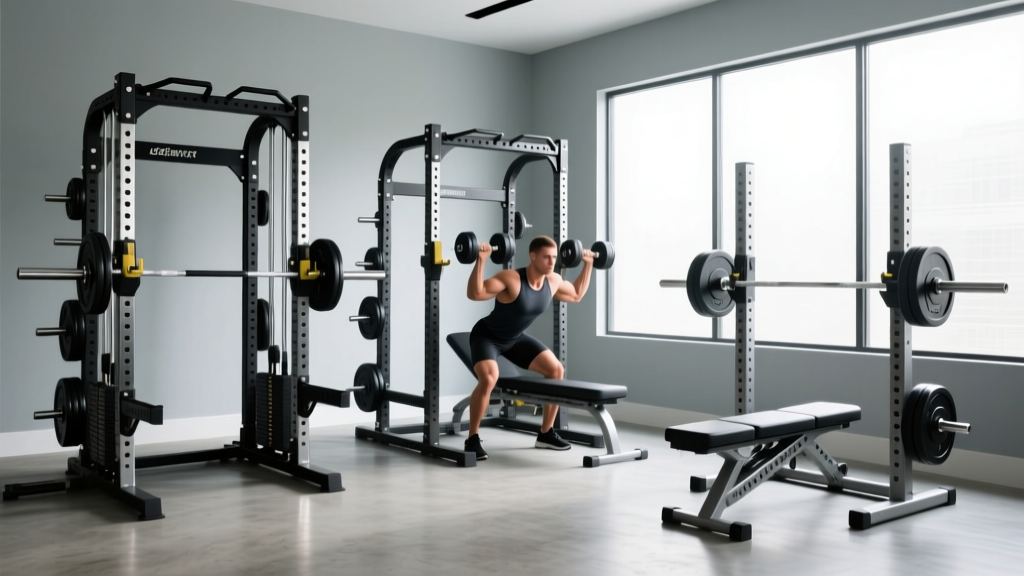
Power Rack vs Squat Rack vs Squat Stand: Incline Dumbbell Raises
Compare power rack vs squat rack vs squat stand. Discover which rig offers the best clearance, safety, and setup for incline dumbbell raises in 2026.

When outfitting a home gym or commercial facility, most buyers obsess over pull-up bar configurations, safety strap materials, and hole spacing. However, if your programming includes high-volume accessory work, your rack's physical dimensions dictate your movement quality just as much as its weight capacity. The debate of power rack vs squat rack vs squat stand is usually settled by looking at heavy barbell squats and bench presses. But what happens when you need to perform wide-range isolation movements?
💡 The Accessory Clearance Dilemma: Heavy compound lifts require safety spotter arms. Isolation movements, like incline dumbbell raises, require massive lateral and sagittal plane clearance. Choosing the wrong rig in 2026 means choosing between sacrificing safety on your squats or constantly banging your dumbbells against steel uprights during your accessory work.The Anatomy of the Big Three Rigs
Before analyzing movement compatibility, we must define the structural differences between the three primary rig categories available on the market today.
1. The Power Rack (Full Cage)
A true power rack features four to six vertical uprights, creating a fully enclosed cage. Models like the Rogue R-3 or Rep Fitness PR-4000 utilize 3x3-inch 11-gauge steel and offer 47 to 49 inches of interior width. They are the gold standard for safety, allowing lifters to fail heavy squats and bench presses without a spotter. However, their enclosed nature and 24-inch to 48-inch depths can severely restrict movements that require the lifter to extend outside the footprint of the bench.
2. The Squat Rack (Half Rack / Open 4-Post)
Squat racks, often referred to as half-racks or open-front 4-post systems (like the Titan T-3 Half Rack or Bells of Steel Barefoot 4.0), feature two front uprights and two rear uprights, but lack the crossmembers that enclose the lifter. They offer a middle ground: excellent spotter arm coverage for barbell work, with an open front that allows for slightly better dumbbell clearance, provided the bench is pulled forward.
3. The Squat Stand
Squat stands consist of two independent or bolted-together vertical posts with a minimal base footprint. The Rogue SML-2 or Atlas Strength Squat Stands are prime examples. They offer zero enclosure, meaning you have 360 degrees of unrestricted space around the bench. The trade-off? A severe lack of overhead and lateral safety for heavy barbell lifting unless heavy-duty, extended spotter arms are utilized and the unit is bolted to the floor.
The Biomechanics of Incline Dumbbell Raises & Rack Interference
To understand why rack selection matters for this specific movement, we must look at the biomechanics. According to kinesiology data regarding upper-body isolation from ExRx.net, incline dumbbell movements—whether targeting the anterior deltoids via raises or the clavicular pectoralis via flies—require significant lateral extension.
When an adjustable bench is set to a 30-to-45-degree incline, the lifter's center of gravity shifts upward and backward. If you are holding a pair of 90-pound hex dumbbells, which typically measure between 14 and 15 inches end-to-end, your arms will extend wide at the bottom of the eccentric phase.
The Math of Interference: A standard Olympic flat/incline bench is 12 inches wide. If you center this bench inside a budget 43-inch-wide Amazon power rack, you only have 15.5 inches of clearance on each side. Add the 14-inch length of a heavy dumbbell and the width of the lifter's shoulder, and you will physically strike the steel uprights before reaching a full stretch. A minimum of 48 inches of interior upright spacing is mandatory for unrestricted incline dumbbell raises.
2026 Equipment Comparison Matrix
Below is a breakdown of how the most popular rig archetypes handle both heavy barbell safety and the specific spatial demands of incline dumbbell raises. Pricing reflects average market rates for 3x3-inch, 11-gauge steel configurations as of early 2026.
| Rig Type & Popular Model | Interior Width | Depth / Footprint | Est. 2026 Price | Incline Raise Clearance |
|---|---|---|---|---|
| Power Rack (Rep PR-4000) | 47.25" | 24" - 41" | $1,399 | Moderate (Bench must be pulled forward) |
| Squat Rack (Titan T-3 Half) | 48" | 24" base | $799 | High (Open front design) |
| Squat Stand (Rogue SML-2) | 49" | 4" base | $595 | Unrestricted (Zero enclosure) |
| Budget Cage (Generic 2x2) | 41" - 43" | 24" | $250 - $350 | Fail (Constant upright clipping) |
Real-World Edge Cases & Failure Modes
When evaluating the power rack vs squat rack vs squat stand debate for accessory work, experienced lifters and gym owners must account for several real-world failure modes that manufacturers rarely mention in their marketing copy.
Edge Case 1: The UHMW Plastic Interference
Modern J-cups are lined with UHMW (Ultra-High-Molecular-Weight) polyethylene to protect barbell knurling. While great for steel, this plastic adds roughly 0.5 to 0.75 inches of bulk to the inside of the upright. If you are performing incline dumbbell raises inside a 47-inch rack, that lost inch of clearance is often the difference between a clean repetition and a scuffed dumbbell head striking the plastic liner during the stretch.
Edge Case 2: Squat Stand Tipping Hazards
Squat stands offer the ultimate freedom for incline dumbbell raises, but they introduce severe safety hazards if used improperly. As highlighted in comprehensive rig safety reviews by BarBend, squat stands have a high center of gravity and a short moment arm. If you are performing heavy drop-sets, dynamic movements, or using resistance bands attached to the base, the stand can tip. If you choose squat stands to maximize your dumbbell clearance, you must bolt them to a reinforced concrete floor or purchase models with extended 30-inch rear safety spotter arms that act as a counterweight base.
Edge Case 3: Bench Backrest Adjustment Clearance
Many adjustable benches feature a ladder-style backrest adjustment mechanism that extends 10 to 14 inches behind the main pad. If you push your bench deep into a 24-inch deep power rack to utilize the safety straps for barbell incline pressing, the ladder mechanism will physically hit the rear crossmembers or uprights. This prevents you from achieving a true 45-degree angle, forcing you to compromise on your incline dumbbell raises or presses.
Final Decision Framework: Which Should You Buy?
Selecting the right equipment requires aligning your primary training goals with your spatial constraints. Use this framework to make your final 2026 purchasing decision:
- Choose the Power Rack if: Your primary focus is heavy, unspotted barbell lifting (squats, bench, overhead press). You are willing to accept that you must physically drag your adjustable bench forward, out of the cage, to perform unrestricted incline dumbbell raises and lateral flyes.
- Choose the Squat Rack (Half Rack) if: You want the optimal hybrid. The open front allows you to keep the bench inside the footprint for safety, while providing enough lateral clearance for 90% of dumbbell isolation movements, including incline dumbbell raises, without clipping the uprights.
- Choose the Squat Stand if: You are training in a cramped apartment, a low-clearance garage, or a dedicated Olympic weightlifting space where barbell catching is preferred over cage spotting. You prioritize total freedom for dumbbell and kettlebell accessory work and have the ability to bolt the stands to the floor for safety.
Ultimately, do not let the tail wag the dog. Prioritize the rig that keeps you safe during your heaviest, most dangerous compound lifts. For most lifters, a 48-inch or 49-inch interior width half-rack or power rack provides the perfect synthesis of barbell safety and the necessary clearance to execute incline dumbbell raises with perfect biomechanical form.
For more detailed specifications on upright spacing and attachment compatibility, always consult the manufacturer's CAD drawings on the Rogue Fitness official site before finalizing your home gym layout.
More gear to consider
All reviews
Collar Guide for Any Barbell and Dumbbell Leg Workout
Power Rack vs Squat Stand: Deltoid Muscle Dumbbell Workouts & Squats

Bumper Plate vs Iron Plate: EZ Bar Curl vs Dumbbell Curl Setups

Best Storage Solutions for SA Gear Dumbbells & Heavy Free Weights

2026 Market Trends: Racks for the Back Squat Dumbbell Alternative
