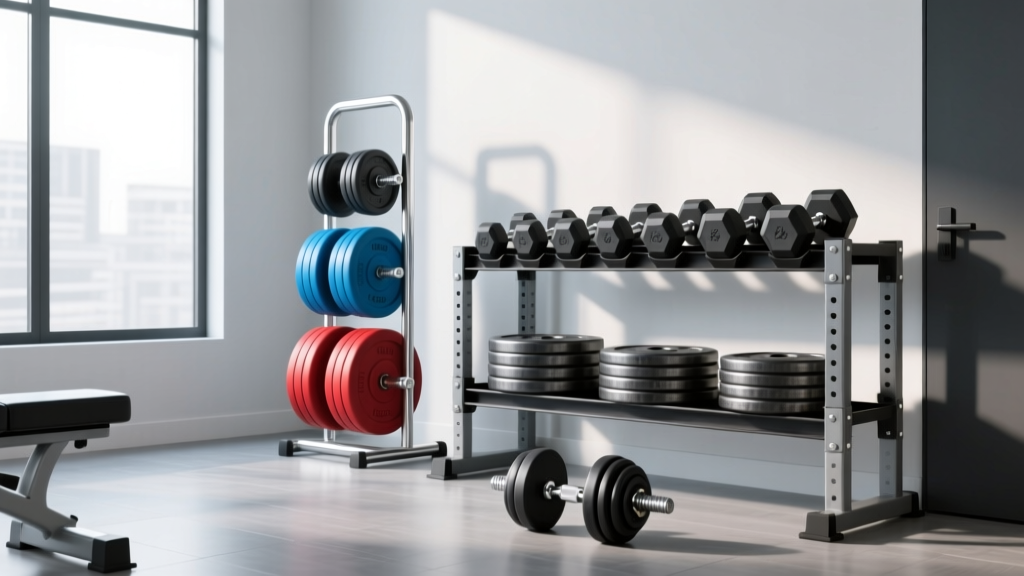
Bumper vs Iron Plates: Space for Alternating Dumbbell Hammer Curls
Optimize your home gym layout by comparing bumper vs iron plate storage footprints and designing clearance zones for alternating dumbbell hammer curls.

The Spatial Reality of Home Gym Design in 2026
Designing a high-performance home gym in 2026 requires more than just purchasing top-tier equipment; it demands a rigorous approach to spatial geometry and layout optimization. As urban and suburban garage gyms shrink in average square footage, the physical footprint of your weight plates and the clearance required for dynamic movements have become the primary bottlenecks in facility design. The ongoing debate between stocking bumper plates versus traditional cast iron plates is no longer just about noise reduction or Olympic lifting—it is fundamentally a question of volumetric storage and floor plan efficiency.
Furthermore, your storage decisions directly dictate the 'active zones' of your gym. If you improperly place a weight tree, you instantly compromise the biomechanical envelope required for foundational isolation movements. In this guide, we will dissect the exact dimensional differences between bumper and iron plates, map out optimal storage configurations, and establish the precise floor clearance metrics needed to perform exercises like alternating dumbbell hammer curls without spatial interference.
The Geometry of Iron vs. Bumper Plates
To optimize your layout, you must first understand the volumetric disparity between plate types. Bumper plates are designed to a strict International Weightlifting Federation (IWF) diameter of 450mm, with thickness varying based on the rubber compound and internal steel hub. Cast iron plates, conversely, prioritize density, resulting in a significantly thinner profile but a smaller overall diameter.
According to equipment specifications from Rogue Fitness, a standard 45lb HG 2.0 Bumper Plate measures 3.25 inches in thickness. In stark contrast, a 45lb Rogue Machined Iron plate measures approximately 1.3 inches thick. This 2.5x difference in thickness drastically alters how you must zone your storage equipment.
Volumetric Storage Comparison Matrix
| Plate Type (45lb / 20kg) | Thickness | Optimal Storage Method | Storage Footprint (Sq Ft) | 2026 Avg Cost / LB |
|---|---|---|---|---|
| Virgin Rubber Bumper | 3.25" | Heavy-Duty Horizontal Tree | 4.5 - 6.0 | $2.80 - $3.50 |
| Crumb Rubber Bumper | 4.00"+ | Vertical Wall Rack | 3.0 - 4.0 | $1.80 - $2.20 |
| Machined Cast Iron | 1.30" | Compact A-Frame / Wall Mount | 1.5 - 2.5 | $1.40 - $1.90 |
| Urethane Coated Iron | 1.45" | Horizontal Tree / Tiered Rack | 2.0 - 3.0 | $2.50 - $3.00 |
Note: Storage footprint calculations assume a standard 6-plate tree or equivalent wall-mounted rack capacity, including the base footprint and required pull-clearance.
The Biomechanical Envelope: Carving Out Movement Zones
Equipment storage is only half the spatial equation. The other half is the 'active zone'—the cleared floor area required to execute movements safely and effectively. To establish a baseline for lateral clearance in your gym layout, we use the alternating dumbbell hammer curls as a primary spatial benchmark.
Why this specific exercise? According to kinesiological data from ExRx, the hammer curl heavily targets the brachioradialis and brachialis. The neutral grip requires the elbows to remain pinned to the torso while the dumbbells swing slightly outward and upward during the concentric phase. Unlike a barbell curl, which operates in a fixed sagittal plane, alternating dumbbell hammer curls demand a lateral 'wingspan' clearance.
The Adjustable Dumbbell Factor
If your 2026 gym setup utilizes block-style adjustable dumbbells (such as PowerBlock Elites or Nuobells) rather than traditional round urethane hex dumbbells, you must add an extra 2 to 3 inches of lateral clearance per side. The rectangular geometry of adjustable handles increases the risk of the dumbbell heads clipping your torso or thighs during the eccentric lowering phase of alternating dumbbell hammer curls if your stance is too narrow or your walls are too close.
To perform alternating dumbbell hammer curls safely, you need a minimum personal clearance zone of 4 feet wide by 6 feet deep. If your horizontal plate tree is positioned immediately adjacent to your dumbbell rack, the protruding sleeves and loaded bumpers will inevitably intersect with this lateral swing path, forcing you to alter your biomechanics or risk damaging your equipment.
Step-by-Step Layout Blueprint for Compact Gyms
To harmonize plate storage with dynamic movement zones, follow this sequential layout protocol:
- Anchor the Power Rack: Place your squat rack against the primary load-bearing wall. Ensure at least 24 inches of clearance behind the uprights for plate loading and barbell sleeve overhang.
- Establish the Dumbbell Station: Position your dumbbell rack perpendicular to the power rack, not parallel. This creates an 'L-shaped' active zone, opening up the center of the room for movements requiring lateral clearance.
- Zone the Plate Storage: If using thick bumper plates, utilize a vertical wall-mounted rack (like the Rogue Fold-Up Wall Mount Plate Rack) rather than a freestanding horizontal tree. This reclaims up to 4 square feet of floor space and eliminates the 'trip hazard' protrusion that interferes with walking lunges and lateral dumbbell movements.
- Map the Active Zone: Tape off a 4x6 foot rectangle directly in front of the dumbbell station. This is your dedicated isolation zone, guaranteed to be free of plate tree sleeves, ensuring unobstructed alternating dumbbell hammer curls and lateral raises.
Edge Cases and Failure Modes in Gym Layouts
"The most common failure mode in garage gym design is treating floor space as a 2D plane rather than a 3D volume. Vertical clearance for plate storage and lateral clearance for dumbbell tracking are equally critical." — Facility Design Guidelines, National Strength and Conditioning Association (NSCA)
When integrating heavy iron or dense bumpers into a tight layout, be wary of the 'drop zone' overlap. Bumper plates are designed to be dropped, but in a space-optimized gym, your dropping zone (inside or immediately in front of the rack) often overlaps with your dumbbell isolation zone. If you drop a 45lb bumper plate, the bounce radius can extend 12 to 18 inches outward. If your dumbbell rack or a loaded weight tree is within this bounce radius, the kinetic transfer can destabilize the rack, sending adjustable dumbbells or iron plates cascading to the floor.
For deep-dive recommendations on mitigating bounce and selecting the right dead-bounce rubber for tight spaces, the Garage Gym Reviews Bumper Plate Guide offers extensive drop-testing data that is invaluable for compact layout planning.
Summary: Making the Spatial Decision
Ultimately, the choice between bumper and iron plates in a space-constrained gym hinges on your training style. If your programming requires frequent Olympic lifts and drops, bumpers are mandatory, but you must invest in vertical wall storage to preserve the floor space needed for accessory work. If your training is strictly powerlifting, bodybuilding, or functional fitness, high-density machined iron plates offer a superior space-to-weight ratio, allowing you to store hundreds of pounds on a compact A-frame and leaving the floor entirely open for your active movement zones.
More gear to consider
All reviews
Power Rack vs Squat Stand: Setup for Single Dumbbell Deadlifts

Power Rack vs Squat Rack vs Squat Stand for Your Nike Dumbbells Set
EZ vs Straight Bar Maintenance & One Arm Dumbbell Snatch Tips

How to Choose Adjustable Dumbbells for a Triceps Workout at Home (2026)

Power Rack vs Squat Rack vs Stand: Layout Mistakes & Dumbbell Twists
