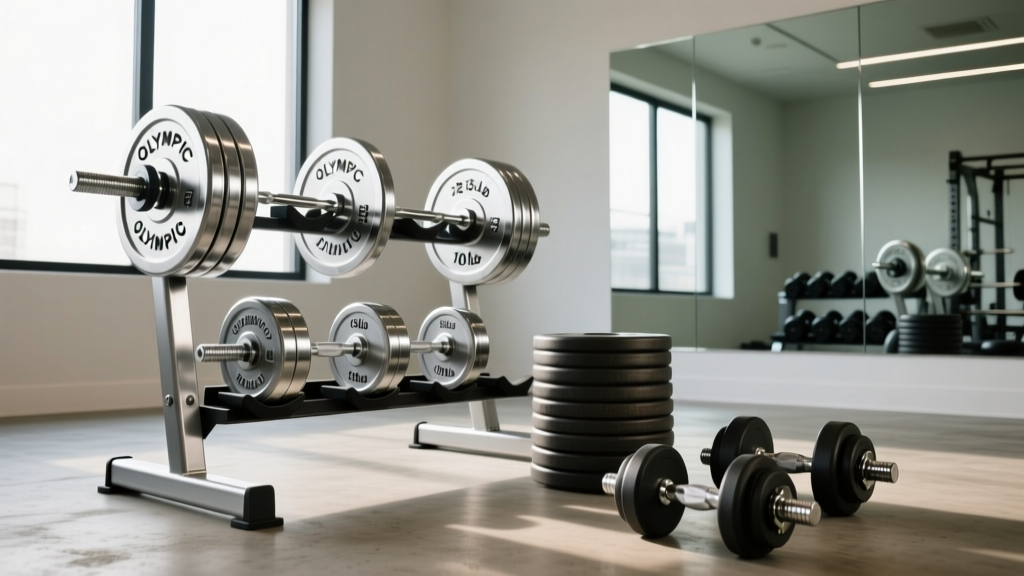
Olympic vs Standard Plates: Home Gym & HIIT Workout with Dumbbells
Compare Olympic vs standard weight plates for your 2026 home gym. Includes a buying matrix, load limits, and a complementary HIIT workout with dumbbells.

Building a comprehensive home gym in 2026 requires more than just throwing money at the first pieces of iron you find online. Whether you are outfitting a two-car garage or a dedicated basement studio, the foundation of your strength training setup hinges on a critical, often misunderstood decision: choosing between Olympic and standard weight plates. While heavy barbell work builds your baseline strength, a complete fitness ecosystem also demands metabolic conditioning. That is why this guide not only dissects the engineering and economics of weight plate types but also bridges the gap to cardiovascular health by providing a high-intensity interval training (HIIT) protocol using adjustable dumbbells.
The Anatomy of the Hole: 2-Inch vs 1-Inch
The distinction between Olympic and standard plates is not merely a branding exercise; it is a fundamental difference in mechanical engineering, load distribution, and standardized sizing.
Olympic Plates (2-Inch / 50.6mm)
Olympic plates feature a center hole measuring exactly 2 inches (50.8mm), designed to slide onto barbell sleeves that are 50.6mm in diameter. This 0.2mm tolerance allows for smooth loading and unloading while minimizing sleeve rattle. According to the National Strength and Conditioning Association (NSCA), Olympic specifications are the global standard for competitive lifting and serious strength training. Furthermore, true Olympic 45-pound (20kg) plates adhere to the International Weightlifting Federation (IWF) diameter standard of 450mm (17.7 inches). This uniform diameter is crucial because it ensures the barbell sits exactly 8.75 inches off the floor, providing the correct starting biomechanics for deadlifts and Olympic lifts.
Standard Plates (1-Inch / 25.4mm)
Standard plates feature a 1-inch (25.4mm) center hole, typically paired with lightweight, hollow steel or basic solid steel bars found in big-box department stores. The most glaring issue with standard plates is the lack of diameter regulation. A 45-pound standard plate might only measure 14 inches in diameter. If you attempt a deadlift with standard plates, the barbell sits dangerously close to the floor, forcing you into a compromised, rounded-spine starting position that drastically increases the risk of lumbar herniation.
⚠ 2026 Buyer Warning: Do not confuse 'standard' with 'entry-level.' Many commercial-grade cast iron plates are Olympic. 'Standard' strictly refers to the 1-inch bore. Investing in a standard plate ecosystem in 2026 is a dead-end; you will inevitably outgrow the load limits and be forced to repurchase your entire inventory.2026 Comparison Matrix: Olympic vs Standard Plates
Below is a data-driven breakdown of how these two plate categories compare across critical performance and purchasing metrics in the current market.
| Feature | Olympic (2-Inch) | Standard (1-Inch) |
|---|---|---|
| Center Hole | 50.8mm (2 inches) | 25.4mm (1 inch) |
| 45lb Plate Diameter | 450mm (17.7 inches) | Varies (Often 13-15 inches) |
| Barbell Load Limit | 500 lbs to 1,500+ lbs | 200 lbs to 300 lbs (Max) |
| 2026 Avg. Price (Cast Iron) | $1.60 - $2.20 / lb | $0.90 - $1.30 / lb |
| Material Options | Iron, Urethane, Crumb Rubber, Competition Steel | Basic Cast Iron, Vinyl-filled Cement |
| Resale Value | High (Retains 60-80% value) | Near Zero (Difficult to offload) |
The Hidden Dangers of Standard Plates and 1-Inch Bars
The primary failure mode of standard equipment is not the plate itself, but the barbell it mounts to. A 1-inch solid steel bar lacks the sheer strength and tensile yield required for heavy compound movements. When loaded past 200 pounds, a standard bar will exhibit severe 'whip' and permanent plastic deformation. If you drop a 250-pound standard barbell from the top of a deadlift, the kinetic energy transfer will likely snap the bar or bend it beyond repair.
Furthermore, standard bars lack rotating sleeves. During dynamic movements like the power clean or snatch, the inability of the plate to rotate independently of the bar places immense torsional stress on the lifter's wrists and elbows. Olympic bars feature precision needle or bushing bearings that allow the sleeves to spin, dissipating rotational torque and protecting your joints.
Bridging Heavy Plates with Metabolic Conditioning
Once your Olympic plate and barbell foundation is secured, the next pillar of a 2026 home gym is metabolic conditioning. While moving heavy iron builds raw force production, cardiovascular health and work capacity require a different stimulus. This is where adjustable dumbbells become indispensable. Modern adjustable dumbbells, such as the Nuobell 80lb or the Bowflex SelectTech 1090, replace entire racks of fixed-weight dumbbells, saving up to 80% of floor space while allowing for rapid weight transitions during high-intensity circuits.
'A well-rounded home gym separates the heavy, low-rep barbell work from the high-rep, metabolic conditioning work. Trying to use your Olympic barbell for high-rep AMRAP conditioning is a recipe for central nervous system burnout and form breakdown. Adjustable dumbbells are the perfect bridge.'
The 20-Minute HIIT Workout with Dumbbells
According to guidelines published by the American Council on Exercise (ACE), High-Intensity Interval Training (HIIT) is highly effective for improving VO2 max and increasing excess post-exercise oxygen consumption (EPOC). Below is a 20-minute EMOM (Every Minute on the Minute) protocol designed to complement your heavy Olympic lifting days. Set your adjustable dumbbells to a moderate weight (roughly 30-40% of your max dumbbell press).
EMOM 20 Protocol: The Metabolic Flush
- Minute 1: Dumbbell Thrusters (15 Reps)
Start with the dumbbells at shoulder height. Drop into a full front squat, then explosively drive through your heels, using the momentum to press the dumbbells overhead in one fluid motion. Control the descent back to the shoulders. - Minute 2: Renegade Rows (12 Reps per Arm)
Assume a push-up position gripping the dumbbells. Keep your hips square to the floor. Row the right dumbbell to your ribcage, lower it, and repeat on the left. This challenges your anti-rotational core stability while taxing the lats. - Minute 3: Dumbbell Romanian Deadlifts (15 Reps)
Hold the dumbbells in front of your thighs. Hinge at the hips, pushing your glutes back while maintaining a slight bend in the knees. Lower the weights until you feel a deep stretch in the hamstrings, then squeeze the glutes to return to standing. - Minute 4: Mountain Climbers (40 Reps / 20 per leg)
Drop the weights. Assume a high plank position and rapidly alternate driving your knees to your chest. Focus on keeping your shoulders directly over your wrists. - Minute 5: Active Recovery
Walk around your training space, focus on diaphragmatic breathing, and reset your adjustable dumbbells for the next round. Do not sit down.
Repeat this 5-minute cycle four times for a total of 20 minutes. The rest period is built into the time remaining at the end of each minute. If you finish your 15 thrusters in 35 seconds, you earn 25 seconds of rest.
Sourcing, Storage, and Expert Verdict
When sourcing Olympic plates in 2026, the market has stabilized. Urethane-coated Olympic plates, which previously carried a massive premium, are now hovering around $2.80 to $3.20 per pound from direct-to-consumer brands like Titan Fitness and Rep Fitness. For those on a budget, bare cast iron remains the gold standard for value, typically costing around $1.70 per pound, though you must invest in a set of heavy-duty rubber stall mats to protect your subfloor from impact spalling.
Storage is equally critical. Never leave Olympic plates scattered on the floor; it is a tripping hazard and degrades the rubber or urethane over time. Invest in a plate tree or a power rack with integrated weight horns. Ensure your storage solution is rated for at least 800 pounds, as a standard 450-plate tree can easily weigh over 500 pounds when fully loaded with iron.
Ultimately, standard plates belong in the history books or as doorstops. Committing to the Olympic standard ensures your home gym can scale with your strength from your first empty-bar squat to a 500-pound deadlift. Pair that heavy foundation with a targeted hiit workout with dumbbells, and you will have built a complete, elite-tier training facility within your own four walls.
More gear to consider
All reviews
Best Adjustable Dumbbells for Arm and Chest Workouts: 2026 Guide
Barbell Collar and Clamp Types Comparison: Securing the Drag Curl with Dumbbells
Rubber Hex vs Urethane Dumbbells: Dumbbell Pullover Care Guide

Cheap vs Premium Breakdown: What $20, $85, and $220 Weights Actually Deliver

2026 Dumbbell Rack Market: Storing Your B Stance Hip Thrust Dumbbell
