Olympic vs Standard Plates Setup and Light Dumbbell Training Guide
Compare Olympic vs standard weight plates for your home gym setup, plus expert tips on integrating light dumbbell training for complete muscle development.

Building a Versatile Free Weight Zone: The 2026 Blueprint
Designing a comprehensive home gym requires more than just buying the first barbell you see on sale. As we navigate the home fitness landscape in 2026, space optimization and equipment versatility are paramount. One of the most common hurdles for new home gym owners is deciding between weight plate types: Olympic vs standard. While the heavy barbell work often steals the spotlight, a truly complete setup must also accommodate targeted isolation work. This is where integrating a dedicated station for light dumbbell training becomes essential for joint health, muscular symmetry, and rehabilitation. In this complete setup and installation walkthrough, we will break down the biomechanical and structural differences between plate types, provide a step-by-step installation guide for your storage hardware, and show you exactly how to layout your space for seamless transitions between heavy lifts and light dumbbell training.
The Core Foundation: Olympic vs. Standard Weight Plates
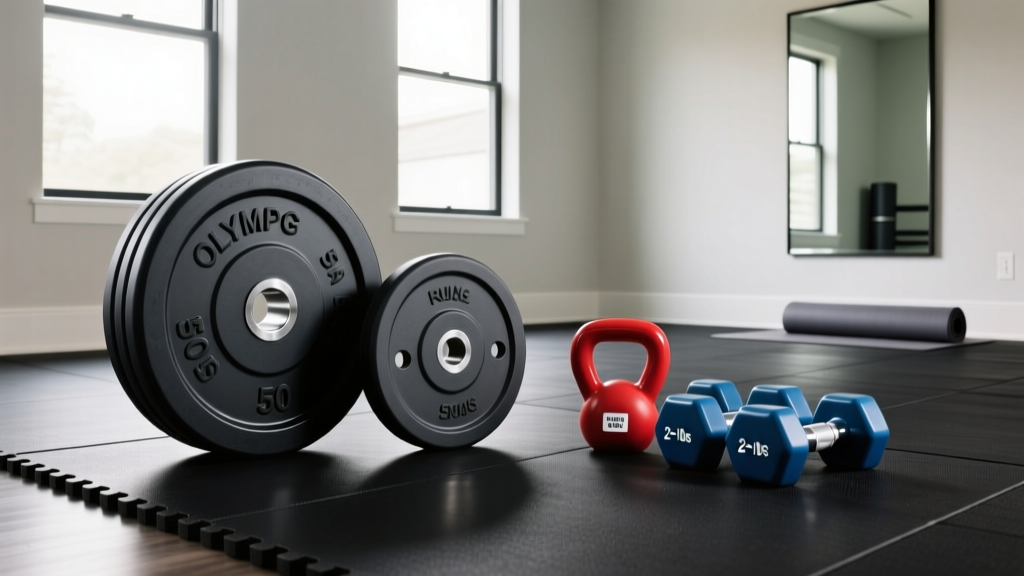
The distinction between Olympic and standard weight plates fundamentally comes down to the center hole diameter and the corresponding barbell sleeve size. Standard plates feature a 1-inch (25mm) center hole, designed to fit on lightweight, often solid-steel or basic tubular bars. Olympic plates, the gold standard for commercial and serious home gyms, feature a 2-inch (50mm) center hole. This seemingly small difference dictates the entire load-bearing capacity of your setup.
Standard equipment is often marketed as a budget-friendly entry point. A basic 110-pound standard cast iron set can cost under $100. However, standard bars typically max out at 200 to 300 pounds before the sleeves begin to bend or the bar whips dangerously. In contrast, Olympic bars are engineered with high-tensile strength steel (often 190,000 to 215,000 PSI) and rotating sleeves that accommodate the torque of heavy, dynamic lifts. When investing in premium options like Rogue Echo Bumper Plates, you are paying for precise weight calibration (within 1% tolerance), drop-tested rubber durability, and a 2-inch hub that fits seamlessly onto any regulation Olympic barbell.
Specification Comparison Matrix
| Feature | Standard Plates (1-inch) | Olympic Plates (2-inch) |
|---|---|---|
| Center Hole Diameter | 25mm (1 inch) | 50mm (1.968 inches) |
| Max Barbell Load Capacity | 200 - 350 lbs | 700 - 1,500+ lbs |
| Barbell Sleeve Rotation | Rare (Fixed sleeves) | Standard (Bushings/Bearings) |
| Plate Material Options | Cast Iron, Cement-filled | Cast Iron, Urethane, Crumb Rubber |
| Average Cost Per Pound | $1.00 - $1.50 | $2.50 - $5.00+ |
Step-by-Step Installation: Plate Trees and Storage Racks
Before you can focus on your workout programming, you must safely install your weight storage. Improperly loaded weight trees are a leading cause of home gym accidents, often resulting in tipped racks and damaged flooring. Follow this walkthrough to secure your Olympic and standard plate storage.
- Subfloor Preparation: Never place a loaded weight tree directly on hardwood, laminate, or bare concrete. Lay down 3/4-inch thick vulcanized rubber horse stall mats (typically 4x6 feet). These absorb the kinetic energy of dropped plates and distribute the static point-load across a wider surface area.
- Weight Tree Assembly & Torque: Whether you are using a 6-peg Olympic tree or a standard A-frame rack, assemble the base on a level surface. Use a calibrated torque wrench to tighten all structural hex bolts. For most commercial-grade trees, the manufacturer specifies 60 to 80 ft-lbs of torque. Under-tightening leads to base wobble; over-tightening can strip the threads on lower-grade steel.
- Wall-Mounted Dumbbell Rack Installation: To save floor space for your light dumbbell training zone, opt for a wall-mounted 3-tier rack. Use a high-quality stud finder to locate the wooden or metal studs behind your drywall. Mark your drill holes at 16-inch or 24-inch centers. Pre-drill using a 3/16-inch bit, then secure the rack's mounting brackets using 3/8-inch x 3-inch structural lag bolts. Never use drywall anchors for weight storage.
- Ergonomic Spacing: Ensure there is a minimum of 24 inches of clearance between your plate tree and your dumbbell rack. This allows you to safely carry a 45-pound Olympic plate or a heavy adjustable dumbbell without your elbows striking adjacent equipment.
Integrating Light Dumbbell Training into Your Layout
While heavy Olympic barbell squats and deadlifts build foundational strength, they often neglect the smaller stabilizer muscles and unilateral imbalances. This is where light dumbbell training (typically utilizing the 5 lb to 25 lb range) becomes a non-negotiable component of a mature fitness regimen. According to resistance training guidelines highlighted by the Mayo Clinic, incorporating lighter, controlled resistance is vital for joint stabilization, tendon health, and correcting muscular asymmetries that heavy bilateral lifting can mask.
To properly integrate light dumbbell training into your home gym layout, designate a 'finishing zone' adjacent to your main power rack. This zone should house a dedicated tier of fixed dumbbells or a high-quality adjustable set. Exercises like scapular retractions, YTWL raises, lateral raises, and rotator cuff external rotations require precise weight increments. If your light dumbbells are stored across the room on a cluttered Olympic plate tree, you are less likely to complete your accessory work.
Expert Workflow Tip: Keep your 5lb, 10lb, and 15lb dumbbells on the top tier of your wall-mounted rack at roughly chest height (48 inches from the floor). This eliminates the need to bend over and pick up light weights with a rounded lower back immediately after a heavy, fatiguing set of barbell deadlifts.Material Science: Urethane vs. Neoprene for Light Dumbbells
When outfitting your light dumbbell training station, the material coating of the dumbbells dictates their lifespan and hygiene profile. Many budget-friendly light dumbbells are coated in neoprene or vinyl. While these provide a soft grip and come in various colors, they are highly porous. Over a few years of intense use, neoprene absorbs sweat, chalk, and skin oils, leading to a degraded, tacky surface and unpleasant odors.
For a permanent 2026 home gym setup, invest in virgin urethane. Options like Rep Fitness Urethane Dumbbells offer a Shore A durometer rating that resists scratching, fading, and sweat absorption. Urethane is completely odorless and can be wiped down with hospital-grade disinfectants without breaking down the chemical bonds of the coating. Though a 5-to-25 lb urethane set will cost roughly 40% more upfront than a neoprene equivalent, the decade-long lifespan makes it the superior choice for serious lifters.
Safety and Structural Considerations for Heavy & Light Zones
A common oversight in home gym installations is failing to calculate the cumulative dead load of the equipment. A standard 6-peg Olympic weight tree loaded with 500 pounds of cast iron concentrates that weight into a footprint of less than 4 square feet. This creates a massive point-load on your floor joists.
- Ground Floor / Concrete Slab: You have virtually no structural limitations. Place your heaviest Olympic plate trees and barbell storage directly on the slab.
- Second Floor / Wood Joists: Standard residential floor joists are typically rated for 40 pounds per square foot (live load). Placing a 500 lb weight tree in the center of a room can cause long-term deflection. Always position heavy plate storage racks perpendicular to the floor joists, and ideally push them against a load-bearing exterior wall where the joists transfer weight directly to the foundation.
- Light Dumbbell Zone Placement: Your light dumbbell training area and wall-mounted racks can safely be placed anywhere in a wood-framed room, as the distributed weight of 100 lbs of light dumbbells across a 4-foot wall bracket poses no structural threat.
'The mark of an elite home gym isn't just the maximum weight on the bar; it's the seamless accessibility of the tools required for longevity. A perfectly organized light dumbbell training station ensures that the crucial, unglamorous pre-hab and accessory work actually gets done.' — FitGearPulse Editorial Team
Finalizing Your Setup
By understanding the mechanical superiority of Olympic plates for heavy compound movements, and deliberately carving out an ergonomic, well-lit space for light dumbbell training, you create a facility that supports both peak performance and long-term joint preservation. Secure your trees with the proper torque, anchor your wall racks into the studs, and invest in urethane for your isolation tools. Your home gym is now fully calibrated for whatever training block 2026 throws your way.
More gear to consider
All reviews
Best Adjustable Dumbbells for a 20 Pound Dumbbell Workout (2026)

Wing Exercises Dumbbells Guide: Top Adjustable Picks Reviewed (2026)

Isometric Dumbbell Row Hold: Loadable Dumbbell Budget Guide

Cast Iron vs Competition Bells & Dumbbell Romanian Deadlift GIF Trends
Outgrowing Things to Do With Dumbbells: Barbell Knurling Guide
