Power Rack vs Squat Rack vs Stand for Dumbbell Ground to Overhead
Compare power racks, squat racks, and squat stands for 2026. Discover which setup offers the best clearance and safety for the dumbbell ground to overhead.

The 2026 home gym landscape has decisively shifted toward hybrid training. Lifters are no longer choosing strictly between powerlifting and functional fitness; they are blending heavy barbell cycles with high-volume conditioning. This evolution has brought a specific spatial challenge to the forefront of equipment selection: how do you accommodate expansive, full-body movements inside a home gym footprint? To solve this, we use a single, uncompromising benchmark: the dumbbell ground to overhead.
This movement—picking up heavy dumbbells from the floor and driving them to a full overhead lockout—tests vertical clearance, lateral stance width, and floor staging. It is the ultimate stress test for your rack setup. Below, we break down the head-to-head differences between a full power rack, a squat rack (half rack), and squat stands to help you decide which configuration supports your training style without compromising safety or biomechanics.
Defining the Contenders: Cage, Half-Rack, and Stands
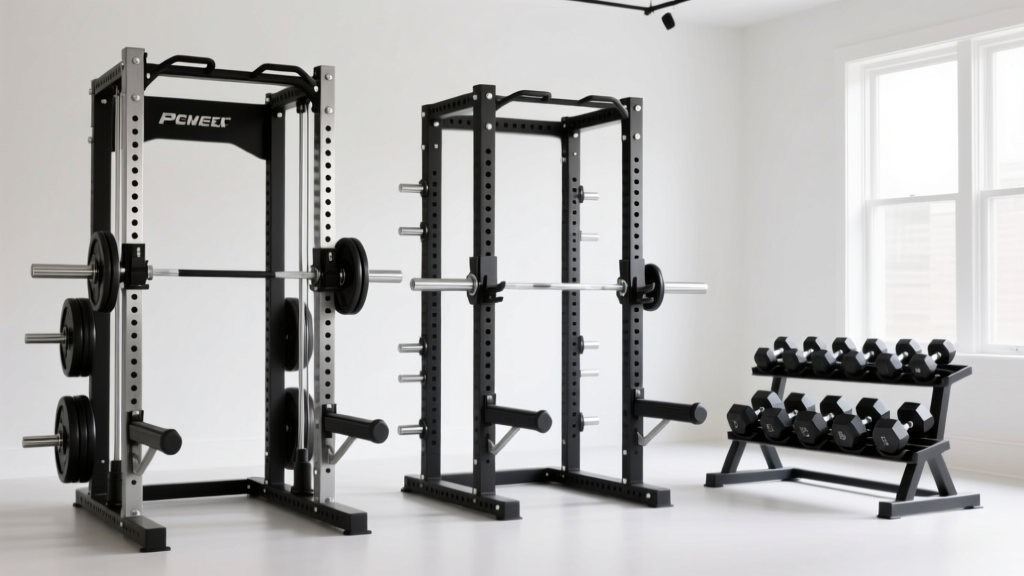
Before analyzing spatial dynamics, we must establish the exact equipment profiles we are comparing in this 2026 buying cycle:
- Power Rack (Full Cage): A four-to-six-post enclosed steel structure. Baseline Model: Rogue RML-390F (approx. $1,450).
- Squat Rack (Half Rack): A two-to-four-post structure with an open front face and rear uprights. Baseline Model: Titan Fitness T-3 Short Power Rack (approx. $699).
- Squat Stands: Two independent, freestanding uprights with spotter arms. Baseline Model: Rogue SML-2C Squat Stands (approx. $415).
Head-to-Head Comparison Matrix
| Feature | Power Rack (Rogue RML-390F) | Squat Rack (Titan T-3) | Squat Stands (Rogue SML-2C) |
|---|---|---|---|
| Interior Width | 43 inches | 48 inches | Unlimited (Open Floor) |
| Vertical Clearance | Restricted (Pull-up bar at 90') | Moderate (Open top front) | Unrestricted |
| Dumbbell Staging | Excellent (Multiple pin options) | Good (Rear storage) | Poor (Floor or add-on pegs) |
| Safety / Spotting | Maximum (Straps/Pins enclosed) | High (Extended spotter arms) | Moderate (Requires precise racking) |
| Avg. 2026 Price | $1,300 - $1,800 | $650 - $850 | $350 - $500 |
The Spatial Test: Executing the Dumbbell Ground to Overhead
Why use the dumbbell ground to overhead as the deciding factor for your rack purchase? Because it exposes the hidden flaws of enclosed spaces. According to biomechanical analyses of overhead lifting, optimal force transfer requires a stable, wide base and a completely unobstructed vertical bar path (or in this case, dumbbell path). When you introduce heavy 50lb to 100lb dumbbells into the equation, your stance widens, and your lockout point elevates.
Biomechanical Warning: The average male lifter standing 5'10" will achieve an overhead lockout height of roughly 82 to 86 inches. If you are 6'0" or taller, your lockout exceeds 90 inches. Attempting a dumbbell ground to overhead inside a standard 90-inch power rack will result in the dumbbells colliding with the pull-up bar or top crossmembers, forcing an unnatural, forward-angled press that places severe shear stress on the rotator cuff.1. Power Racks: The Fortress (and the Trap)
Full power racks like the top-rated models reviewed by Garage Gym Labs are unmatched for heavy barbell squats and bench presses. The enclosed 43-inch interior width of the Rogue RML-390F provides a safe sanctuary for failed reps. However, for the dumbbell ground to overhead, the power rack is fundamentally restrictive.
The initial phase of the movement requires a hip hinge and a wide stance to clear the knees. Inside a 43-inch cage, your shins will scrape the front uprights, and your feet will hit the base gussets. Furthermore, pulling heavy dumbbells from the floor inside a cage limits your ability to use momentum or a slight swing to clean the weights to the shoulders. You are forced into a strict, highly taxing muscle-clean motion that prematurely fatigues the biceps and anterior deltoids before the overhead press even begins.
2. Squat Racks: The Compromise
The squat rack, or half rack, removes the front uprights, offering a 48-inch interior width and an open front face. This solves the shin-scraping issue and allows for a proper hip hinge during the ground pickup. Models like the Titan T-3 provide extended 24-inch spotter arms, making them incredibly safe for barbell work while offering a more breathable environment for dumbbell work.
However, the squat rack still falls short for the pure overhead phase. The rear uprights and top crossmembers still create a 'ceiling' effect. While you won't hit a pull-up bar, the psychological barrier of being inside a three-sided box often causes lifters to subconsciously alter their dumbbell ground to overhead trajectory, pressing slightly forward rather than in a true vertical line.
3. Squat Stands: The Minimalist's Dream for Overhead Space
If your programming heavily features functional movements, Olympic lifts, or the dumbbell ground to overhead, independent squat stands are the undisputed champions of spatial freedom. As noted in BarBend's comprehensive squat stand guide, modern stands like the Rogue SML-2C feature 2.0" x 3.0" 11-gauge steel and heavy-duty UHMW plastic-lined catchers.
With squat stands, you have 360 degrees of open floor space. You can set your dumbbells as wide as you need, hinge deeply without hitting steel, and drive the weights overhead with zero fear of clipping a crossmember. The floor is entirely yours.
'Functional fitness requires open space. Enclosing yourself in a 43-inch steel cage fundamentally alters the biomechanics of wide-stance hinge movements. If your gym is built around dumbbells and kettlebells as much as barbells, open stands are non-negotiable.' — 2026 Home Gym Design Symposium Notes
Safety and Spotting: Where Stands Fail and Racks Shine
While squat stands win the spatial test for the dumbbell ground to overhead, we must address the elephant in the room: safety. When you fatigue on the 15th rep of a heavy dumbbell press, you cannot simply drop the weights backward as you would with a barbell in a power rack.
Failure Modes and Edge Cases
- Power Rack Failure: If you fail a barbell bench press, the safety straps catch it. If you fail a dumbbell press inside a power rack, the dumbbells fall outside the 43-inch safety perimeter, potentially damaging your floor or your toes.
- Squat Stand Failure: Squat stands rely on a wide, weighted base (often requiring you to load plates on the rear storage pegs to prevent tipping). If you drop a 100lb dumbbell near the base of a squat stand, the impact vibration can theoretically shift the stand if it is not properly bolted or weighted.
Final Verdict: Which Should You Buy?
Your choice ultimately depends on your primary training modality and ceiling height.
Choose the Power Rack if: Your primary focus is heavy barbell powerlifting (squats, bench, rack pulls). You have a ceiling height of at least 96 inches, and the dumbbell ground to overhead is only an occasional accessory movement where you can use lighter weights and strict form inside the cage.
Choose the Squat Rack (Half Rack) if: You want a balance. You need the safety of extended spotter arms for solo barbell benching, but you want enough front-end clearance to comfortably perform dumbbell snatches, kettlebell swings, and the dumbbell ground to overhead without bashing your shins.
Choose Squat Stands if: Your training is heavily functional, CrossFit-inspired, or bodybuilding-focused with heavy dumbbells. You have low ceilings (under 90 inches), limited square footage, and the dumbbell ground to overhead is a staple in your weekly programming. Just remember to invest in heavy-duty crash pads and a dedicated dumbbell storage rack to mitigate the inherent safety trade-offs of an open-floor setup.
More gear to consider
All reviews
Gym Layouts: Rubber Hex vs Urethane for Reverse Dumbbell Laterals

Clamp Comparison: Securing Your Glute Workout with Dumbbells

2026 Dumbbell Rack Trends for Your Back and Shoulders Workout

Cast Iron vs Competition Kettlebells & Dumbbell Rear Lat Raise Swaps
EZ Curl Bar vs Straight Bar & Cable Fly Alternative with Dumbbells
