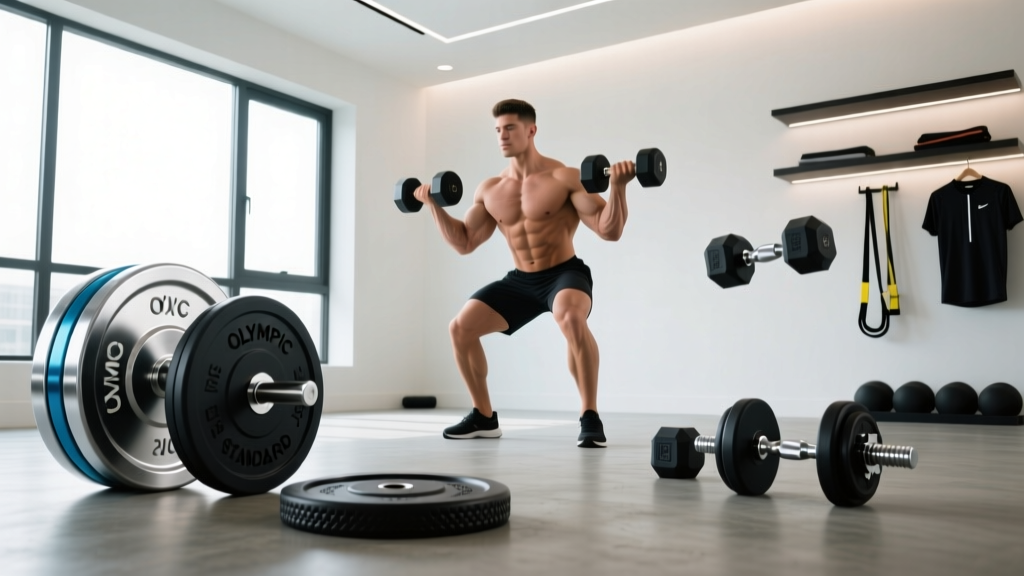
Olympic vs Standard Plates & How to Get Pecs with Dumbbells
Compare Olympic vs standard weight plates for your home gym, plus expert routines on how to get pecs with dumbbells for maximum chest hypertrophy.

Foundation and Hypertrophy: The Ultimate Home Gym Guide
Building a functional home gym and sculpting a massive chest are two sides of the same iron-forged coin. Before you can execute a flawless dumbbell press, you need a reliable infrastructure of weight plates and racks. Yet, many lifters stall their progress by purchasing incompatible gear or ignoring the biomechanical nuances of chest training. This comprehensive guide breaks down the critical differences between Olympic and standard weight plates, followed by an evidence-based masterclass on how to get pecs with dumbbells using stretch-mediated hypertrophy protocols.
Editor's Note (2026 Market Update): The price gap between commercial-grade Olympic plates and standard plates has narrowed. Expect to pay roughly $1.80 to $2.20 per pound for virgin rubber Olympic plates, while standard cast iron hovers around $1.50 per pound. Always prioritize sleeve tolerance over raw price.The Core Debate: Olympic vs. Standard Weight Plates
The distinction between Olympic and standard plates is not merely a branding exercise; it is a matter of engineering tolerances, load capacity, and long-term safety. The primary differentiator is the center hole diameter, which dictates the barbells, dumbbell handles, and storage racks you can use.
Dimensional Breakdown and Tolerances
Standard weight plates feature a 1-inch (25.4mm) center hole. They are designed for lightweight, budget-friendly home gym setups. However, standard barbells typically max out at a tensile strength of 30,000 to 45,000 PSI, meaning the bar will permanently bend if loaded past 200–250 lbs.
Olympic plates, governed by the International Weightlifting Federation (IWF), feature a 2-inch (50.8mm) center hole. High-quality Olympic bars, like the Rogue Ohio Bar, boast a tensile strength of 190,000 PSI and can safely support upwards of 1,500 lbs without permanent deformation.
| Feature | Standard Plates | Olympic Plates |
|---|---|---|
| Center Hole Diameter | 1.00 inch (25.4mm) | 2.00 inches (50.8mm) |
| Max Barbell Capacity | ~250 lbs (before bending) | 1,000 - 1,500+ lbs |
| Plate Material Options | Cast Iron, Cement/Vinyl | Cast Iron, Rubber, Urethane, Bumper |
| Average Cost (2026) | $1.20 - $1.60 / lb | $1.80 - $4.50 / lb |
| Calibration Accuracy | +/- 5% variance | +/- 1% (IWF Certified) |
Material Science: Iron vs. Urethane vs. Bumper
- Cast Iron: The gold standard for durability and compactness. Machined iron plates (like those from Titan Fitness) offer a tighter fit on the sleeve, reducing rattle during heavy dumbbell or barbell presses.
- Virgin Rubber: Excellent for dropping weights, but cheaper rubber emits a strong odor and degrades under UV light. Always opt for virgin rubber over recycled crumb rubber.
- Urethane: The premium choice for commercial gyms. Urethane is virtually odorless, impervious to sweat and moisture, and resists chipping, though it commands a 40% price premium over rubber.
Translating Gear to Gains: Setting Up for Chest Day
Why does your plate choice matter for chest isolation? If you are using adjustable dumbbell handles (like the classic spin-lock style), standard 1-inch plates are common. However, loading standard plates past 45 lbs per hand becomes cumbersome due to the sheer volume of 2.5lb and 5lb standard plates required. Upgrading to Olympic-compatible adjustable dumbbells or a dedicated rack of fixed-weight urethane dumbbells allows for faster progressive overload, which is the primary driver of muscle growth.
The Biomechanics of How to Get Pecs with Dumbbells
When researching how to get pecs with dumbbells, most lifters overlook the biomechanical advantage of the stretched position. The pectoralis major is a fan-shaped muscle with two distinct heads: the clavicular (upper) and sternocostal (mid/lower). According to Schoenfeld's mechanisms of muscle hypertrophy, mechanical tension is the primary catalyst for growth. Dumbbells allow for a deeper range of motion (ROM) at the bottom of the press compared to a barbell, which stops when the bar touches your sternum.
Recent studies on resistance training variables for hypertrophy confirm that training a muscle at long muscle lengths (the stretched position) yields significantly more hypertrophy than training at shortened lengths. Dumbbells are the ultimate tool for exploiting this physiological loophole.
⚠️ Form Warning: Flaring your elbows to 90 degrees during dumbbell presses places extreme shear stress on the anterior shoulder capsule. Always tuck your elbows to a 45-to-60-degree angle relative to your torso to protect the rotator cuff while maximizing sternal pec recruitment.The 3-Movement Dumbbell Pec Protocol
Implement this sequence twice a week, ensuring at least 48 hours of recovery between sessions. Focus on a controlled eccentric (lowering) phase of 3 seconds per rep.
1. 15-Degree Incline Dumbbell Press
Most commercial benches are set to 30 or 45 degrees, which shifts the load heavily onto the anterior deltoids. By dropping the bench to a 15-degree incline (use a single bumper plate under the base of a flat bench if it doesn't adjust this low), you isolate the clavicular head of the pec without sacrificing tension to the shoulders.
- Sets/Reps: 3 x 8-10
- Tempo: 3-1-1 (3s down, 1s pause at the stretch, 1s explosive press)
- RIR (Reps in Reserve): 1
2. Flat Dumbbell Press with 1.5 Reps
To maximize time under tension in the stretched position, utilize the 1.5 rep method. Lower the dumbbells to the bottom of the movement, press them halfway up, lower them back to the bottom, and then press all the way to the top. That constitutes one full rep.
- Sets/Reps: 3 x 6-8 (full reps)
- Execution: The bottom half of the movement is where the most muscle damage and mechanical tension occur. Do not lock out at the top; keep constant tension on the pecs.
3. Deficit Dumbbell Chest Flyes
Lie on a flat bench. Instead of stopping the flye when your arms are parallel to your torso, allow the dumbbells to travel slightly past the plane of your body, feeling an intense stretch across the sternocostal fibers. Use lighter weight (e.g., 25-35 lb dumbbells for an intermediate lifter) to prevent bicep tendon strain.
- Sets/Reps: 3 x 12-15
- Cue: Imagine you are hugging a massive oak tree. Keep a slight, locked bend in the elbows throughout the entire arc.
Frequently Asked Questions
Can I use standard plates on an Olympic barbell?
No, the 1-inch hole will not fit over a 2-inch Olympic sleeve. However, you can purchase aluminum or steel sleeve adapters (typically $15-$25 per pair) that slide over the Olympic bar, allowing you to temporarily use standard plates. This is not recommended for heavy, dynamic movements like Olympic lifts due to the added play and rattle.
Are dumbbells strictly better than barbells for chest growth?
For pure hypertrophy and muscle symmetry, dumbbells hold a distinct edge. They allow each side of the body to work independently, correcting strength imbalances, and they permit a deeper stretch at the bottom of the movement. Barbells, however, are superior for moving absolute maximum loads and overloading the central nervous system. A well-rounded 2026 training program should incorporate both.
How heavy should my dumbbells be for chest flyes?
Weight selection for flyes should be roughly 40-50% of your working weight for flat dumbbell presses. If you press 70 lb dumbbells for 8 reps, use 30 or 35 lb dumbbells for flyes. The lever arm is much longer during a flye, meaning the torque placed on the shoulder joint is exponentially higher. Prioritize the stretch and the squeeze over the number on the dumbbell.
Final Verdict: Invest in the Iron, Execute the Science
Upgrading from standard to Olympic plates is a non-negotiable step for any lifter serious about progressive overload and equipment longevity. Pair that robust foundation with an intelligent, stretch-focused dumbbell routine, and you will unlock a new tier of pectoral development. Stop relying on ego-lifting and half-reps; embrace the biomechanics, respect the eccentric phase, and watch your chest hypertrophy respond accordingly.
More gear to consider
All reviews
Dumbbell vs Barbell Setups: The Complete Barbell Collar & Clamp Guide

Power Rack vs Squat Rack vs Stand: Single Dumbbell Row Setups (2026)

EZ Bar vs Straight Bar: Budget & Good Chest Exercises with Dumbbells
Top Loadable Dumbbells: The Best One Arm Dumbbell Row Alternative
Loadable Dumbbell Value: Chest Supported Dumbbell Row Muscles Worked
