Olympic vs Standard Plates: Setup & Dumbbell Wall Rack Guide
Master your home gym setup with our Olympic vs standard weight plate guide, plus step-by-step dumbbell wall rack installation for ultimate storage.

The Foundation of Home Gym Storage: Olympic vs. Standard Ecosystems
Designing a functional home gym in 2026 requires more than just buying equipment; it demands a meticulous approach to spatial planning, structural load limits, and storage ergonomics. One of the most critical decisions you will make early in your setup is choosing between Olympic and standard weight plates. This choice dictates not only the barbells you can use but also the entire storage ecosystem of your gym, including plate trees, shelving units, and your dumbbell wall rack configuration.
While standard plates remain a budget-friendly entry point for casual lifters, Olympic plates are the undisputed standard for serious strength training. However, mixing the two without a proper storage and installation strategy leads to cluttered floors, damaged drywall, and severe safety hazards. This comprehensive walkthrough will break down the technical differences between these plate types and guide you through a complete, structurally sound installation of your weight storage and wall-mounted racks.
Technical Breakdown: Olympic vs. Standard Weight Plates
Before driving a single lag screw into your wall studs, you must understand the physical dimensions and material properties of the plates you intend to store. The differences extend far beyond the center hole diameter.
| Feature | Olympic Plates (2-Inch / 50.4mm) | Standard Plates (1-Inch / 25.4mm) |
|---|---|---|
| Hub Diameter | 50.4mm (Fits Olympic sleeves) | 25.4mm (Fits standard spin-lock sleeves) |
| Material & Build | Cast iron cores, steel hubs, urethane/rubber coating | Solid cast iron or vinyl-cement filled |
| Weight Tolerance | Calibrated within 10g (Competition grade) | Varies by up to 5% (Cement shifts over time) |
| Durometer (Bounce) | Shore A 85-90 (Dead-blow, minimal bounce) | N/A (Hard iron chips floors; cement cracks) |
| 2026 Avg. Price | $2.50 - $6.00+ per pound | $1.20 - $2.50 per pound |
| Storage Solution | Heavy-duty A-frame trees, wall-mounted pegs | Vertical spindle trees, floor stacks |
Why Olympic Plates Dominate Serious Setups
According to guidelines from the American Council on Exercise (ACE), investing in commercial-grade equipment reduces long-term injury risks associated with equipment failure. Olympic plates feature steel-insert hubs that glide smoothly onto barbell sleeves without grinding away the zinc or chrome finish. Furthermore, high-quality urethane Olympic plates (like those from Rogue or Rep Fitness) resist UV degradation and odors, making them ideal for garage gyms where temperature and humidity fluctuate.
Complete Setup Walkthrough: Anchoring Your Storage Ecosystem
Storing hundreds of pounds of iron requires respecting the physics of your home's framing. Most residential interior walls are framed with 2x4 or 2x6 wooden studs spaced 16 inches on-center (OC), covered by 1/2-inch drywall. Drywall alone has a pull-out strength of less than 20 pounds. Therefore, every piece of wall-mounted storage must anchor directly into the wooden or steel studs.
Step 1: Locating Studs and Calculating Load Limits
Use a high-quality magnetic or ultrasonic stud finder to map out your wall. As detailed in structural guides by The Family Handyman, you must verify the stud edges to ensure your fasteners bite into the center of the wood.
- Locate the center: Find the left and right edges of the stud, mark them, and draw a line exactly in the middle.
- Verify spacing: Measure 16 inches left and right to find adjacent studs.
- Calculate Shear vs. Pull-Out Force: A 3/8-inch lag screw driven 2.5 inches into a standard pine stud can hold over 300 lbs in shear force (downward weight) but significantly less in pull-out force (leveraging away from the wall).
Step 2: Installing the Heavy-Duty Dumbbell Wall Rack
Mounting a dumbbell wall rack is one of the most demanding structural tasks in a home gym. A fully loaded 3-tier rack holding 5lb to 50lb dumbbells can easily exceed 400 lbs of dynamic load. When a user aggressively grabs or drops a dumbbell onto the rack, the shockwave multiplies the shear force on the top mounting brackets.
- Select the Right Hardware: Discard the cheap drywall anchors or standard wood screws included with budget racks. Purchase 3/8" x 3" structural lag screws (such as Simpson Strong-Tie SDS screws).
- Mark and Pre-Drill: Hold the rack's mounting bracket against the wall, ensuring it aligns perfectly with your stud center lines. Use a 7/32" drill bit to pre-drill pilot holes 2.5 inches deep. This prevents the wood stud from splitting under the torque of the lag screw.
- Mount the Bottom Tier First: Secure the lowest bracket first, using a torpedo level to ensure it is perfectly horizontal. The bottom tier bears the brunt of the heaviest dumbbells (e.g., 40lb and 50lb pairs).
- Secure Upper Tiers: Attach the remaining tiers, checking for plumb and level. Tighten all lag screws with a socket wrench until the bracket is flush and slightly compressing the drywall, but stop before you crush the gypsum core.
Step 3: Assembling and Anchoring the Olympic Plate Tree
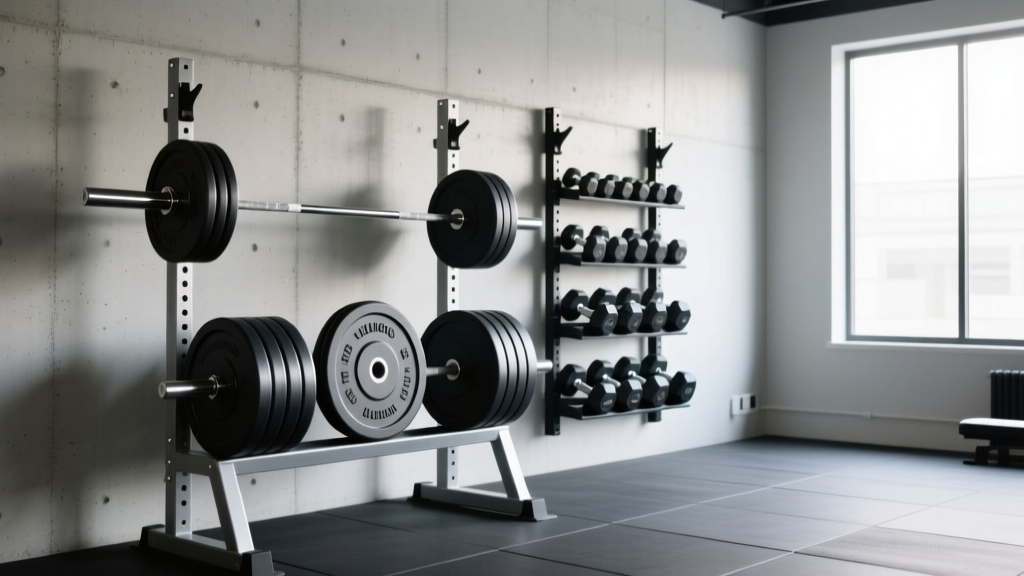
While your dumbbells are secured to the wall, your Olympic plates require a floor-based A-frame or vertical plate tree. Models like the Rogue Fitness Olympic Plate Tree feature a wide, gusseted base to prevent tipping.
- Placement Strategy: Position the plate tree at least 18 inches away from your dumbbell wall rack to allow for safe loading and unloading without swinging heavy plates into your wall-mounted hardware.
- Load Distribution: Always store 45lb and 35lb bumper plates on the lowest, widest pegs. Store 10lb and 2.5lb fractional plates on the highest pegs. This lowers the center of gravity and eliminates tip-over risks.
- Anti-Tip Anchoring (Optional but Recommended): If you have children or pets, use a furniture anti-tip strap to connect the top of the plate tree to a wall stud. According to safety reports from Rogue Fitness and commercial gym standards, anchoring freestanding storage units is a best practice for high-traffic garage gyms.
'The most common failure in home gym setups isn't the equipment breaking; it's the wall failing. When you hang 400 pounds of iron on a drywall anchor, you aren't testing the metal; you are testing the tensile strength of compressed gypsum. Always respect the stud.'
— Certified Strength and Conditioning Specialist (CSCS) Home Gym Safety Guidelines
Storage Ergonomics and Workflow Optimization
Once your hardware is securely mounted, organizing your space for optimal workflow is the final step. The goal is to minimize the distance you carry heavy loads.
The 'Triangle of Efficiency'
Arrange your storage in a triangle relative to your primary lifting platform or squat rack:
- Point A (The Rack/Platform): Where the lifting occurs.
- Point B (Plate Tree): Should be within 3-4 steps of the barbell sleeve. You should never have to carry a 45lb plate across the room.
- Point C (Dumbbell Wall Rack): Position this on a perpendicular wall. This keeps the floor space open for kettlebell swings, lunges, or stretching, while keeping the wall rack accessible for accessory work.
Frequently Asked Questions (FAQ)
Can I use Olympic plates on a standard barbell with adapters?
Technically, yes. You can buy plastic or aluminum sleeve adapters that slip over a 1-inch standard barbell to accept 2-inch Olympic plates. However, this is highly discouraged for heavy lifting. Standard barbells lack the load-bearing capacity and tensile strength of Olympic bars, and the adapters introduce a dangerous point of lateral flex and wobble during squats or deadlifts.
My dumbbell wall rack is pulling away from the wall at the top. How do I fix it?
This indicates a pull-out force failure, usually caused by hitting the edge of a stud, using inadequate screws, or mounting into metal studs without toggle bolts. Immediately remove the weight. You must install a horizontal wooden cleat (a 2x4) directly into multiple studs, and then mount the rack brackets to that cleat using heavy-duty structural screws.
Do standard vinyl-cement plates damage storage trees?
Over time, vinyl-cement plates can crack or leak if dropped, but their primary issue regarding storage is the 1-inch center hole. Many cheap standard plates have poorly cast holes with jagged iron burrs. These burrs will scrape the paint and zinc coating off your plate tree pegs, leading to rust. Always sand the inner rim of cheap cast-iron or cement plates before storing them on metal racks.
Final Thoughts on Gym Setup
Transitioning from a makeshift garage corner to a fully optimized training space requires respecting the engineering behind your equipment. By understanding the distinct mechanical profiles of Olympic versus standard plates, and by executing a rigorous, stud-anchored installation of your dumbbell wall rack and plate trees, you ensure that your home gym is as safe as it is effective. Invest in the right fasteners, map your studs accurately, and build a storage ecosystem that supports your strength journey for years to come.
More gear to consider
All reviews
What Are Dumbbells? A Guide to Neoprene Coated Weights for Home Gyms

Are Loadable Dumbbells Best for Your Dumbbell Kick Back? A Value Analysis
Best Adjustable Dumbbells for Dumbbell Pushups & Lifts (2026)

Dumbbell Halos & Barbell Collar Types: A Setup Walkthrough
Rubber Hex vs Urethane: Best Pull Up Alternative Dumbbell