
Olympic vs Standard Plates: Fixing Dumbbell Bench Press Variations
Troubleshoot equipment mistakes with Olympic vs standard weight plates and learn how they impact your dumbbell bench press variations and home gym setup.

The 1-Inch vs. 2-Inch Dilemma: Why Your Plates Dictate Your Press
When building a home gym, many lifters prioritize the barbell and rack, treating dumbbells as an afterthought. This often leads to a costly and biomechanically frustrating mistake: purchasing standard 1-inch weight plates and attempting to use them for advanced dumbbell bench press variations. While standard plates (featuring a 1-inch center hole) and Olympic plates (featuring a 2-inch or 50mm center hole) might look similar to the untrained eye, their dimensional differences fundamentally alter the mechanics of your pressing movements.
As of 2026, the home fitness equipment market has seen a massive influx of adjustable Olympic dumbbell handles, such as the Titan Fitness 2-Inch Olympic Dumbbell Handles and the IronMind Tough-As-Nails loading pins. Yet, thousands of lifters remain trapped using cheap standard spin-lock handles because they previously invested in standard cast-iron plates. This troubleshooting guide will dissect the most common mistakes lifters make when pairing weight plate types with dumbbell bench press variations, and provide actionable solutions to fix your pressing mechanics.
⚠️ CRITICAL SAFETY WARNING: Never attempt to drill out or modify the center holes of standard cast-iron plates to fit Olympic dumbbell handles. This compromises the structural integrity of the plate, creating a severe crushing hazard during overhead or bench pressing movements.3 Critical Mistakes When Using Standard Plates for Dumbbell Variations
Mistake 1: The Diameter Trap on Neutral-Grip and Incline Presses
The most glaring difference between standard and Olympic plates is the diameter-to-weight ratio. A standard 10-pound cast-iron plate typically shares the same 9-inch outer diameter as a 25-pound plate; it is simply thinner. Conversely, an Olympic 10-pound urethane plate (like those from Rogue Fitness) features a compact 5-inch diameter.
When performing neutral-grip dumbbell bench press variations, your hands are positioned close together, and the weights travel down the centerline of your chest. If you are using standard 10-pound or 15-pound plates, the wide 9-inch edges will collide with each other before your elbows can achieve a full 90-degree flexion. According to biomechanical data from ExRx.net's kinesiology database, limiting the eccentric stretch at the bottom of a pressing movement drastically reduces pectoralis major activation. By switching to Olympic plates, the compact diameter allows the dumbbells to travel deeper, maximizing the stretch-mediated hypertrophy that makes dumbbell variations so effective.
Mistake 2: Spin-Lock Failure During Alternating Presses
Alternating dumbbell bench press variations require independent stabilization and introduce rotational torque to the handle. Standard 1-inch dumbbell handles rely on threaded spin-lock collars. Under the dynamic, alternating load of a heavy pressing set, the rotational force transferred through your wrist and palm can gradually unscrew the spin-lock collar. This results in the plates shifting outward, altering the center of gravity mid-rep and posing a severe safety risk.
Olympic dumbbell handles utilize either heavy-duty screw-down collars with O-ring seals or spring-clip snap rings that lock into a machined groove on the 2-inch sleeve. This completely eliminates rotational shifting, allowing you to perform alternating and single-arm dumbbell bench press variations with absolute mechanical stability.
Mistake 3: Floor Press Range-of-Motion Restrictions
The dumbbell floor press is an excellent variation for building lockout strength and triceps mass. However, standard plates are notoriously thin. A stack of standard 10s and 5s on a 1-inch handle will sit much closer to the floor than a stack of thick Olympic urethane bumpers or grippers. When using standard plates, your triceps will hit the floor prematurely, cutting off the top 20% of the pressing range of motion. Upgrading to thicker Olympic plates or specialized Olympic grip bells ensures your elbows hit the floor at the exact point where your upper arms are parallel to the torso, optimizing the movement's intended biomechanical profile.
Troubleshooting Matrix: Matching Plate Types to Press Variations
Use the following diagnostic table to identify how your current plate setup might be sabotaging your specific dumbbell bench press variations.
| Dumbbell Variation | Standard Plate Failure Mode | Olympic Plate Solution |
|---|---|---|
| Neutral-Grip Press | Wide 10lb/15lb plates collide at the bottom, eliminating the eccentric stretch. | Compact 5-inch Olympic plates allow full depth and chest contact. |
| Alternating Press | Rotational torque loosens 1-inch spin-lock collars mid-set. | 2-inch snap-ring collars withstand multi-planar torque securely. |
| Dumbbell Floor Press | Thin plates reduce floor clearance, shortening the lockout phase. | Thicker urethane bumpers provide optimal elbow-to-floor contact point. |
| Decline Press | Handles are too short to accommodate enough standard plates for heavy loads. | Longer Olympic sleeves allow for 100+ lb loadouts per hand safely. |
The 2026 Financial Breakdown: Standard vs. Olympic Investments
One of the primary reasons lifters stick with standard plates is the perceived cost savings. Let us break down the actual financial reality of upgrading your pressing arsenal in 2026.
💡 EXPERT INSIGHT: The True Cost Per PoundAs of early 2026, standard cast-iron plates generally retail between $1.20 and $1.50 per pound. However, you must also factor in the cost of standard 1-inch dumbbell handles ($25-$40 per pair).
Olympic urethane-coated plates (which protect your floors and reduce noise) average $3.50 to $5.00 per pound. High-quality Olympic dumbbell handles with snap-ring collars cost between $80 and $120 per pair. While the upfront cost of Olympic gear is roughly 60% higher, the National Strength and Conditioning Association (NSCA) frequently highlights that commercial-grade, standardized equipment yields a vastly superior lifespan and safety profile, making the cost-per-use significantly lower over a 10-year period.
If you are strictly performing basic flat presses with light weights, standard plates may suffice. But if your programming includes heavy, progressive overload across multiple dumbbell bench press variations, the structural limitations of standard gear will become a bottleneck within 12 to 18 months.
Step-by-Step Upgrade Path for Home Gym Owners
- Audit Your Current Handles: Measure the sleeve diameter. If it is 1 inch (25mm), you are locked into the standard ecosystem.
- Liquidate Standard Iron: Standard plates hold their value well on the secondary market. Sell your 1-inch plates locally to recoup 70-80% of your initial investment.
- Invest in Olympic Loading Dumbbells: Purchase a pair of 2-inch sleeve Olympic dumbbell handles (e.g., Titan Fitness or Rogue Loadable Dumbbells).
- Buy Fractional Olympic Plates: To precisely match the weight jumps required for dumbbell bench press variations, prioritize buying 2.5lb, 5lb, and 10lb Olympic fractional plates before buying the massive 45lb bumpers.
Frequently Asked Questions (FAQ)
Can I use Olympic plates on a standard barbell or dumbbell handle?
No. Olympic plates have a 2-inch (50mm) center hole, while standard handles have a 1-inch (25mm) sleeve. The Olympic plate will simply slide over the standard handle without resting on the sleeve, making it impossible to secure and highly dangerous to lift.
Are grip bells better than traditional plates for dumbbell pressing?
For specific dumbbell bench press variations like the neutral-grip press or the squeeze press, Olympic grip bells (which feature integrated handles) offer superior ergonomics and eliminate the need for collars entirely. However, traditional loadable handles with standard Olympic plates remain more versatile for accommodating varying grip widths and micro-loading.
Does plate thickness affect the balance of the dumbbell?
Yes. Standard plates are often narrower in width but wider in diameter, pushing the center of mass further away from the handle's core. Olympic plates, particularly dense urethane or steel varieties, keep the weight localized closer to the handle, providing a more balanced and stable feel during unilateral dumbbell bench press variations.
Expert Verdict: Building a Future-Proof Pressing Arsenal
Troubleshooting your home gym equipment is just as important as troubleshooting your lifting form. While standard 1-inch plates offer a cheap entry point into weightlifting, their inconsistent diameters, thin profiles, and reliance on inferior spin-lock collars actively sabotage the biomechanics of advanced dumbbell bench press variations. By understanding the physical limitations of standard gear and transitioning to the standardized, secure, and compact ecosystem of Olympic weight plates, you will unlock a deeper range of motion, safer rotational mechanics, and a more sustainable path to upper-body hypertrophy.
More gear to consider
All reviews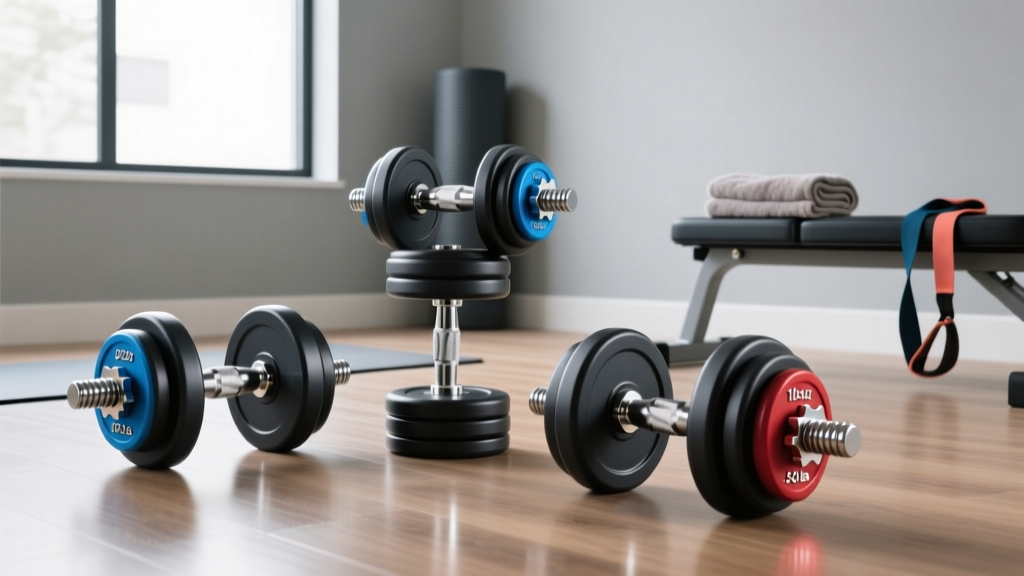
Best Adjustable Dumbbells for Dumbbell Pushups & Lifts (2026)

Dumbbell Exercise for Belly Workouts: Neoprene Mistakes & Fixes

Bicep Dumbbell Workouts: Troubleshooting & Adjustable Dumbbell Reviews

From Seated Dumbbell Hammer Curls to Deadlifts: Bumper vs Iron Plates
Bumper vs Iron Plates: Space Layouts & Transparent Background Assets
