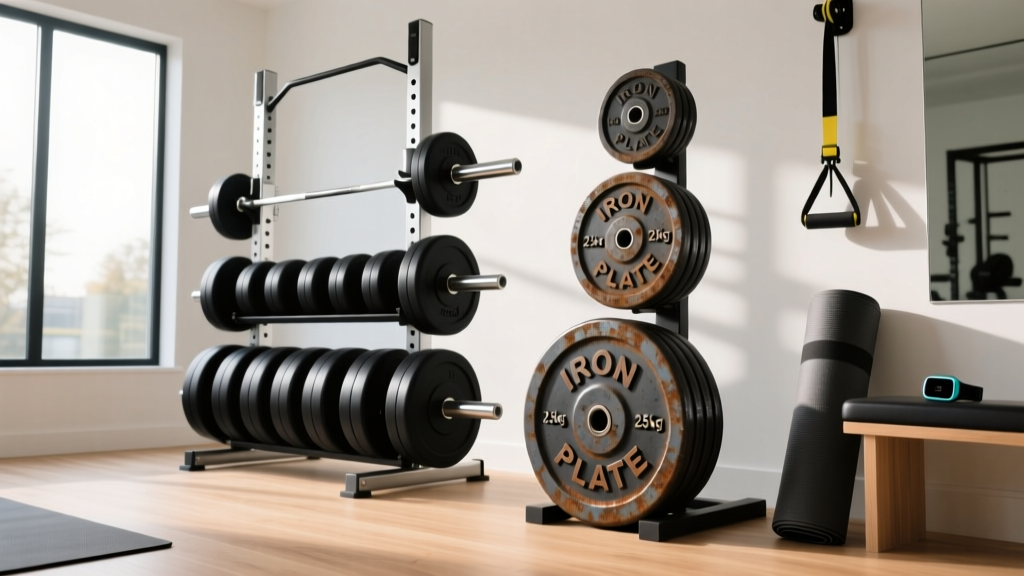
Bumper Plate vs Iron Plate Comparison: Upgrading Beyond 75 lb Dumbbells
Compare bumper plate vs iron plate setups for heavy home gyms. We break down costs, durability, and when to upgrade from 75 lb dumbbells to barbells.

The Heavy Lifter's Dilemma: Moving Past 75 lb Dumbbells
Every serious home gym owner eventually hits the same plateau: the ceiling of their dumbbell set. Whether you are pressing a pair of fixed urethane 75 lb dumbbells or maxing out adjustable sets like the PowerBlock Elite 75s, there comes a point where dumbbells simply cannot provide the mechanical stability or progressive overload required for heavy lower-body and back development. Trying to goblet squat or perform heavy Romanian deadlifts with 75 lb dumbbells limits your central nervous system's adaptation. To continue progressing, you must transition to a barbell.
Once you invest in a quality Olympic barbell, you are immediately faced with the most critical equipment decision in your gym's lifecycle: bumper plate vs iron plate. This choice dictates your gym's noise levels, floor integrity, barbell sleeve capacity, and ultimately, your lifting style. In this 2026 expert guide, we break down the metallurgy, rubber vulcanization, and real-world failure modes of both plate types to help you build the ultimate heavy-lifting arsenal.
Material Science: Virgin Rubber vs. Cast Iron
To understand the performance gap, we have to look at how these plates are manufactured. According to extensive testing by Garage Gym Labs, the durometer (hardness) rating of the rubber and the machining tolerance of the iron dictate the lifespan of the plate.
Expert Callout: The Hub Insert Matters
Cheap bumper plates use brass or low-grade steel inserts that warp and chew up your barbell's zinc or cerakote finish. Premium bumpers (like Rogue Echo or Titan Elite) use hooked stainless steel inserts that grip the barbell sleeve securely without scratching. For iron plates, look for machine-cast hubs with a 50.4mm to 50.6mm inner diameter tolerance to prevent 'clanking' during heavy deadlifts.
Bumper Plates: Engineered for Impact
Bumper plates are constructed from virgin or recycled rubber vulcanized around a steel hub. Their primary purpose is to be dropped from overhead without shattering the plate, the barbell, or your flooring. High-quality bumpers feature a 'dead bounce' design, meaning the rubber compound absorbs kinetic energy rather than returning it, preventing the barbell from bouncing back into your shins during a missed Olympic clean.
Cast Iron Plates: Engineered for Density
Iron plates are sand-cast and typically finished with enamel paint, zinc plating, or a machine-cast bare iron finish. They are incredibly dense, rigid, and offer zero shock absorption. When you drop an iron plate, 100% of the kinetic energy transfers directly into the floor and the barbell sleeve.
Hands-On Comparison Matrix: 2026 Top Models
We tested four industry-standard plates to see how they perform when loading heavy compounds. Here is how the top bumpers and iron plates compare in real-world metrics.
| Model | Type | Thickness (45lb) | Price per lb (Avg) | Drop Rating |
|---|---|---|---|---|
| Rogue Echo Bumper V2 | Virgin Rubber | 3.25 inches | $4.50 - $5.00 | High (Oly Safe) |
| Titan Fitness Elite | Virgin Rubber | 3.30 inches | $3.80 - $4.20 | High (Oly Safe) |
| Rogue Machined Olympic | Cast Iron | 1.30 inches | $2.00 - $2.50 | Zero (Do Not Drop) |
| York Legacy Iron | Cast Iron | 1.35 inches | $1.50 - $1.80 | Zero (Do Not Drop) |
5 Critical Failure Modes and Edge Cases
When transitioning from the controlled environment of 75 lb dumbbells to heavy barbell work, lifters often overlook the physics of plate loading. Here are the edge cases that dictate your purchase.
1. The Sleeve Capacity Problem (The 405lb Limit)
A standard Olympic barbell sleeve is 16.3 inches long. Because bumper plates are nearly three times thicker than iron plates, you will physically run out of room on the barbell much faster. With 45lb Rogue Echo bumpers, you can only fit four plates per side (plus a collar), maxing out around 405 lbs. With machined iron plates, you can easily load 550+ lbs on the same sleeve. If your goal is a 500lb deadlift, thick bumpers will literally prevent you from loading the bar.
2. Barbell Whip and Deadlift Mechanics
According to biomechanical analyses featured on BarBend, the distribution of weight on the sleeve affects barbell 'whip' (the oscillation of the bar during heavy pulls). Iron plates sit closer to the barbell's center of gravity, reducing whip and providing a more stable, rigid pull for heavy powerlifting deadlifts. Bumpers push the mass further outward, increasing whip, which is highly beneficial for Olympic weightlifters using the bounce out of the hole in a clean, but detrimental to a heavy sumo deadlifter.
3. Floor Destruction and Acoustic Shockwaves
Dropping iron plates, even on 3/4-inch horse stall mats, will eventually crack your concrete slab. The acoustic shockwave of dropping 315 lbs of iron in a garage gym can exceed 110 decibels, easily violating neighborhood noise ordinances. Bumpers reduce acoustic transfer by up to 70%, making them mandatory for any lifter performing Olympic variations or high-rep CrossFit-style touch-and-go deadlifts.
4. The Recycled Rubber 'Stink' Factor
If you opt for budget bumpers made from recycled tire rubber, be prepared for a massive off-gassing problem. In a closed garage gym during the summer heat, recycled rubber bumpers will emit volatile organic compounds (VOCs) that smell like a burning tire fire. Always invest in virgin rubber bumpers if your gym lacks industrial ventilation.
5. Rust, Humidity, and Maintenance
Cast iron plates are highly susceptible to oxidation. If your garage gym experiences humidity fluctuations, unpainted or enamel-coated iron plates will develop surface rust within months, leaving orange dust on your hands and barbell sleeves. Zinc-plated or urethane-coated iron plates solve this but come at a 20% price premium.
2026 Cost Breakdown: Budgeting Your Upgrade
Leaving your 75 lb dumbbells behind means investing in a full plate set. Here is what you can expect to spend in the current market for a standard 230 lb plate set (Pair of 45s, Pair of 25s, Pair of 10s, Pair of 5s):
- Premium Virgin Bumpers (e.g., Rogue HG 2.0): ~$950 - $1,100
- Budget/Recycled Bumpers (e.g., Hi-Temp): ~$550 - $650
- Machined Cast Iron (e.g., Rogue Echo Iron): ~$450 - $550
- Basic Enamel Iron (e.g., CAP Barbell): ~$250 - $350
Pro-Tip: Shipping costs for iron plates have stabilized in 2026, but buying locally via Facebook Marketplace or used gym liquidations can save you up to 40% on cast iron, as it rarely degrades over time.
Expert Verdict: Which Should You Buy?
The decision between bumper plate vs iron plate ultimately comes down to your training modality and your respect for your flooring.
Buy Bumper Plates If:
- You perform Olympic lifts (snatches, cleans, jerks) and need to drop the bar from overhead.
- You do high-rep, fatiguing deadlifts where controlling the eccentric descent is unsafe.
- Your gym is in a shared space or attached garage where noise mitigation is critical.
Buy Cast Iron Plates If:
- You are strictly a powerlifter or bodybuilder focusing on squats, bench presses, and controlled deadlifts.
- You plan on lifting over 405 lbs and need maximum barbell sleeve capacity.
- You want the most cost-effective, durable, and space-efficient option for a dedicated platform.
Upgrading from 75 lb dumbbells to a barbell setup is a massive leap in your strength journey. By matching your plate material to your specific training demands, you ensure that your home gym remains safe, efficient, and capable of handling the heavy loads your new barbell routine demands. For more detailed specs on building out your rack, check out our comprehensive guides on Rogue's official equipment lineup and always prioritize proper flooring beneath your lifting platform.
More gear to consider
All reviews
Barbell Collar vs Clamp: Securing Lifts Beyond a Dumbbell Squat GIF

Barbell Collar vs Clamp Setup & Dumbbell Scap Trap Guide

Cast Iron vs Competition Kettlebells: Space & How to Dumbbell Shrug

Beyond Dumbbell Overhead Extensions: Olympic Barbell Knurling Guide

Beginner Full Body Dumbbell Workout at Home with Neoprene Weights
