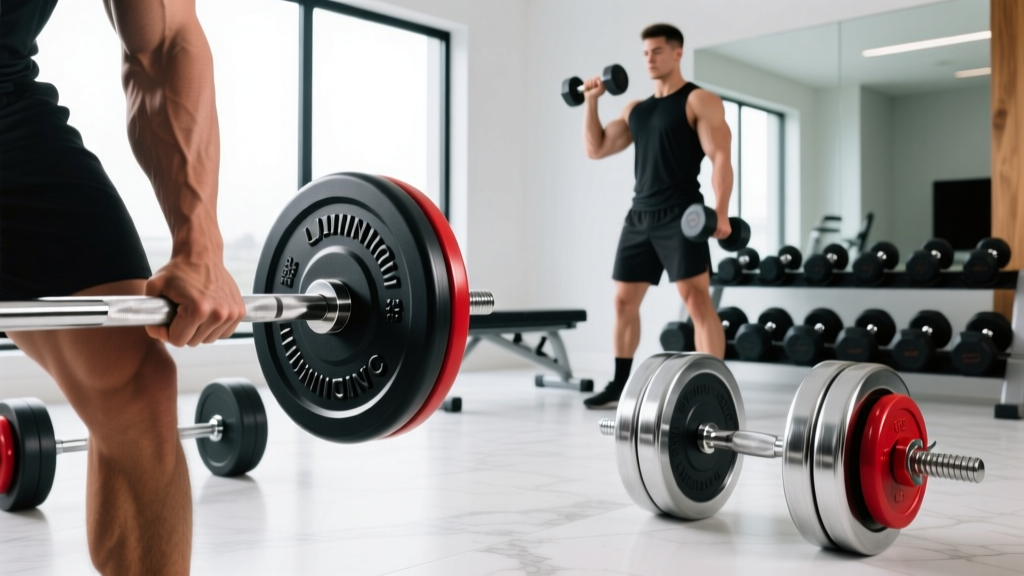
Olympic Barbell Knurling & Dumbbell Exercises for Bigger Biceps
Compare top Olympic barbells on weight tolerance and knurling. Plus, discover the best dumbbell exercises for bigger biceps to optimize your 2026 arm day.

The 2026 Free Weight Arsenal: Bridging Heavy Pulls and Arm Hypertrophy
Building a complete home gym in 2026 requires a meticulous approach to equipment selection. While the Olympic barbell remains the undisputed king of compound loading, its specific characteristics—namely weight tolerance and knurling patterns—dictate not just your squat and deadlift performance, but also how you approach isolation work. Many lifters fail to realize that the aggressive knurling designed to keep a 500 lb deadlift secure in the hands will absolutely shred your calluses during high-repetition barbell curls.
This biomechanical and metallurgical reality forces a strategic pivot in modern hypertrophy programming. Elite coaches now reserve the barbell for heavy, low-rep compound movements, strategically transitioning to targeted dumbbell exercises for bigger biceps to protect the hands and allow for natural radioulnar rotation. In this comprehensive guide, we put two of the most popular multi-purpose Olympic barbells head-to-head, decode the science of tensile strength, and outline the exact dumbbell protocols you need to maximize arm growth without destroying your grip.
Head-to-Head: Rogue Ohio Bar (Stainless) vs. American Barbell Cali Bar
When evaluating an Olympic barbell buying guide, weight and knurling are the primary differentiators. For the 2026 market, the Rogue Ohio Bar (Stainless Steel) and the American Barbell Cali Bar represent the gold standard for hybrid training. Both feature 190,000 PSI tensile strength shafts, but their approach to knurling and finish varies drastically.
Rogue Ohio Bar (Stainless Steel)
- Price: ~$325.00
- Knurling: Rogue's signature 'Volcano' pattern. It features sharp, pointed peaks with a small crater in the center, providing maximum surface area contact.
- Finish: Bare stainless steel shaft with stainless sleeves. Requires zero maintenance and resists oxidation entirely.
- Bushing System: Bronze bushings for a smooth, controlled spin ideal for heavy pressing and pulling.
American Barbell Cali Bar
- Price: ~$295.00
- Knurling: A 'Hill' or hybrid pattern. The peaks are slightly rounded off, offering a secure grip without feeling like a cheese grater during high-rep sets.
- Finish: Hard chrome shaft and sleeves. Highly durable, though it requires occasional oiling to prevent surface rust in humid environments.
- Bushing System: Composite bushings. These are significantly quieter than bronze, making the Cali Bar a favorite for garage gyms with shared walls.
Decoding Weight Tolerance: Tensile vs. Yield Strength
A common mistake in any Olympic barbell buying guide is confusing tensile strength with yield strength. Both the Rogue and American Barbell models boast a 190,000 PSI tensile strength rating. But what does that actually mean for your training?
⚠️ Critical Metallurgy Warning
Tensile Strength (190k PSI) is the absolute breaking point of the steel. Yield Strength is the point at which the bar bends and will not return to its original straight form. A 190k PSI bar is perfectly adequate for 95% of lifters. However, if you regularly drop 400+ lbs on the pins of a power rack, or leave the bar loaded with 500+ lbs on a squat rack for weeks at a time, you risk exceeding the yield strength, resulting in a permanent bend. For dedicated powerlifters moving 600+ lbs, a 215k PSI stiff bar is required, but for general strength and hypertrophy, 190k PSI provides the optimal balance of durability and 'whip'.
The Knurling Matrix: Matching Steel to Your Lifts
The knurl is the physical interface between your nervous system and the load. Here is how the primary knurling shapes compare in real-world application:
| Knurl Type | Shape Profile | Best Application | Example Bar |
|---|---|---|---|
| Volcano | Pointed with micro-craters | Heavy pulling, CrossFit, Olympic lifts | Rogue Ohio Bar |
| Mountain | Sharp, aggressive peaks | Low-rep Powerlifting (Deadlifts) | Texas Power Bar |
| Hill | Rounded, passive peaks | High-rep hypertrophy, Olympic lifting | American Barbell Cali |
The Biomechanical Pivot: Why Lifters Switch to Dumbbell Exercises for Bigger Biceps
When programming for arm hypertrophy, the traditional barbell curl is often the default. However, utilizing a barbell with an aggressive 'Volcano' or 'Mountain' knurl for sets of 12-15 repetitions will rapidly tear your palm calluses. Furthermore, the fixed, straight path of a barbell locks your wrists into forced supination. According to biomechanical data cataloged by ExRx.net, this fixed path ignores the natural carrying angle of the elbow, frequently leading to medial epicondylitis (golfer's elbow) in heavy lifters.
This is precisely why modern hypertrophy programs strategically incorporate dumbbell exercises for bigger biceps as the primary drivers of isolation growth. Dumbbells allow the radioulnar joint to rotate naturally, sparing the connective tissue while placing a massive, sustained stretch on the biceps brachii.
The 2026 Arm-Day Dumbbell Protocol
To maximize hypertrophy without relying on the barbell for isolation, integrate these three specific movements into your routine. Focus on the eccentric (lowering) phase, as muscle damage and subsequent growth are highly correlated with time-under-tension during the eccentric load.
- 45-Degree Incline Dumbbell Curl (Long Head Focus)
Set an adjustable bench to exactly 45 degrees. Let your arms hang dead straight behind your torso to place the long head of the bicep in a fully stretched position. Curl up without moving your elbows forward. Prescription: 3 sets of 10-12 reps with a 3-second eccentric lowering phase. - Zottman Curl (Brachioradialis & Eccentric Focus)
Curl the dumbbells up with a supinated (palms up) grip. At the top of the movement, pause for 1 second, then rotate your wrists to a pronated (palms down) grip. Lower the weight slowly in this reverse-grip position. This targets the biceps on the concentric and the brachioradialis/brachialis on the eccentric, building massive forearm and lower-bicep thickness. Prescription: 3 sets of 8-10 reps. - Cross-Body Hammer Curl (Brachialis Focus)
Instead of curling straight up, curl the dumbbell diagonally across your torso toward the opposite shoulder. This shifts the mechanical advantage to the brachialis, a muscle that sits under the biceps and physically pushes the bicep peak upward when developed. Prescription: 3 sets of 12-15 reps per arm.
'The barbell is for moving maximum loads from point A to point B. The dumbbell is for sculpting the tissue in between. Never confuse the tools.' — 2026 Hypertrophy Coaching Consensus
Final Verdict: Building Your 2026 Free Weight Arsenal
Choosing the right Olympic barbell requires looking past the brand name and analyzing the metallurgy and knurling geometry. If your training revolves around heavy, low-rep powerlifting and aggressive pulling, the Rogue Ohio Bar (Stainless) and its Volcano knurl will provide the secure grip you need. If your programming leans heavily into high-rep hypertrophy, CrossFit, and you want to save your hands for those crucial dumbbell exercises for bigger biceps, the smoother Hill knurl and quiet composite bushings of the American Barbell Cali Bar offer superior daily drivability.
Ultimately, a complete 2026 free weight setup respects the biomechanical limits of the human body. Invest in a high-quality 190k PSI barbell for your squats, presses, and deadlifts, but rely on adjustable dumbbells and targeted isolation protocols to build your arms safely and effectively.
More gear to consider
All reviews
Cast Iron vs Competition Kettlebell Care & Front Raises GIF

Lat Workouts at Home with Dumbbells: Rubber Hex vs Urethane
Squat Rack vs Power Rack: Space for Lateral Lunge with Dumbbells

Setup for the Best Dumbbell Workout Routine: Clamps vs Collars

Best Racks for 200 lbs Dumbbells: 2026 Heavy-Duty Storage Guide
