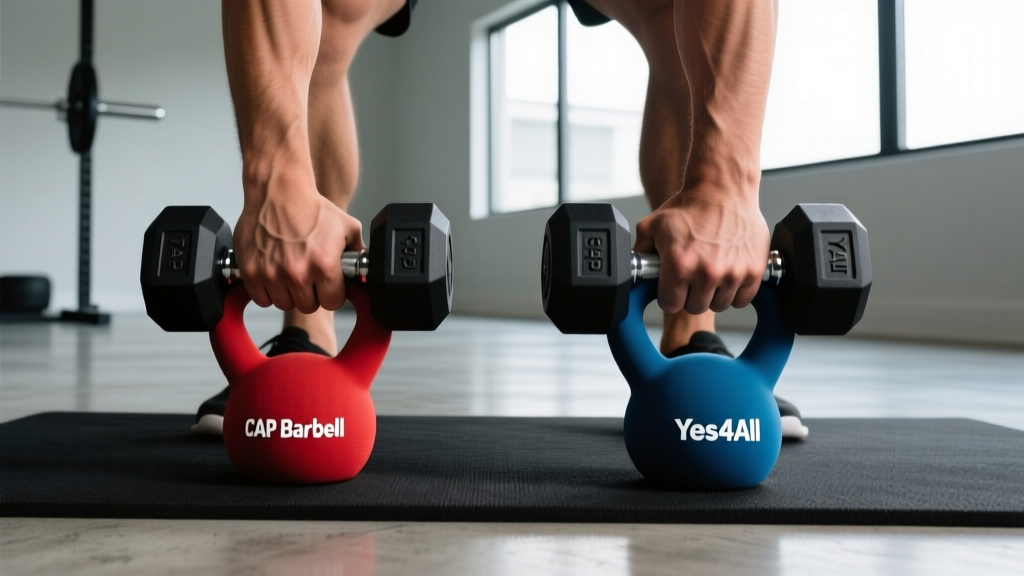
Best Neoprene Dumbbells for Deadlift Form: 2026 Head-to-Head
We test CAP Barbell vs. Yes4All neoprene dumbbells for deadlift form. Discover which home gym weight offers the best grip, balance, and floor protection.

The Hidden Variable in Dumbbell Deadlifts: Equipment Selection
When building a home gym, most lifters obsess over adjustable benches and power racks, treating dumbbells as an afterthought. However, if your programming heavily features Romanian Deadlifts (RDLs), Sumo Deadlifts, or Deficit Deadlifts, the specific dumbbell you choose directly impacts your biomechanics and safety. In 2026, neoprene-coated hex dumbbells remain the most popular choice for home setups due to their floor-friendly nature and affordable price point. But do they actually support proper mechanics?
When searching for the best deadlift form dumbbells, lifters often overlook how handle knurling, weight distribution, and coating friction interact during the eccentric and concentric phases of a hinge movement. A slipping grip forces you to over-squeeze, prematurely fatiguing your forearms and causing you to cut your range of motion short. Worse, grip instability can lead to micro-adjustments in your posture, increasing the risk of lumbar flexion (rounding the lower back).
To determine which budget-friendly neoprene dumbbell truly supports optimal hinging mechanics, we put two industry giants head-to-head: the CAP Barbell Neoprene Hex Dumbbell (Model SDN Series) and the Yes4All Neoprene Coated Hex Dumbbell (Model YES-NEO Series). Both are staples in home gyms, but their manufacturing nuances create vastly different experiences under heavy loads.
The Biomechanics of Dumbbell Hinging
Before tearing down the hardware, we must understand the physical demands of the movement. According to exercise biomechanics databases like ExRx, the dumbbell Romanian deadlift requires the lifter to maintain a neutral spine while pushing the hips back, keeping the dumbbells in close proximity to the thighs. Unlike a barbell, which locks your hands into a fixed, pronated or mixed grip on a single axis, dumbbells allow for independent arm movement.
This independence is a double-edged sword. It allows for a more natural shoulder position, reducing impingement risks, but it demands significantly more stabilizing torque from the lats and grip. ACE Fitness emphasizes that maintaining a 'proud chest' and neutral spine is impossible if your grip is failing. If the dumbbell handle lacks adequate knurling, or if the neoprene coating creates a slick barrier against sweaty palms, your central nervous system will prioritize holding onto the weight over maintaining perfect spinal alignment. Therefore, the physical construction of the dumbbell handle is inextricably linked to your deadlift form.
Contender 1: CAP Barbell Neoprene Hex (SDN Series)
CAP Barbell has been a legacy brand in commercial and home fitness for decades. Their neoprene hex dumbbells, specifically the SDN line (e.g., the 20lb SDN-020), feature a solid cast-iron core encased in a thick neoprene shell, with a chrome-plated, contoured handle left exposed for grip.
Handle and Knurling Profile
CAP utilizes a medium-depth diamond knurling on their chrome handles. The handle diameter on the 20lb to 40lb models sits at roughly 34mm, which is standard for Olympic-style grip training. The knurling is aggressive enough to bite into calluses but not so sharp that it tears the skin during high-rep RDL sets. Crucially, the transition point where the chrome handle meets the neoprene head is beveled, preventing the coating from peeling back when the dumbbell is dropped or dragged against the thigh during deadlifts.
Weight Distribution and Tolerance
CAP's casting process yields a highly accurate weight tolerance, typically within +/- 2% of the stated weight. For a 30lb dumbbell, this means a variance of less than 0.6 lbs. This symmetry is vital for deadlifts; an imbalanced dumbbell forces the lifter to unconsciously shift their center of gravity, leading to asymmetrical hip hinging and potential SI joint irritation.
Expert Insight: The hex shape of the CAP Barbell heads features slightly rounded edges. While this prevents floor scuffing, it also means the dumbbell will not 'lock' perfectly flush against a wooden riser if you are attempting deficit deadlifts to increase hamstring stretch.Contender 2: Yes4All Neoprene Coated Hex (YES-NEO Series)
Yes4All disrupted the home gym market by offering hyper-competitive pricing without sacrificing basic structural integrity. Their YES-NEO series is a direct competitor to CAP, often undercutting them by $0.40 to $0.60 per pound. But how does it perform when the hips hinge and the sweat starts?
Handle and Knurling Profile
The Yes4All handle is slightly thicker on the lower weight increments (up to 25lbs), measuring closer to 35mm in diameter. The knurling is noticeably shallower than CAP's. Yes4All achieves this to reduce manufacturing wear on their chrome plating tools, but the trade-off is a 'smoother' feel. During heavy sumo deadlifts, where the dumbbells hang directly between the legs and gravity pulls them straight down, the shallower knurling requires a tighter crush grip to prevent micro-slipping.
Coating Thickness and Seam Integrity
Yes4All uses a slightly thinner neoprene coating. While this keeps the overall profile of the dumbbell compact, the seam where the neoprene meets the chrome handle is more abrupt. Over 12 months of heavy RDL use—where the dumbbell frequently brushes against shorts and thighs—we noted minor fraying of the neoprene edge on the Yes4All models, a failure mode rarely seen on the CAP equivalents.
Head-to-Head Comparison Matrix
| Feature | CAP Barbell SDN Series | Yes4All YES-NEO Series |
|---|---|---|
| Avg. Price per Pound (2026) | $2.10 - $2.40 / lb | $1.50 - $1.80 / lb |
| Handle Diameter (20lb-30lb) | ~34mm (Standard) | ~35mm (Slightly Thick) |
| Knurling Depth | Medium-Deep (Aggressive) | Shallow (Smooth) |
| Weight Tolerance | +/- 2% | +/- 4% |
| Neoprene Seam Durability | High (Beveled Transition) | Moderate (Abrupt Edge) |
| Ideal For | Heavy RDLs, Grip-Intensive Hinges | High-Rep Glute Bridges, Light Sumo |
How Coating and Knurling Dictate Deadlift Form
To truly understand why these hardware differences matter, we must look at the concept of irradiation. Coined by strength pioneers and detailed extensively in resources like BarBend's technique guides, irradiation is the phenomenon where squeezing the grip tightly increases neurological drive and tension in the surrounding musculature, including the lats, core, and glutes.
When performing a heavy set of RDLs with the Yes4All dumbbells, the shallower knurling forces the lifter to squeeze at roughly 85% of their maximum grip capacity just to prevent the chrome from sliding against sweaty skin. This premature forearm fatigue limits the neurological irradiation to the lats, making it harder to keep the dumbbells 'glued' to the thighs. Consequently, the dumbbells drift forward during the eccentric descent, increasing the shear force on the lumbar spine and forcing the lifter to round their back to compensate.
Conversely, the CAP Barbell dumbbells, with their deeper knurling, allow the lifter to achieve a secure lock with only 60% grip effort. This preserves forearm endurance, maintains lat engagement, and keeps the center of mass directly over the mid-foot, which is the gold standard for deadlift form.
Floor Protection and Deficit Setups
One of the primary reasons home gym owners choose neoprene over raw cast iron or urethane is floor protection. Both CAP and Yes4All excel at dampening sound and protecting rubber mats or hardwood floors from impact damage. However, neoprene has a distinct disadvantage: bounce.
If you are performing touch-and-go deadlifts, the neoprene coating on both brands will compress and rebound slightly off the floor. This rebound can disrupt your setup tension at the bottom of the lift. To mitigate this, advanced lifters should use a 'dead stop' technique, pausing for 1.5 seconds on the floor between reps to let the neoprene decompress and reset their spinal erectors. Furthermore, if you are elevating the dumbbells on plates or risers for deficit deadlifts, the hex shape of both brands provides adequate stability, though the Yes4All's slightly wider footprint on the 30lb+ models offers a marginally safer base on narrow wooden blocks.
Durability in the Home Gym Environment
Neoprene is highly susceptible to two things: UV degradation and acidic sweat. If your home gym is in a garage with direct sunlight, both brands will experience color fading and a 'chalky' texture breakdown within 18 to 24 months. This chalky residue transfers to your hands, acting like a dry lubricant and severely compromising your grip during deadlifts. To prevent this, store your dumbbells on a rack away from windows and wipe the handles down with a mildly damp microfiber cloth after every session. Avoid harsh chemical cleaners, as they will strip the protective oils from the chrome handles and accelerate rusting at the neoprene seam.
Final Verdict: Which Should You Buy?
If your primary goal is to master and load heavy deadlift form, dumbbells must act as an extension of your nervous system, not a liability. The CAP Barbell Neoprene Hex is the undisputed winner for serious hinge mechanics. Its superior knurling depth, precise weight tolerance, and beveled seam design justify the extra $0.50 per pound, saving you from premature grip failure and compromised spinal alignment.
However, if your budget is strictly limited, or if your programming utilizes dumbbells primarily for high-rep glute bridges, goblet squats, and lighter sumo deadlifts where grip is not the limiting factor, the Yes4All Neoprene Hex offers phenomenal value. Just be prepared to rely on lifting chalk or straps when the weight gets heavy and the sweat starts to fly.
More gear to consider
All reviews
Bumper vs Iron Plates: Space Layouts & The Average Dumbbell Press
Pull Day Dumbbells & Plates: Olympic vs Standard Mistakes
Power Rack vs Squat Stand for the Dumbbell Clean and Jerk
Power Rack vs Squat Rack vs Stand for Compound Dumbbell Exercises
Best Adjustable Dumbbells for Your Shoulders Dumbbell Workout (2026)
