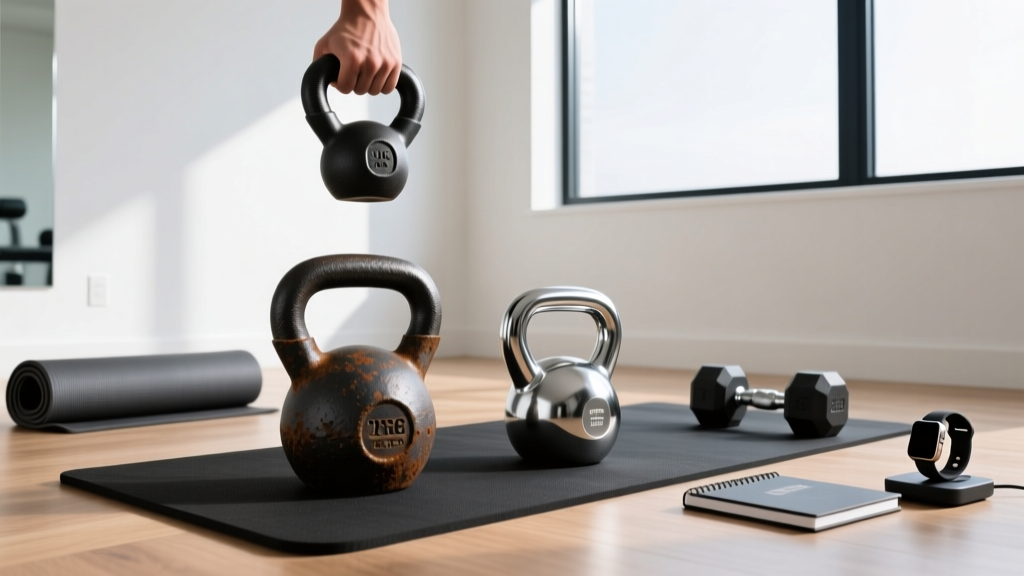
Beyond a Dumbbell Only Workout: Cast Iron vs Competition Kettlebells
Upgrade from a dumbbell only workout with our 2026 budget breakdown of cast iron vs competition kettlebells. Discover pricing, ROI, and buying frameworks.

The Dumbbell Only Workout Plateau: Why Add Kettlebells?
For years, the dumbbell only workout has been the gold standard for home gym hypertrophy and general strength. Dumbbells are versatile, space-efficient, and excellent for isolation movements. However, as your training evolves to include explosive, ballistic movements like the kettlebell swing, clean, or snatch, the biomechanical limitations of a dumbbell become glaringly obvious. A dumbbell's center of mass is fixed directly in your palm, which creates awkward wrist extension and poor force transfer during high-velocity hip hinges.
Transitioning beyond a dumbbell-centric routine requires investing in kettlebells. But as you browse the market in 2026, you will immediately face a critical purchasing decision: Cast Iron vs. Competition Steel. This is not merely an aesthetic choice; it is a profound budget and value analysis that will dictate your equipment's longevity, your joint health, and your overall return on investment (ROI).
'The geometry of the implement dictates the biomechanics of the lifter. A shifting center of mass or an inconsistent handle diameter will force the central nervous system to compensate, limiting power output.' — StrongFirst Kettlebell Instructor Guidelines
Below, we break down the exact costs, failure modes, and long-term value of both kettlebell types to help you allocate your home gym budget effectively.
Cast Iron Kettlebells: The Budget Baseline
Cast iron kettlebells are poured into molds, resulting in a solid, dense piece of metal. They are the traditional choice for garage gyms and are significantly cheaper per pound than their steel counterparts.
2026 Pricing & Value Metrics
As of early 2026, the average cost for a high-quality cast iron kettlebell ranges from $1.60 to $2.80 per pound. Brands like Rogue Fitness, Rep Fitness, and CAP Barbell dominate this space. A standard 16kg (35lb) cast iron bell will typically cost between $55 and $85, making it an accessible entry point for lifters upgrading from a dumbbell only workout.
Expert Insight: The Handle Inconsistency Problem
Because cast iron bells are molded individually, the handle diameter and the distance between the handle and the bell's 'horns' change as the weight increases. A 12kg bell might have a narrow 32mm handle, while a 32kg bell features a thick 45mm handle. This inconsistency forces your grip to adapt to every new weight, which can hinder motor learning when practicing technical lifts like the snatch.
Edge Cases & Failure Modes
- Base Wobbling: Cheaper cast iron bells often have poorly machined flat bases. If you plan to do renegade rows or goblet squats where the bell rests on the floor, a rounded or uneven base will cause dangerous wobbling.
- Coating Degradation: E-coat and enamel finishes look great on day one but can chip or wear smooth over 2-3 years of heavy chalk use, leading to rust or a slippery grip during high-rep sets.
- Floor Damage: Bare cast iron will destroy hardwood floors and crack concrete if dropped. You must factor in the cost of horse-stall mats ($60-$80 per 4x6 mat) to protect your training space.
Competition Kettlebells: The Premium Standard
Competition kettlebells are made from a hollow steel shell. The defining feature of a competition bell is that every single weight shares the exact same physical dimensions (typically 210mm wide by 280mm tall), and the handle diameter is uniformly 33mm (or 35mm for heavy-duty variants).
The Geometry of Steel
According to exercise biomechanics databases like ExRx.net, consistent implement geometry allows for perfect replication of movement patterns across different loads. When you transition from a 16kg to a 24kg competition bell, the rack position rests on your forearm in the exact same spot. The handle clears your wrist identically during a snatch. This uniformity is invaluable for preventing forearm bruising and mastering complex, multi-planar movements.
2026 Pricing & Value Metrics
Precision machining and steel tariffs have kept competition bells at a premium. Expect to pay between $5.50 and $8.50 per pound in 2026. A 16kg (35lb) competition bell from brands like Kettlebell Kings or Onnit will cost between $110 and $140. While the upfront cost is nearly double that of cast iron, the ROI manifests in injury prevention and technical mastery.
Edge Cases & Failure Modes
- Internal Chalk Impaction: The hollow 'window' inside a competition bell can trap moisture and gym chalk. Over 4 to 5 years, this mixture can cause internal rust that compromises the steel shell from the inside out. Fix: Vacuum the window monthly and store in a dry environment.
- Denting on Concrete: Unlike solid cast iron, a thin steel shell can dent if dropped directly onto bare concrete from overhead, potentially altering the bell's center of mass.
Value Analysis Matrix: Cast Iron vs. Competition
| Metric | Cast Iron | Competition Steel | Budget Winner |
|---|---|---|---|
| Price per lb | $1.60 - $2.80 | $5.50 - $8.50 | Cast Iron |
| Handle Diameter | Varies (32mm-45mm) | Uniform (33mm/35mm) | Competition |
| Dimensions | Scales with weight | Fixed (210x280mm) | Competition |
| Durability (Drops) | High (Solid core) | Moderate (Hollow shell) | Cast Iron |
| Best ROI For | Swings, Goblet Squats | Snatches, Cleans, Double Work | Depends on Goal |
The $400 Home Gym Transition Framework
If you are graduating from a dumbbell only workout and have a strict $400 budget to introduce kettlebells, do not blow it all on a single heavy competition bell. Instead, use this phased allocation strategy to maximize your training variety and protect your joints.
Step 1: Retain Your Dumbbells for Hypertrophy
Keep your existing adjustable or fixed dumbbells for strict presses, rows, and isolation work. Do not buy kettlebells for movements that dumbbells already perform perfectly (e.g., floor presses or bicep curls).
Step 2: Allocate Budget for Ballistics (The 'Swing' Bell)
Purchase a single, heavy Cast Iron Kettlebell for two-handed swings and goblet squats. Since these movements do not require the bell to rest in the 'rack' position on your forearm, the varying dimensions of cast iron do not matter. Recommended: 24kg or 28kg Cast Iron (~$50 - $75).
Step 3: Invest in Precision for Technical Lifts (The 'Snatch' Bell)
Allocate the remainder of your budget to a single Competition Steel Kettlebell in a lighter weight (12kg or 16kg). Use this exclusively for learning the snatch, clean, and single-arm presses, where handle clearance and forearm comfort are non-negotiable. Recommended: 16kg Competition (~$120 - $140).
Total Spend: ~$190 - $215. You have successfully integrated both modalities, secured the right tool for the right biomechanical demand, and kept nearly half your budget intact for future plate purchases or gym mats.Final Verdict on Long-Term ROI
The debate between cast iron and competition kettlebells is ultimately a question of training intent. If your goal is raw conditioning, heavy swings, and general fitness to supplement your dumbbell only workout, cast iron offers unbeatable financial value. However, if you intend to pursue kettlebell sport, master the snatch, or perform double-kettlebell front squats, the uniform geometry of competition steel is a mandatory investment that will save you from chronic wrist and forearm bruising. Evaluate your 12-month training roadmap, and buy the steel that matches your destination.
More gear to consider
All reviews
Loadable Dumbbell Setups for Every Biceps Exercise Using Dumbbells
EZ vs Straight Bar Maintenance & How to Work Out Lats With Dumbbells

Dumbbell Rack Layouts: Space for Seated Dumbbell Front Raises

Adjustable Dumbbell Review: Setup & The Perfect Dumbbell Rows GIF

EZ Curl vs Straight Bar Budget: The One Dumbbell Lunge Alternative
