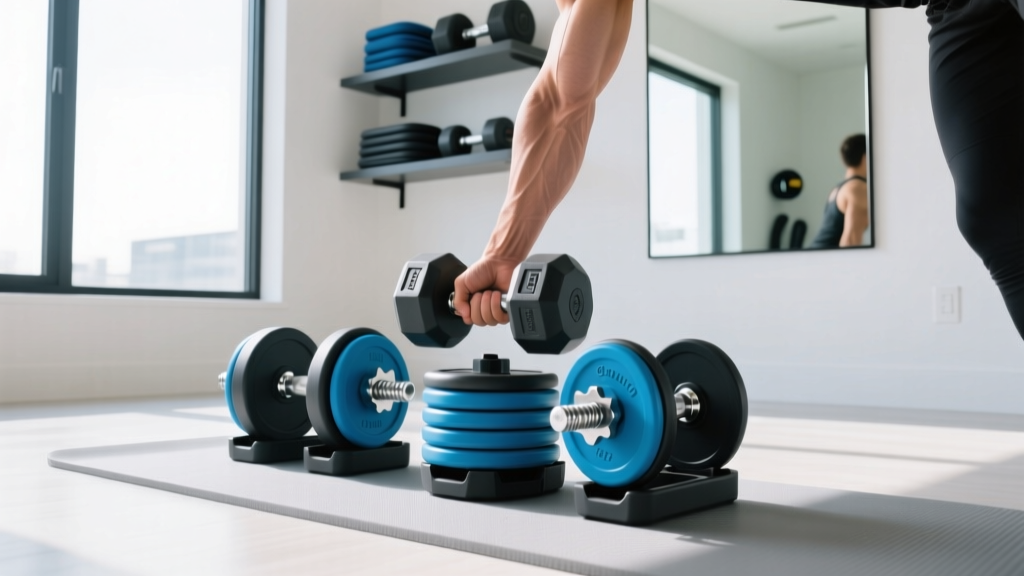
Space-Saving Loadable Dumbbells for One Arm Dumbbell Chest Press
Master your home gym layout with loadable dumbbells. Discover space-saving designs, plate geometry, and setup tips for the one arm dumbbell chest press.

As home gym design evolves in 2026, the paradigm has shifted from sprawling garage setups to high-density, micro-gym environments. Space optimization is no longer just about fitting equipment into a room; it is about engineering a layout that supports complex, multi-planar movements without spatial compromise. At the intersection of extreme space efficiency and heavy resistance training lies the loadable dumbbell with interchangeable plates. While adjustable dial dumbbells have dominated the consumer market for years, loadable handles offer unmatched durability, precise weight increments, and a vastly superior spatial footprint. But how does this equipment hold up when subjected to the rigorous biomechanical and spatial demands of unilateral training? To answer this, we use the one arm dumbbell chest press as our ultimate stress test for equipment geometry, plate selection, and layout ergonomics.
The Spatial Math: Fixed Racks vs. Interchangeable Plates
Before analyzing the biomechanics of the press, we must quantify the spatial advantage of loadable systems. A traditional set of fixed rubber hex dumbbells ranging from 5 to 50 pounds (in 5-pound increments) requires a 3-tier A-frame rack. This rack typically measures 42 inches wide by 24 inches deep, consuming roughly 7 square feet of static floor space. When you factor in the 36 inches of clearance required to safely pull and return the weights, the total operational footprint balloons to nearly 18 square feet.
Spatial Footprint Comparison
- Fixed Dumbbell Set (5-50 lbs): ~18 sq. ft. operational footprint | 550+ lbs total mass
- Loadable Handle + 200 lbs Plate Set: ~4 sq. ft. operational footprint | 210 lbs total mass
- Space Saved: 77% reduction in required floor space
By utilizing a pair of loadable handles and a vertical plate tree, you compress your entire dumbbell training arsenal into a 2-square-foot corner. This reclaimed space is critical for accommodating the wide stance and rotational clearance required for unilateral movements like the one arm dumbbell chest press, ensuring you never strike a wall or adjacent rack during a heavy set.
Biomechanics and Clearance: The Unilateral Stress Test
Why use the one arm dumbbell chest press as the benchmark for layout and equipment viability? Unilateral pressing introduces severe rotational torque and demands a massive range of motion (ROM). According to ExRx.net's biomechanical breakdown of the dumbbell bench press, the pectoralis major and anterior deltoid require a deep, unobstructed stretch at the bottom of the movement to achieve maximum muscle fiber recruitment.
When you perform this movement with a single arm, your torso naturally wants to rotate to counterbalance the load. If your home gym layout is cramped, or if your loadable dumbbell features an excessively long sleeve, the plates will physically collide with the bench pad, your torso, or the floor before your chest muscles reach full extension. This spatial interference prematurely halts the ROM, effectively robbing you of the hypertrophic benefits of the exercise. Therefore, selecting a loadable handle with optimized sleeve geometry is not just a matter of preference; it is a strict requirement for proper unilateral pressing mechanics.
Loadable Handle Specifications and Spatial Geometry
Not all loadable dumbbell handles are created equal. The overall length and sleeve depth dictate how much weight you can load and whether that weight will interfere with your bench press mechanics. Below is a comparison of the top space-optimized loadable handles available in 2026, evaluated specifically for their compatibility with deep-ROM chest pressing.
| Brand & Model | Total Length | Sleeve Length | Approx. Price | Chest Press Clearance |
|---|---|---|---|---|
| Rogue Loadable Handle | 20.5 inches | 6.5 inches | $110.00 | Excellent (Fits up to 45 lbs of slim plates) |
| Titan Fitness Loadable | 20.0 inches | 6.3 inches | $85.00 | Very Good (Slightly shorter grip) |
| Yes4All Olympic | 18.0 inches | 5.5 inches | $45.00 | Fair (Limits max loadable weight) |
For the one arm dumbbell chest press, the Rogue Loadable Dumbbell Handle is the gold standard. Its 35mm grip diameter mimics a standard Olympic barbell, reducing forearm fatigue during heavy unilateral presses, while the 6.5-inch sleeve provides enough real estate for substantial loading without extending so far that it compromises the bottom position of the press.
Plate Geometry: Diameter vs. Range of Motion
The spatial optimization of your loadable dumbbell extends beyond the handle itself; the interchangeable plates you select fundamentally alter the physical dimensions of the tool. This is where many home gym owners make a critical error that directly impacts their one arm dumbbell chest press.
The Bumper Plate Interference Problem: A standard 10-pound urethane bumper plate has a diameter of roughly 17 inches. If you are using a standard flat bench (which sits 17 inches off the floor), the bottom of the plate will physically graze the floor at the deepest point of your chest press, artificially stopping your ROM before your pectoral muscles are fully stretched.
To maintain a true, unobstructed range of motion during unilateral pressing, you must prioritize compact cast iron plates or specialized fractional steel plates. A 10-pound cast iron plate has a diameter of roughly 9 inches. This compact profile keeps the center of mass tight to the handle and ensures that even if your arm drops past parallel, the plates will never strike the floor or the bench pad. When designing your interchangeable plate collection, allocate your budget toward slim, high-density steel plates for your 5lb, 10lb, and 25lb increments to preserve your pressing geometry.
Designing the Unilateral Workflow Zone
Space optimization is not just about static storage; it is about dynamic workflow. The one arm dumbbell chest press requires frequent loading and unloading, especially if you are utilizing drop sets or pyramid schemes. If your plate storage tree is located across the room, you are forced to carry a heavily loaded, unbalanced dumbbell through a tight space, increasing the risk of dropping a plate on your foot or damaging your flooring.
The 36-Inch Radius Rule
For optimal layout design, position your vertical plate tree or wall-mounted plate rack within a 36-inch radius of the head of your bench. This specific measurement allows you to sit at the head of the bench, lean forward, and safely slide plates onto the loadable handle without standing up or twisting your spine under load.
- Anchor the Bench: Place the flat/incline bench parallel to your longest wall, leaving at least 24 inches of lateral clearance on the pressing side for your elbow and the dumbbell to drop safely during a failed rep.
- Position the Plate Tree: Place the tree directly behind the head of the bench. This creates a 'cockpit' effect where all weight management happens within arm's reach.
- Flooring Considerations: Use 3/8-inch or 1/2-inch interlocking rubber mats specifically in the loading zone to dampen the acoustic impact of sliding cast iron plates on and off the loadable sleeves.
Edge Cases and Failure Modes
Warning: Rotational Torque and Collar Slippage
The one arm dumbbell chest press generates immense rotational torque, particularly during the concentric (pressing) phase as your wrist naturally supinates. Standard spring-clip collars or cheap spin-lock collars will fail under this specific unilateral load, causing the interchangeable plates to slide outward and shift the center of gravity mid-rep. This is a severe safety hazard. You must use heavy-duty clamp collars (such as Rogue HG Collars or OSO Pro Clamps) that lock onto the sleeve with mechanical pressure, ensuring the plates remain perfectly flush against the handle base throughout the entire pressing arc.
Furthermore, be mindful of the knurling on your loadable handle. Some budget handles feature aggressive, deep knurling that extends all the way to the sleeve base. During the bottom of the one arm dumbbell chest press, your thumb and index finger can get ground against this knurling, leading to callus tearing. Look for handles with a smooth ring or 'no-knurl' gap near the sleeve junction to protect your grip during deep unilateral stretches.
Conclusion
Transitioning to a loadable dumbbell with interchangeable plates is the single most effective space-saving upgrade you can make to a micro-gym in 2026. However, true spatial optimization requires looking beyond the storage footprint and analyzing how the equipment behaves in three-dimensional space during complex movements. By selecting a handle with precise sleeve geometry, pairing it with compact cast iron plates, and engineering a tight 36-inch workflow radius around your bench, you create an environment where the one arm dumbbell chest press can be executed with perfect biomechanics, zero spatial interference, and maximum hypertrophic stimulus.
More gear to consider
All reviews
Cast Iron vs Competition Kettlebells: The Bend Over Row Dumbbell Test
Building a Custom 55 Dumbbell: Olympic vs Standard Plate Mistakes

Olympic vs Standard Plates and Glute Exercises with Dumbbells

Barbell Collar Guide: Beyond Back Workouts with Dumbbells and Bench
Best Neoprene Dumbbells for Leg Lifts With Dumbbells (2026)
