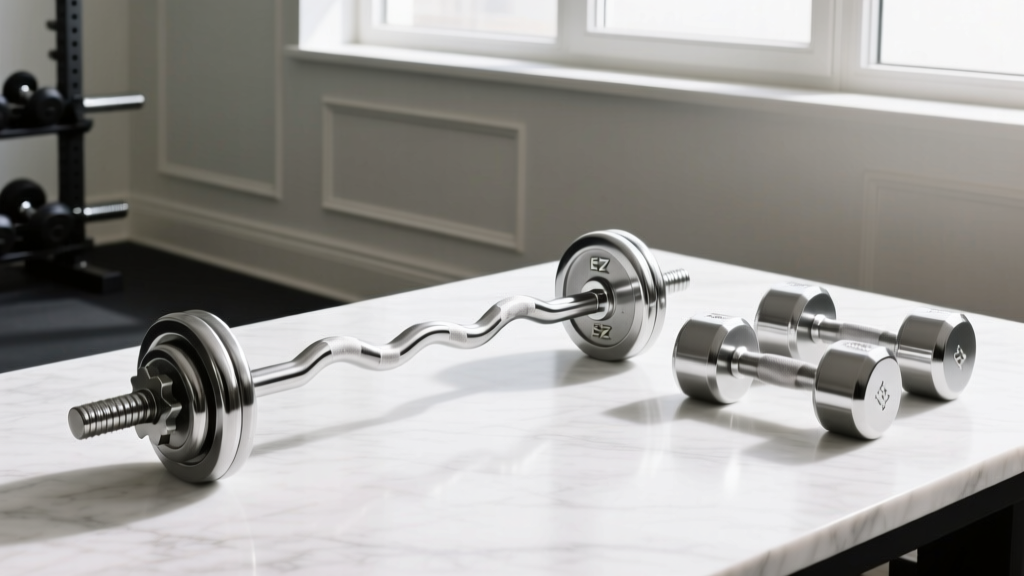
Bumper Plate vs Iron Plate: Layouts for Dumbbell Bulgarian Split
Compare bumper plate vs iron plate dimensions, storage footprints, and layout strategies to optimize space for dumbbell Bulgarian split workouts.

The Spatial Dilemma: Unilateral Movements in Compact Gyms
Designing a high-functioning home gym in 2026 requires moving beyond simple equipment checklists and focusing on dynamic spatial clearance. When programming unilateral, high-sway exercises like the dumbbell Bulgarian split squat, spatial awareness is critical. This movement demands a bench, lateral dumbbell swing room, and a safe step-back zone. However, a frequently overlooked variable in this layout equation is the type of weight plates stored on your adjacent barbell or rack.
The debate between bumper plates and cast iron plates is usually framed around noise reduction or Olympic lifting safety. But from a space optimization and layout design perspective, the dimensional differences between these two plate types dictate your gym's traffic flow, storage footprint, and safety clearances. If your power rack is positioned adjacent to your split squat zone, the diameter and thickness of your plates will directly impact your usable floor space.
Bumper Plate vs Iron Plate: The Dimensional Matrix
To understand how plates affect your layout, we must first look at the raw dimensional data. Bumper plates are manufactured to the International Weightlifting Federation (IWF) standard of 450mm (17.7 inches) in diameter, regardless of weight. Iron plates, conversely, scale in diameter as weight increases.
| Plate Weight | Bumper Diameter (Rogue Echo) | Bumper Thickness | Iron Diameter (Rogue Deep Dish) | Iron Thickness |
|---|---|---|---|---|
| 10 lbs | 17.7" (450mm) | 2.15" | 9.0" | 0.9" |
| 25 lbs | 17.7" (450mm) | 2.75" | 12.0" | 1.1" |
| 45 lbs | 17.7" (450mm) | 3.25" | 14.5" | 1.3" |
The 450mm Uniformity Problem (Bumpers)
The uniform diameter of bumper plates is excellent for barbell mechanics but terrible for tight spatial layouts. If you are warming up for a dumbbell Bulgarian split squat with a barbell loaded with 10lb or 25lb bumper plates resting on the floor or on low J-cups, those plates still extend 8.85 inches above the ground at their center, and 17.7 inches vertically. This creates a massive physical and visual barrier in compact rooms.
The Tapered Advantage (Iron)
Cast iron plates offer a tapered profile. A 10lb iron plate sits just 4.5 inches off the ground. When designing a multi-use zone where a barbell might be parked on the floor while you perform split squats nearby, iron plates drastically reduce the risk of your trailing foot or hanging dumbbells clipping the weight stack during the descent phase of the movement.
Designing the Dumbbell Bulgarian Split Zone
When mapping out the floor plan for your split squat station, you must calculate the 'sway envelope'—the three-dimensional space your body and the dumbbells occupy during the eccentric and concentric phases of the lift.
Clearance Math: The Sway Envelope
According to biomechanical analysis of unilateral loading, a lifter holding 50-100lb dumbbells will experience a lateral sway of up to 6-10 inches per side to maintain balance.
- Base Bench Width: 12 inches
- Lifter Stance Width: 18 inches
- Lateral Sway Buffer: 10 inches (each side)
- Minimum Required Width: 60 inches (5 feet) of unobstructed lateral space.
If your power rack is loaded with 45lb bumper plates (adding ~17.7" of overhang per side to a standard 49" wide rack), your total rack footprint is 84.4". Placing your split squat bench adjacent to this requires a minimum of 144.4" (12 feet) of total wall-to-wall width to maintain safe clearances.
Storage Footprints and Rack Overhang
Space optimization isn't just about the floor space where you lift; it's about where you store the gear when you aren't using it. The choice between bumpers and iron dictates your storage infrastructure.
Vertical Plate Trees vs. Horizontal Wall Racks
Iron plates are easily stored on vertical A-frame plate trees. A standard 6-peg vertical tree has a footprint of roughly 24" x 24" (4 square feet). Because iron plates are thin, you can stack multiple 45s on a single peg without exceeding the sleeve length.
Bumper plates, due to their thickness (a pair of 45lb Rogue Echo bumpers is 6.5" thick), quickly overwhelm vertical trees. Most home gym owners are forced to use horizontal wall-mounted plate racks or massive 3-tier horizontal cradles. A wall-mounted rack protrudes 10-14 inches from the wall and spans 40+ inches horizontally. In a garage gym where the wall is shared with a vehicle parking zone, this protrusion can severely limit where you can safely place your split squat bench without risking a dumbbell strike against the wall.
Real-World Pricing and 2026 Market Analysis
When allocating budget for space-optimized gear, consider the cost-per-square-foot of your storage solutions alongside the plate cost.
- Rogue Echo Bumper Plates: ~$375 per 45lb pair. Requires robust horizontal storage (approx. $150-$250 for a heavy-duty wall mount).
- Rogue Deep Dish Iron Plates: ~$315 per 45lb pair. Can be stored on a compact vertical tree (approx. $65-$90).
- Rep Fitness Urethane Grip Plates (Hybrid): ~$399 per 45lb pair. These feature a 12-sided urethane coating with a tapered profile closer to iron, offering a middle-ground for tight layouts while protecting floors.
"In facilities under 200 square feet, the uniform diameter of bumper plates creates 'dead zones' in the lower visual and physical field. Transitioning to calibrated steel or tapered iron for accessory work zones can recover up to 15% of usable floor space."
— 2025 Home Gym Ergonomics & Layout Report
Step-by-Step Layout Guide for the Split Squat Zone
If you are committed to using bumper plates but need to integrate a dumbbell Bulgarian split squat zone, follow this layout protocol to maximize safety and space:
- Anchor the Rack to the Wall: Eliminate the rear overhang by bolting your rack directly to the wall using a stringer system. This immediately saves 17.7 inches of depth.
- Establish the Drop Zone: Bumper plates are designed to be dropped. Outline a 4' x 6' drop zone in front of the rack using horse stall mats. Never place your split squat bench inside or overlapping this drop zone.
- Position the Bench Perpendicularly: Instead of placing the bench parallel to the barbell (which risks the trailing foot hitting the 17.7" plates), place the bench perpendicular to the rack, extending outward into the room's center.
- Utilize Low-Profile Dumbbells: To further optimize the vertical sway envelope, use urethane-coated hex dumbbells rather than round-headed ones, allowing you to set them on the floor tightly against the bench legs when not in use.
Final Verdict: Which Plate Wins the Space Game?
If your primary training modality is Olympic weightlifting or CrossFit, the bumper plate is non-negotiable despite its spatial demands. However, if your gym is a hypertrophy and general strength facility under 150 square feet, and you frequently perform high-clearance unilateral movements like the dumbbell Bulgarian split squat, cast iron plates are the superior choice for space optimization. Their tapered profile, compatibility with compact vertical storage trees, and reduced floor-level overhang allow you to pack more functional training zones into a tighter footprint without compromising safety or movement mechanics.
More gear to consider
All reviews
2026 Trends: Bumper vs Iron Plates & Dumbbell Quadriceps Exercises

Barbell Collar Comparison & Dumbbell Silicone Coatings

Cast Iron vs Competition Kettlebells & MX55 Dumbbells Guide

Olympic Barbell Guide: Weight, Knurling & the Dumbbell Plank Row GIF
Best Racks for Your Dumbbell Only Workout Routine in 2026