
Dumbbell Fly Standing Variations: 2026 Loadable Market Trends
Analyze 2026 market trends for loadable dumbbells and how interchangeable plates optimize dumbbell fly standing variations for home gyms.

The Biomechanical Bottleneck of Dumbbell Fly Standing Variations
As the home fitness equipment market matures in 2026, a distinct shift is occurring among advanced lifters and physical therapy professionals: the migration away from fixed-weight urethane dumbbell sets toward loadable dumbbell handles with interchangeable plates. While adjustable dial dumbbells dominate the casual market, loadable plate systems are capturing the serious hypertrophy and rehabilitation demographics. This trend is heavily driven by the biomechanical demands of isolation movements, specifically dumbbell fly standing variations.
Unlike bench-supported chest flies, standing variations—such as the standing anterior fly, standing rear deltoid fly, and standing cross-body adductor fly—remove the stabilizing support of a bench. According to the biomechanical breakdowns provided by ExRx.net, the standing position requires significant isometric contraction of the core, glutes, and erector spinae to prevent lumbar hyperextension. Because the central nervous system is dividing resources between prime mover activation and postural stabilization, the absolute load a lifter can strictly press or fly is significantly lower than in seated or supine positions.
Expert Insight: In standing dumbbell fly variations, the limiting factor is rarely the pectoralis major or posterior deltoid. It is grip endurance and core stabilization. Loadable handles allow for precise micro-loading, preventing the nervous system from being overwhelmed by aggressive weight jumps.The '5-Pound Jump' Problem in Isolation Movements
The primary catalyst for the 2026 surge in loadable dumbbell sales is the mathematical failure of fixed-weight dumbbells in isolation exercises. Standard commercial dumbbell sets increment in 5-pound jumps. For a compound movement like a goblet squat, jumping from 30 lbs to 35 lbs is a manageable 16% increase. However, for a standing rear deltoid fly, a lifter might max out strict form at 12.5 lbs per hand. The next available fixed dumbbell is 15 lbs—a 20% load increase.
The National Strength and Conditioning Association (NSCA) guidelines recommend load increments of 2.5% to 5% for upper-body isolation exercises to ensure continuous progressive overload without compromising joint integrity. A 20% jump forces the lifter to utilize momentum, shifting the tension away from the target muscle and onto the anterior deltoid and lower back. Loadable dumbbell handles paired with fractional plates (0.5 lb, 0.75 lb, and 1.25 lb) solve this bottleneck, allowing for exact adherence to progressive overload principles.
2026 Market Analysis: Loadable Handles vs. Fixed Sets
From a consumer spending perspective, the economic argument for loadable dumbbells has never been stronger. In 2026, premium urethane fixed dumbbells average $3.50 to $5.00 per pound. Building a set from 10 lbs to 50 lbs requires a capital expenditure exceeding $1,200. Conversely, a pair of high-quality Olympic loadable handles paired with machined steel plates costs roughly $250 for the exact same weight range, with the added benefit of infinite micro-loading.
Hardware Matrix: Top Loadable Dumbbells for Fly Variations
Not all loadable handles are created equal. When executing dumbbell fly standing variations, the sleeve length, knurling depth, and overall balance of the handle dictate the quality of the movement. Below is a market comparison of the top loadable handles in 2026:
| Brand / Model | Sleeve Diameter | Handle Length | Knurl Profile | 2026 Retail Price |
|---|---|---|---|---|
| Rogue Loadable Dumbbell Handles | 2-inch (Olympic) | 16.5 inches | Deep / Aggressive | $85.00 / pair |
| Titan Fitness Loadable Handles | 2-inch (Olympic) | 14.0 inches | Medium / Volcano | $59.99 / pair |
| CAP Barbell 14' Solid Steel | 1-inch (Standard) | 14.0 inches | Shallow / Smooth | $35.99 / pair |
Note: For standing fly variations, the 14-inch handles (Titan and CAP) are generally preferred over the 16.5-inch Rogue handles. Longer sleeves push the center of mass further away from the wrist, increasing torque on the radiocarpal joint during the bottom stretch of a standing chest fly.
Plate Profile: How Interchangeable Plates Alter Range of Motion
A critical, often overlooked variable in the loadable dumbbell market is the physical profile of the interchangeable plates. When performing dumbbell fly standing variations, the width of the plate directly impacts the achievable range of motion (ROM).
- Bumper Plates (Rubber): A standard 10 lb bumper plate is roughly 4.5 inches thick. During a standing rear deltoid fly, if the lifter attempts to achieve a deep stretch across the anterior torso, the thick bumper plates will physically collide with the ribcage or torso before the muscle reaches its maximum lengthened position.
- Machined Steel / Cast Iron Plates: A 10 lb machined steel plate is typically under 1.2 inches thick. This slim profile allows the lifter to achieve a full, unobstructed stretch at the bottom of the fly, maximizing sarcomere lengthening and hypertrophic stimulus.
- Fractional Plate Integration: The true value of loadable handles shines when using 0.5 lb steel fractional plates. These plates are paper-thin, allowing for ultra-precise loading without adding any meaningful bulk to the dumbbell head.
Execution Guide: 3 Standing Fly Variations Optimized for Loadable Handles
To fully leverage the micro-loading capabilities of loadable dumbbells, incorporate these three standing variations into your 2026 training macrocycle:
1. The Standing Anterior Chest Fly (Cable Crossover Mimicry)
By hinging slightly at the hips and maintaining a neutral spine, the lifter performs a standard chest fly. The loadable handle allows the lifter to start at a highly conservative weight (e.g., 11.5 lbs per hand) to master the pelvic stabilization required. As core endurance improves, 0.5 lb plates can be added weekly without disrupting the movement pattern.
2. The Standing Hinge Rear Delt Fly
Targeting the posterior deltoid and rhomboids, this variation requires a deep hip hinge (torso nearly parallel to the floor). Because the lower back is under immense isometric stress, grip fatigue sets in rapidly. Loadable handles with medium volcano knurling (like the Titan Fitness model) provide adequate grip security without tearing the calluses, which is a common issue with aggressively knurled Olympic bars.
3. The Standing Cross-Body Adductor Fly
Holding the loadable dumbbells with a neutral grip, the lifter sweeps the weight across the midline of the body, targeting the pectoralis major's sternal heads and the anterior deltoid. The slim profile of steel interchangeable plates prevents the dumbbells from clanking together prematurely at the top of the concentric phase, ensuring constant tension on the muscle.
Future Forecast: The Hybrid Home Gym Standard
Market data indicates that by the end of 2026, the 'hybrid' home gym—featuring a power rack, a barbell, and a set of loadable dumbbell handles with a comprehensive fractional plate set—will overtake the traditional fixed-dumbbell rack in new consumer purchases. The versatility of interchangeable plates, combined with the strict loading requirements of advanced isolation movements like dumbbell fly standing variations, makes loadable systems the undisputed choice for lifters prioritizing joint health, precise progressive overload, and long-term economic efficiency.
More gear to consider
All reviews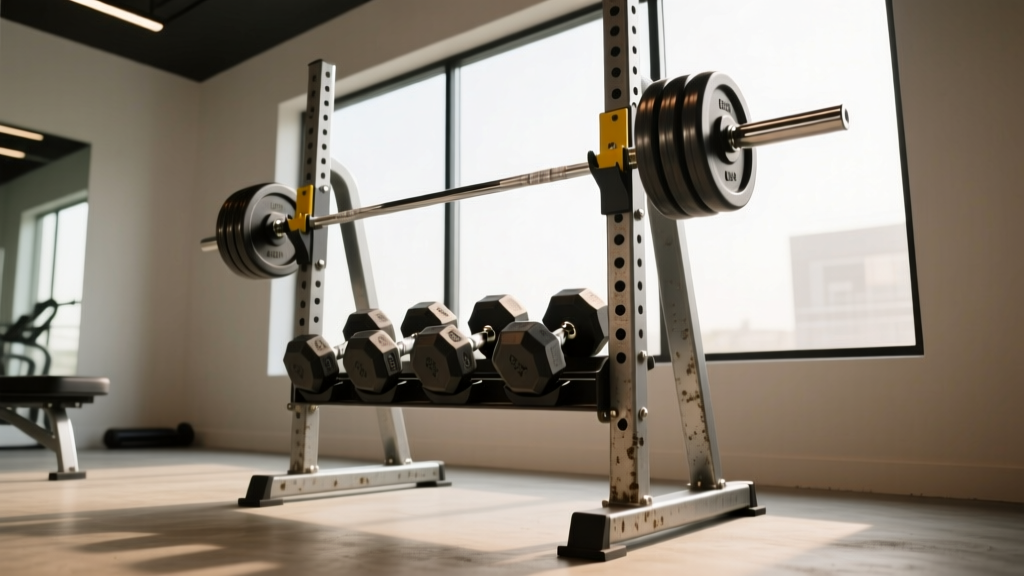
Dumbbell Rack Care for Heavy Compound Movements with Dumbbells
Rubber Hex vs Urethane: Best 110 lb Dumbbells for Home Gyms

Budget Dumbbell Racks for the Dumbbell Romanian Dead Lift (2026)

Power Rack vs Squat Stand: Back Workouts with Dumbbells at Home

One Arm Dumbbell Row: Complete Neoprene Setup Guide
