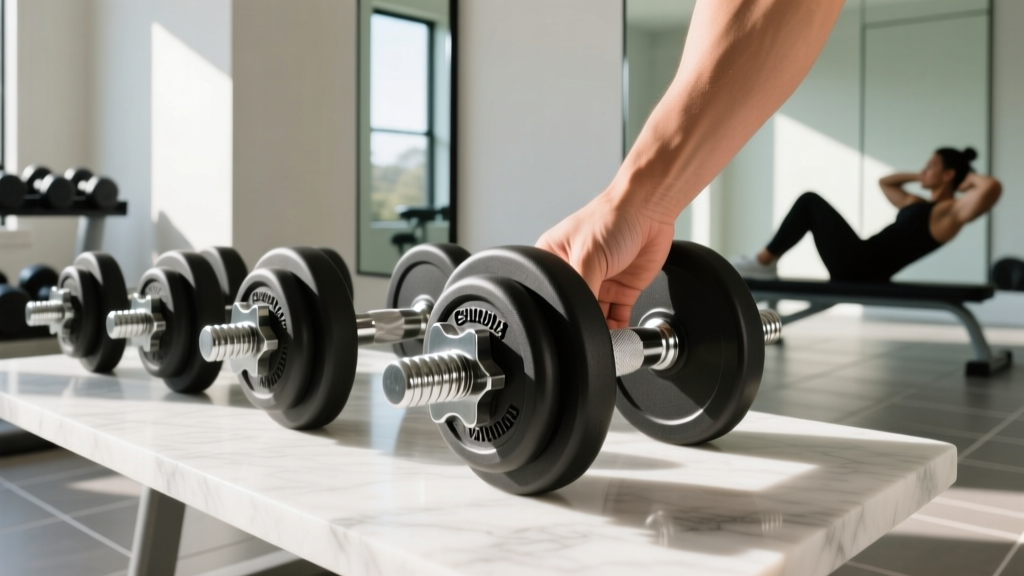
Maintaining Loadable Dumbbells for a Safe Dumbbell Workout for Abdomen
Master loadable dumbbell maintenance to ensure collar security and grip integrity during your next dumbbell workout for abdomen and core training.

The Hidden Equipment Risks of Core Training
When most lifters think about equipment failure, they imagine a snapped barbell during a heavy back squat or a torn resistance band. Rarely do they consider the humble loadable dumbbell. Yet, if you are programming a heavy dumbbell workout for abdomen development, your equipment is subjected to unique, multi-directional shear forces that can compromise poorly maintained collars and handles.
Loadable dumbbells with interchangeable plates—ranging from traditional spin-lock handles to advanced quick-lock systems like the Ironmaster Quick-Lock—are incredibly versatile. They allow for precise micro-loading, which is essential for progressively overloading the rectus abdominis and obliques. However, neglected maintenance can turn a routine core session into a dangerous liability. A loose collar during an overhead extension or a slippery, chalk-caked handle during a rotational twist can lead to severe injury or damaged flooring.
⚠️ Safety Callout: According to core stability research highlighted by the Mayo Clinic, proper form and controlled movements are the bedrock of effective abdominal training. Equipment instability caused by poor maintenance directly undermines this control, forcing stabilizing muscles to compensate for shifting weights rather than targeting the core.Biomechanics of Ab Workouts: Why Collars Take a Beating
To understand why maintenance is critical, we must look at how a dumbbell workout for abdomen targets the core. Unlike a standard bicep curl or chest press where the dumbbell moves in a predictable, linear sagittal plane, core training involves rotational torque, lateral flexion, and extreme leverage shifts.
The 3 Primary Stressors on Loadable Handles
- Rotational Torque: Exercises like Weighted Russian Twists or Dumbbell Windmills apply lateral twisting forces to the dumbbell sleeve. On traditional spin-lock collars, this torque mimics the exact motion required to unscrew the collar.
- Gravitational Shear: Movements like the Dumbbell Pullover or Overhead Core Extensions place the plates in a vertical alignment where gravity is actively pulling them away from the handle shoulder, testing the locking mechanism's tensile strength.
- Grip Degradation: Core workouts often involve high-rep, time-under-tension holds (e.g., Goblet Squat holds or weighted plank pull-throughs). Sweat and chalk rapidly pack into the knurling, creating a slick, abrasive surface that compromises grip security.
Anatomy of Failure: Spin-Lock vs. Quick-Lock Systems
Not all loadable dumbbells are built the same, and their maintenance protocols differ based on their locking mechanisms. The market is currently dominated by two primary designs:
| Feature | Traditional Spin-Lock (e.g., Rogue Loadable) | Quick-Lock / Drop-In Pin (e.g., Ironmaster) |
|---|---|---|
| Mechanism | Threaded sleeve with screw-on star collars | Smooth sleeve with drop-in threaded screw pin |
| Primary Failure Mode | Cross-threading, chalk-clogged threads, vibrational loosening | Stripped pin threads, metal shavings in the locking hole |
| Maintenance Focus | Thread cleaning and lubrication | Pin inspection and hole clearing |
| Average 2026 Cost (Pair) | $95 - $130 | $399 - $450 |
The 2026 Ultimate Loadable Dumbbell Maintenance Protocol
To ensure your equipment survives the rigors of heavy core training, implement this strict maintenance schedule. This protocol applies to Olympic-style loadable handles (like the Rogue Loadable Dumbbell Handles) as well as standard 1-inch threaded variants.
Weekly: The Chalk & Sweat Purge
After every heavy core session, your knurling is likely packed with a mixture of magnesium carbonate (chalk) and sweat. This mixture turns into a mildly acidic paste that accelerates oxidation.
- Tool: Stiff nylon brush (never use a stainless steel wire brush, as it will strip the protective zinc or black oxide finish off the handle).
- Action: Scrub the knurling in multiple directions to dislodge chalk. Wipe down the sleeves and collars with a dry microfiber cloth.
Monthly: Deep Clean & Lubrication
Once a month, or after roughly 12 core-focused sessions, perform a deep restoration.
- Disassemble: Remove all plates and completely unscrew the spin-lock collars.
- Thread Cleaning: Use a brass wire brush specifically on the threaded portions of the sleeve. Brass is softer than steel and will clean the threads without damaging the finish.
- Degrease: Spray a light mist of isopropyl alcohol (70% or higher) onto the threads and wipe away dissolved oils and microscopic metal shavings.
- Lubricate: Apply 3 to 4 drops of 3-IN-ONE Multi-Purpose Oil or food-grade mineral oil to the threads. Screw the collar on and off three times to distribute the oil evenly.
🚫 The WD-40 Warning: Never use standard WD-40 on your dumbbell threads or knurling. WD-40 is a solvent and water displacer, not a long-term lubricant. It leaves a sticky residue that acts as a magnet for chalk dust, eventually creating an abrasive grinding paste that will permanently ruin your threads.
Annually: Structural Integrity Check
Inspect the sleeve welds (where the sleeve meets the handle shaft). Look for hairline fractures or signs of rust weeping from the joint. If you are using quick-lock systems, inspect the drop-in pins for any bending or thread deformation. Replace pins immediately if they show resistance when screwing in by hand.
Executing a Safe Dumbbell Workout for Abdomen
With your equipment properly maintained, you can safely execute advanced core movements. Here is how to pair specific abdominal exercises with pre-workout equipment checks to guarantee safety.
1. The Heavy Dumbbell Pullover
Target: Rectus abdominis (eccentric stretch), serratus anterior, and lats.
Equipment Stress: Extreme gravitational shear. The dumbbell is suspended directly over your face and torso.
Pre-Workout Check: Perform the "Shake Test." Hold the dumbbell at arm's length and shake it vigorously. If you hear any clicking or feel the plates shift, the collars are under-tightened. For spin-locks, ensure the collar is tightened until it physically binds against the plate, then give it one more quarter-turn.
2. Weighted Russian Twists
Target: Internal and external obliques, rotational core stability.
Equipment Stress: High rotational torque and momentum.
Pre-Workout Check: Inspect the knurling. Core twists require a secure, non-slip grip even when your hands are sweaty. If the handle feels slick, your weekly nylon brush cleaning was insufficient. Wipe the handle with a damp cloth and dry it completely before starting your set.
3. Goblet Hold V-Ups
Target: Lower abs, hip flexors, and deep core stabilizers.
Equipment Stress: Sustained isometric grip demand and potential impact if the dumbbell is dropped on the floor during fatigue.
Pre-Workout Check: Check the sleeve shoulders. If you are using bumper plates on your loadable handles, ensure the inner steel ring of the bumper plate isn't warped, which can prevent the collar from seating flush against the plate, leaving a dangerous 2mm gap that allows for momentum-based shifting.
Frequently Asked Questions
Can I use rubber-coated plates on loadable dumbbell handles?
Yes, but be aware that cheap rubber plates often have inconsistent center hole diameters. A slightly oversized hole on a rubber plate will cause it to wobble on the sleeve, creating a distracting noise and uneven weight distribution during delicate core isolation movements. Always pair high-quality loadable handles with calibrated steel or high-density urethane plates for the best fit.
How tight should I make the spin-lock collars for core workouts?
Hand-tightening is rarely enough for dynamic core workouts. Use a specialized dumbbell collar wrench or a rubber mallet to gently tap the star collar into a fully locked position. This prevents the rotational torque of exercises like woodchoppers from vibrating the collar loose mid-set.
Is it necessary to oil the smooth sleeve of an Olympic loadable handle?
No. The smooth portion of the sleeve where the plates slide should remain completely dry and free of oil. Lubricating the sleeve will cause plates to slide off too easily when the dumbbell is tilted during exercises like the dumbbell pullover. Only lubricate the threaded sections and the bushing/bearing (if your handle features internal bronze bushings for sleeve rotation).
More gear to consider
All reviews
Space Layout for a Dumbbell Circuit Routine: Rubber Hex vs Urethane

Rubber Hex vs Urethane: Best Picks for Light Dumbbell Shoulder Press

Power vs Squat Stand: What Weight Dumbbells Should I Use Female

Men's Health Dumbbell Workout Setup: Rack & Storage Budget Guide 2026
Olympic vs Standard Plates for the Dumbbell Single Leg Calf Raise
