
Bumper vs Iron Plates & Back Arms Workout with Dumbbells
Compare bumper vs iron plates for your 2026 home gym budget, then maximize savings with a targeted back arms workout with dumbbells.

The Home Gym Budget Dilemma: Plate Selection and Capital Allocation
Building a comprehensive home gym in 2026 requires ruthless financial prioritization. While the free weights market has seen price stabilization over the last two years, the debate between outfitting your barbell with bumper plates versus traditional cast iron remains a primary budget bottleneck. The choice is rarely just about aesthetics or noise; it is a fundamental decision about cost-per-pound, equipment longevity, and how much capital you have left over for isolation movements.
Many lifters blow their entire free-weights budget on premium virgin rubber bumper plates, leaving them with cheap, fixed-weight dumbbells that limit their hypertrophy potential. This guide breaks down the exact financial and functional differences between bumper and iron plates, and demonstrates how reallocating your savings can fund a premium adjustable dumbbell set to execute a highly effective back arms workout with dumbbells.
Cost-Per-Pound Analysis: Bumper vs. Iron Plates
To understand the value proposition, we must look at the raw material costs and manufacturing processes. According to baseline pricing from Rogue Fitness and broader market averages in 2026, the price gap between iron and rubber is substantial.
| Plate Type | Avg Cost Per Lb | Drop Rating | Noise & Floor Impact |
|---|---|---|---|
| Machined Cast Iron | $1.40 - $1.90 | Low (No drops) | High noise, requires mats |
| Crumb Rubber Bumper | $2.00 - $2.60 | Medium | Medium noise, dead bounce |
| Virgin Rubber Bumper | $2.80 - $4.50 | High (10k+ drops) | Low noise, lively bounce |
The Hidden Costs of Bumper Plates
Virgin rubber bumpers are manufactured to International Weightlifting Federation (IWF) standards, meaning a 45lb plate has a diameter of 450mm (17.7 inches) and a Shore A durometer rating of 85-90. This ensures a consistent, predictable bounce. However, you are paying a premium for the vulcanization process and the steel hub inserts. Furthermore, 10lb and 15lb bumper plates are notorious failure points; dropping a barbell loaded only with light bumpers will bend the steel inserts and warp the rubber, rendering them useless.
The Unbeatable Value of Machined Iron
Machined iron plates, such as the Rep Fitness Equalizer or Rogue Deep Dish lines, offer a vastly superior cost-to-durability ratio for lifters who do not perform Olympic lifts (snatches, clean and jerks). A 255lb set of machined iron plates typically costs around $380 to $450. The exact same weight in virgin rubber bumpers will cost between $700 and $950. That is a minimum difference of $300 to $500—capital that is better spent elsewhere in your training ecosystem.
Budget Reallocation Strategy
By choosing machined iron plates for your heavy barbell deadlifts, squats, and bent-over rows, you save roughly $400 on a standard gym loadout. This exact capital should be reallocated toward a premium adjustable dumbbell set—like the Nuobell 80s ($429) or PowerBlock Elite EXP ($369)—to unlock unilateral isolation work that a barbell simply cannot provide.
Maximizing Your Investment: The Back Arms Workout with Dumbbells
Once you have secured your barbell plates and acquired a high-quality adjustable dumbbell set, it is time to target the musculature that barbells often neglect. The National Strength and Conditioning Association (NSCA) emphasizes that unilateral dumbbell training corrects muscular imbalances and allows for a greater range of motion, which is critical for hypertrophy in the lats, biceps, and triceps.
Below is a specialized back arms workout with dumbbells designed to maximize mechanical tension and metabolic stress. Perform this routine twice a week, ensuring 48 hours of recovery between sessions.
1. Chest-Supported Dumbbell Row (Target: Mid-Back, Rhomboids)
Barbell rows often invite momentum and lower-back fatigue. By using an incline bench set to 30 degrees and performing chest-supported rows, you isolate the latissimus dorsi and rhomboids completely.
- Sets/Reps: 4 sets of 8-10 reps
- Tempo: 3-1-1-0 (3-second eccentric lowering, 1-second pause at the stretch, 1-second concentric pull)
- Execution: Keep your chest glued to the pad. Pull the dumbbells toward your hips, not your armpits, to engage the lower lats. Squeeze the shoulder blades together at the top.
2. Single-Arm Dumbbell Pullover (Target: Lats, Serratus Anterior)
The pullover is one of the few exercises that trains the lats through a deep, loaded stretch without involving the biceps, allowing for pure back isolation.
- Sets/Reps: 3 sets of 12-15 reps per arm
- Tempo: 2-2-1-0
- Execution: Lie perpendicular across a flat bench. Hold a single dumbbell by the inner plate. Lower it slowly behind your head until you feel a deep lat stretch, then pull back to the starting position using only your lats.
3. Incline Dumbbell Curl (Target: Long Head of the Biceps)
According to biomechanical analyses cited by the American Council on Exercise (ACE), placing the shoulder in extension (behind the torso) maximizes the stretch on the long head of the biceps, leading to superior hypertrophic signaling.
- Sets/Reps: 3 sets of 10-12 reps
- Tempo: 3-0-1-1 (1-second peak contraction squeeze)
- Execution: Set a bench to 45 degrees. Let your arms hang straight down with a supinated (palms up) grip. Curl the weight without letting your elbows drift forward.
4. Cross-Body Dumbbell Hammer Curl (Target: Brachialis, Brachioradialis)
To build thick, 3D arms, you must target the brachialis, the muscle that sits underneath the biceps and pushes them upward.
- Sets/Reps: 3 sets of 12 reps per arm
- Execution: Use a neutral grip (palms facing each other). Curl the dumbbell across your torso toward the opposite shoulder. This angle heavily recruits the forearm extensors and the brachialis.
5. Overhead Dumbbell Triceps Extension (Target: Long Head of the Triceps)
The triceps make up two-thirds of your arm mass, and the long head is only fully activated when the arm is raised overhead.
- Sets/Reps: 4 sets of 10-12 reps
- Execution: Sit on a bench with back support. Hold a single heavy dumbbell with both hands overhead. Lower it behind your head by bending only at the elbows, then extend to lockout.
Long-Term Depreciation and Maintenance
When evaluating the budget breakdown of your free weights, you must factor in long-term maintenance and depreciation. Iron plates are virtually indestructible regarding structural integrity, but they are highly susceptible to oxidation. If your gym is in an unclimate-controlled garage with high humidity, bare cast iron will rust within months. You must either purchase enameled/coated iron plates or commit to wiping them down and applying a light coat of 3-in-One oil annually.
Conversely, bumper plates do not rust, but they suffer from environmental degradation. UV exposure from sunlight will cause virgin rubber to dry rot, crack, and fade. Furthermore, storing bumpers in freezing temperatures can alter the durometer rating, making the rubber brittle and prone to shattering upon impact. If you choose bumpers, they must be stored indoors on a vertical plate tree to prevent the steel inserts from warping under the weight of the rubber.
Final Verdict: Build a Balanced Arsenal
The most common mistake home gym owners make is over-indexing on barbell equipment at the expense of dumbbell versatility. Unless you are a competitive Olympic weightlifter or run a CrossFit affiliate where dropping barbells from overhead is a daily occurrence, machined iron plates offer the undeniable financial advantage. By absorbing the noise with a simple $60 horse-stall mat from a farm supply store, you can safely deadlift and row with iron, saving hundreds of dollars.
Reinvest those savings into a high-end adjustable dumbbell set. This strategic budget breakdown not only secures your heavy compound lifts but fully funds a comprehensive back arms workout with dumbbells, ensuring no muscle group is left behind in your 2026 training cycle.
More gear to consider
All reviews
Olympic vs Standard Weight Plates & Dumbbells for Hands
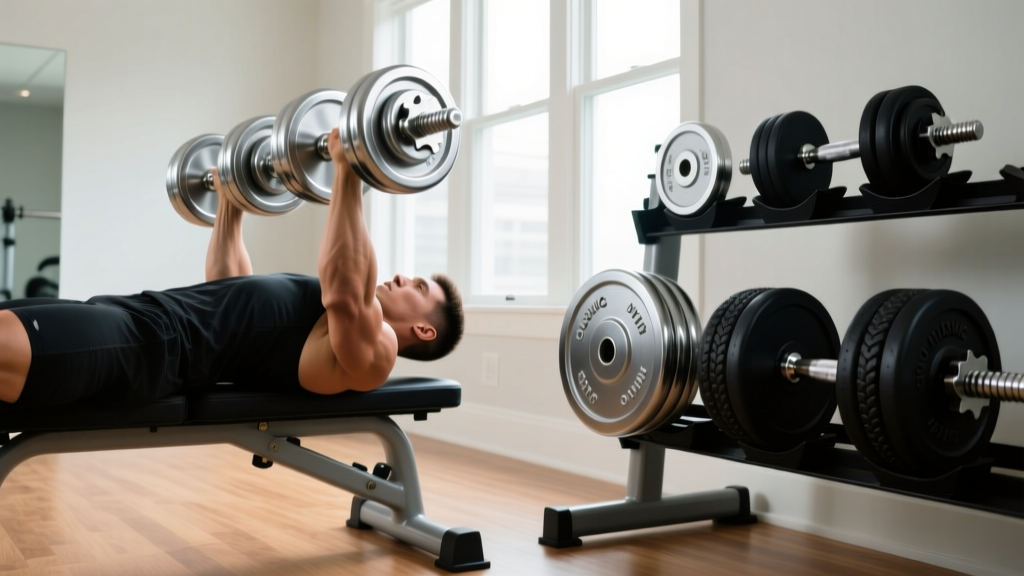
Olympic vs Standard Plates: Guide to Back Extensions with Dumbbells

The Best 70 lb Dumbbell for Beginners: 2026 Adjustable Guide
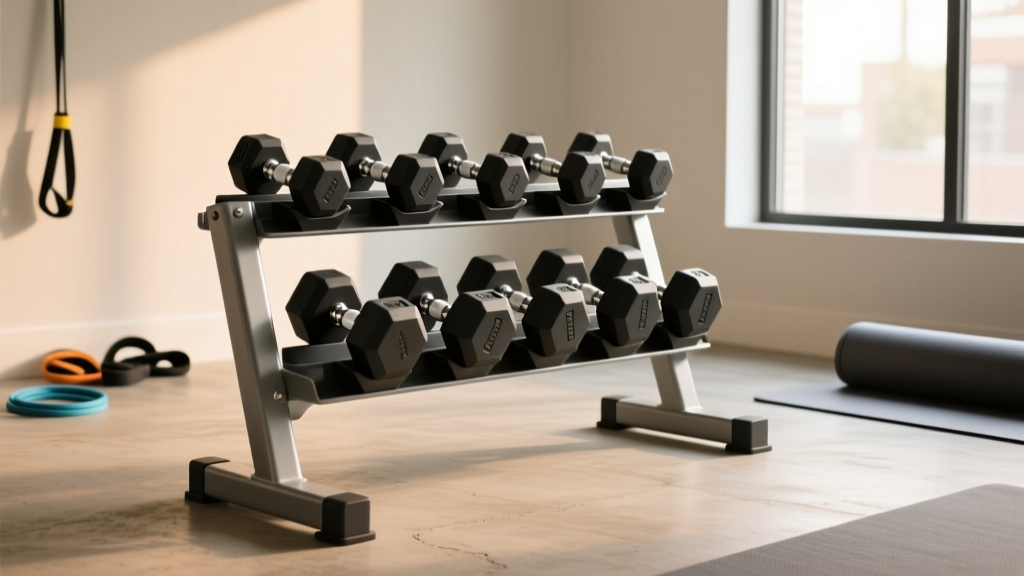
Are Dumbbell Flys Good? Budget Dumbbell Racks & Storage Analysis

Power Rack vs Squat Rack vs Squat Stand: Tricep Bench Dumbbell Fit
