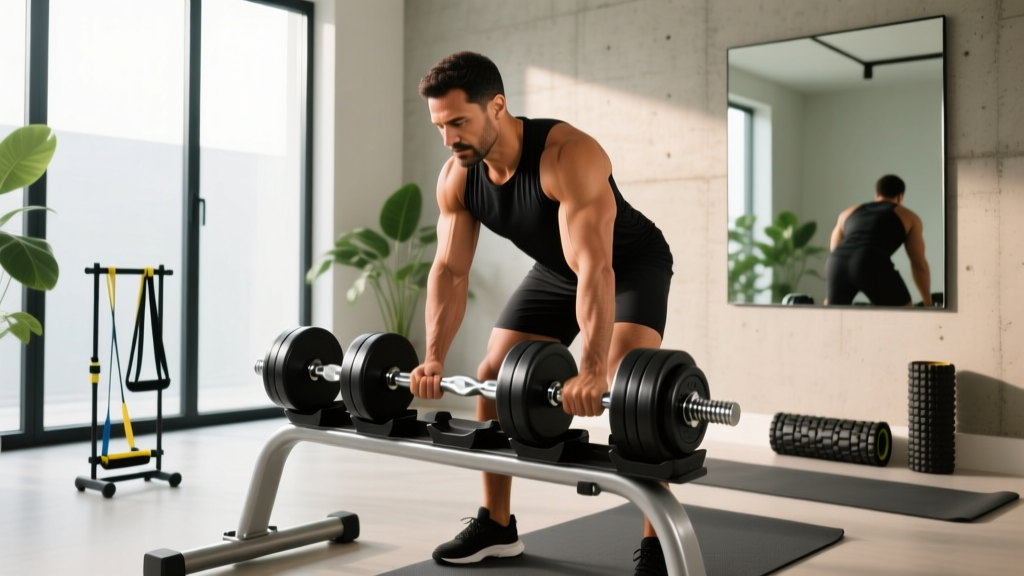
Loadable Dumbbell Only Chest Workout: Budget Breakdown & Value Analysis
Discover how to build a loadable dumbbell only chest workout on a budget. We break down gear costs, plate diameter edge cases, and value analysis.

The Economics of the Loadable Dumbbell Only Chest Workout
When outfitting a home gym for serious hypertrophy, the chest is one of the most equipment-demanding muscle groups. While fixed rubber hex dumbbells and premium adjustable sets (like Nuobell or Bowflex) dominate the market, they come with a steep financial barrier to entry. As we analyze the 2026 fitness equipment market, a highly effective, often overlooked alternative emerges: loadable dumbbell handles with interchangeable Olympic plates.
Executing a strict dumbbell only chest workout using loadable handles offers unparalleled cost-per-pound value, infinite micro-progression, and a rugged durability that adjustable mechanisms simply cannot match. However, transitioning from fixed to loadable dumbbells introduces unique biomechanical constraints—specifically regarding plate diameter and rotational torque—that require intelligent programming and gear selection. This guide breaks down the exact budget, the hidden edge cases of loadable handles, and a chest routine engineered specifically for this equipment style.
Cost Breakdown: Building a 100lb Per Hand Setup
To build a chest-focused setup, you need enough weight to challenge the pectorals through a full range of motion. For an intermediate-to-advanced lifter, a 100lb per hand setup is the benchmark. Let us compare the real-world costs of achieving this across three different equipment categories.
| Equipment Type | Specific Models / Brands | Estimated Cost (100lb Setup) | Cost Per Pound |
|---|---|---|---|
| Fixed Rubber Hex | Rep Fitness / Titan Fitness 100lb Pair | $380 - $450 | $1.90 - $2.25 / lb |
| Premium Adjustable | Nuobell 80lb Set (Max capacity reached) | $329 (Only 80lbs) | $2.05 / lb |
| Loadable Handles + Iron | Titan Fitness Handles + Used Cast Iron | $280 - $310 | $1.40 - $1.55 / lb |
Note: The loadable setup assumes purchasing 15lb Olympic handles (approx. $70/pair from Titan Fitness) and sourcing 170lbs of cast iron plates on the secondary market at an average of $1.25 to $1.50 per pound.
The value proposition is clear. Not only do loadable dumbbells save you upwards of $100 to $150 upfront, but they also have zero mechanical points of failure. Adjustable dumbbells rely on plastic cradles, internal gears, and drop-safety mechanisms that void warranties if mishandled. Loadable handles are essentially indestructible steel sleeves.
The 'Plate Diameter' Edge Case (And How to Fix It)
Here is where most generic fitness guides fail: they do not account for the physical geometry of Olympic plates. When designing a dumbbell only chest workout with loadable handles, you must confront the Plate Diameter Problem.
⚠️ The ROM Restriction
Standard 10lb, 25lb, and 45lb Olympic plates all share a 17.5-inch outer diameter. If you load 60lbs onto a dumbbell using two 25lb plates and a 10lb plate, the physical width and diameter of the plates will likely strike the floor or the uprights of your bench before your elbows reach full extension at the bottom of a chest press or flye. This artificially restricts your Range of Motion (ROM), robbing the pectorals of the deep stretch required for maximal hypertrophy.
The Solutions:
- Fractional Loading: Purchase multiple 2.5lb and 5lb Olympic plates. These smaller plates have a significantly reduced diameter (often under 8 inches), allowing you to stack weight without the plates hitting the floor.
- Bench Elevation: Place your bench on 4-inch to 6-inch risers or stacked bumper plates. This creates a 'deficit' environment, giving the large-diameter plates clearance to travel past your torso.
- Floor Presses: Embrace the floor press. While it limits the stretch, it heavily isolates the triceps and the mid-range lockout of the pecs, making it a staple for loadable dumbbell users.
The Heavy-Duty Loadable Chest Routine
This routine is specifically engineered to bypass the diameter constraints of loadable dumbbells while maximizing mechanical tension. According to the ACE Fitness Exercise Library, varying grip and angle is crucial for complete pectoral development when a barbell is not available.
1. Deficit Loadable Dumbbell Press (3 Sets x 8-12 Reps)
Setup: Elevate your bench on sturdy blocks or stacked plates. Load the handles using 5lb and 2.5lb plates to keep the profile narrow.
Execution: Perform a standard flat press, but allow the dumbbells to travel 2-3 inches past your chest line. The deep eccentric stretch triggers severe muscle damage (the good kind), stimulating growth even if the absolute weight is slightly lower than your fixed dumbbell max.
2. Neutral-Grip Squeeze Press (3 Sets x 10-15 Reps)
Setup: Load the dumbbells with heavier, larger diameter plates (e.g., 25s and 10s). Since the plates will clash if you try a wide flye, we change the grip.
Execution: Press the dumbbells together so the plates are touching. Maintain this inward crushing pressure throughout the entire concentric and eccentric phase. This creates constant adduction tension on the pectorals, mimicking the effect of a cable crossover without requiring a pulley system.
3. Loadable Dumbbell Floor Flye / Pullover Hybrid (3 Sets x 12 Reps)
Setup: Lie on the floor. Use smaller diameter plates (5s and 2.5s) or specialized technique plates.
Execution: Because the floor stops your elbows from hyperextending, you can safely perform heavy flyes or pullovers without a spotter. The floor acts as a built-in safety catch, making this an ideal movement for heavy loadable dumbbells where dropping a weight on your chest is a genuine risk.
Collar Safety: Spring vs. Spinlock
During a chest press, the dumbbell undergoes rotational torque as you naturally pronate and supinate your wrists to lock out the weight. If you are using cheap threaded 'spinlock' handles, this torque will inevitably vibrate the locking nuts loose mid-set. A loose collar shifts the center of gravity, leading to wrist sprains or dropped weights.
Expert Recommendation: Invest in 2-inch Olympic Spring Collars. Brands like Rogue Fitness manufacture heavy-duty Rogue Loadable Dumbbell Handles and matching spring clips that clamp onto the sleeve with hundreds of pounds of lateral force. For a budget setup, standard $15 metal spring clips from any hardware or fitness supplier will outperform spinlock nuts by a massive margin in both safety and loading speed.
Sourcing Plates: Cast Iron vs. Bumpers
When building your interchangeable plate library for dumbbells, avoid rubber-coated or bumper plates for the smaller increments. Bumper plates are designed to be dropped on a barbell; their thick rubber construction makes them incredibly wide. If you try to load three 10lb bumper plates onto a 10-inch dumbbell sleeve, they will not fit.
The 2026 Sourcing Strategy: Scour local marketplace apps for 'Olympic cast iron plates'. Cast iron is dense, thin, and allows you to maximize the weight loaded onto the short sleeves of a dumbbell handle. Reserve your 10lb and 25lb rubber grip plates (which have handholds) for barbell work, and hunt down vintage or used machined cast iron for your dumbbell loading.
Final Value Verdict
Building a dumbbell only chest workout around loadable handles is the ultimate hack for the budget-conscious, space-limited home gym owner. By spending roughly $300, you can assemble a 200lb total setup (100lbs per hand) that will last multiple lifetimes. While you must navigate the edge cases of plate diameter and collar security, the financial savings and raw durability of loadable steel far outweigh the minor inconveniences. For lifters willing to embrace the mechanics of old-school iron, the chest hypertrophy gains are entirely uncompromised.
More gear to consider
All reviews
Bumper vs Iron Plate Trends: Gear for the Dumbbell Chest Fly Exercise

Neoprene Dumbbell Setup & What Muscle Does Incline Dumbbell Press Work

Home Gym Setup: Barbell Knurling & Gorilla Rows with Dumbbells

Racks Compared: Power, Squat, Stands & the Dumbbell Front Lunge

Olympic vs Standard Plates for Dumbbell Rows for Back Muscles