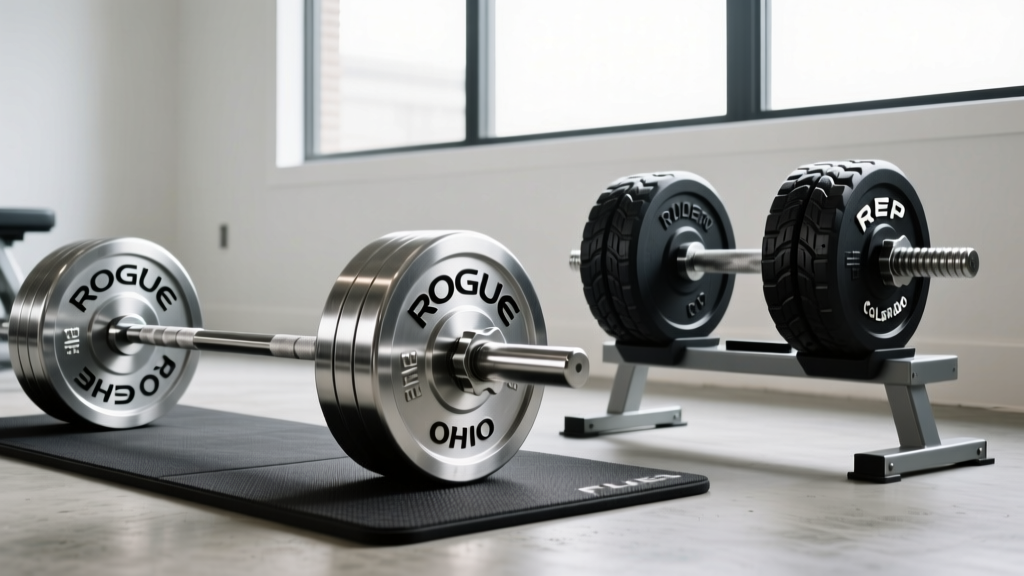
Barbell vs Dumbbell Back Exercises: Olympic Barbell Knurl Guide
Upgrading from dumbbell back exercises? Compare the Rogue Ohio and Rep Colorado Olympic barbells for weight, whip, and knurling in our 2026 guide.

The Biomechanical Shift: Moving Beyond Dumbbells
For years, fitness professionals have championed dumbbell back exercises for their ability to correct muscular imbalances, allow for a neutral grip, and reduce lower back shear forces. Movements like the single-arm dumbbell row and chest-supported dumbbell row are staples in any hypertrophy program. However, as lifters progress into advanced strength phases, the absolute load required to stimulate the latissimus dorsi, rhomboids, and erector spinae often exceeds the maximum available dumbbell weight in commercial or garage gyms. This is the exact bottleneck where heavy Olympic barbell rows—such as the Pendlay row, Yates row, and Meadows row—become mandatory.
Yet, transitioning to heavy barbell rowing introduces a new limiting factor: grip fatigue and knurling aggressiveness. Unlike dumbbells, which can be easily chalked and rotated, a 20kg Olympic barbell forces a strict pronated or alternated grip under immense shear stress. If your barbell's knurling is too shallow, the bar rolls in your calluses; if it is too aggressive (like a dedicated powerlifting bar), high-volume rowing sets will tear your hands to shreds. In this 2026 head-to-head comparison, we evaluate two of the most popular multipurpose Olympic barbells on the market—the Rogue Stainless Steel Ohio Bar and the Rep Fitness Colorado Bar—specifically through the lens of back-day performance, weight tolerances, and knurl topography.
Head-to-Head Specifications: The 2026 Contenders
Before diving into the metallurgical nuances, let us establish the baseline engineering of both bars. Both are classified as 20kg (44 lb) multipurpose bars, but their internal engineering dictates how they perform during heavy pulling movements.
| Feature | Rogue Stainless Ohio Bar | Rep Fitness Colorado Bar |
|---|---|---|
| Shaft Diameter | 28.5mm | 28.5mm |
| Tensile Strength | 190,000 PSI | 190,000 PSI |
| Knurl Pattern | Volcano (CNC Machined) | Volcano (Deep Cut) |
| Sleeve Rotation | Composite Bushings | 4 Needle Bearings |
| Knurl Marks | Dual (IPF & IWF) | Dual (IPF & IWF) |
| Approximate Price | $295.00 | $249.00 - $299.00 |
Knurling Topography: Decoding the "Volcano" Pattern
When executing heavy barbell rows to supplement or replace your standard dumbbell back exercises, the knurl is your only point of contact. Both Rogue and Rep utilize a "volcano" knurl pattern, but the execution differs significantly under a magnifying glass.
The Rogue Ohio Stainless Knurl
Rogue's knurling is widely considered the gold standard for multipurpose bars. Because the Ohio Stainless lacks any exterior coating (like zinc or black oxide), the knurl is cut directly into the bare stainless steel and then CNC-machined to perfection. This results in a true volcano peak: sharp edges that bite into the skin, but a slightly flattened top that prevents the knurl from piercing the callus. According to Rogue Fitness's official engineering specs, this bare steel approach maximizes the depth of the knurl without the "fill-in" effect that occurs when a bar is coated in zinc or cerakote post-cutting. For high-rep Yates rows, this provides a secure lock without excessive skin tearing.
The Rep Fitness Colorado Knurl
Rep Fitness takes a slightly more aggressive approach with the Colorado Bar. While still a volcano pattern, the peaks are noticeably sharper and the valleys are deeper. If you opt for the Cerakote version of the Colorado, the ceramic polymer coating slightly softens the aggressive bite, making it highly forgiving for high-volume back days. However, if you choose their bare stainless or hard chrome variants, the knurl can feel like sandpaper during the eccentric lowering phase of a Pendlay row.
⚠️ Expert Warning: The Chalk FactorStainless steel knurling (like the Ohio) is highly susceptible to chalk impaction. If you are transitioning from dumbbell back exercises where you heavily chalk your hands, you must use a wire brush on the Ohio bar weekly. Impacted chalk turns a sharp volcano knurl into a smooth, slippery hill, completely ruining your grip on heavy barbell rows.
The Hidden Variable: Sleeve Rotation in Unilateral Rows
Most buying guides ignore sleeve rotation when discussing back days, focusing only on deadlifts and cleans. But if you are utilizing unilateral barbell movements to mimic the isolation of dumbbell back exercises—such as Meadows Rows or Landmine Rows—sleeve rotation is a critical biomechanical variable.
During a Meadows row, you load one side of the barbell and pull from the sleeve. As you pull the weight up and rotate your wrist into your hip pocket, the barbell sleeve must spin independently of the shaft.
- Rogue Ohio Bar (Composite Bushings): Bushings are designed for slow, heavy, or static loads. During a heavy Meadows row, the bushing can bind slightly, transferring rotational torque directly into your wrist and elbow. This can lead to medial epicondyle strain over a 12-week hypertrophy block.
- Rep Colorado Bar (Needle Bearings): The Colorado utilizes four needle bearings per sleeve. As noted in comprehensive testing by BarBend's barbell engineering reviews, needle bearings allow the sleeve to spin freely even under asymmetrical loads. This means the plates rotate smoothly as you twist your wrist at the top of the row, vastly reducing joint strain and mimicking the ergonomic freedom of a dumbbell.
Shaft Whip, Weight Tolerance, and Floor Resets
Both bars feature a 28.5mm shaft diameter and 190,000 PSI tensile strength, meaning they share a nearly identical "whip" profile. For Olympic weightlifters, whip is desirable. For back day, it is a nuisance.
When performing strict Pendlay rows, the barbell starts dead-stop on the floor for every single repetition. A bar with too much whip (like a 25mm weightlifting bar) will bounce unpredictably off the floor, altering your pulling trajectory and risking lower back tweaks. The 28.5mm shaft on both the Ohio and Colorado provides the perfect "dead" feel off the floor. The 190k PSI steel is rigid enough to prevent violent oscillation when you aggressively pull 315 lbs off the rubber mats, yet possesses enough yield strength to ensure the bar will never permanently bend, even if you drop it loaded on the pins of a power rack.
💡 Pro Tip: Grip Width and Knurl MarksBoth bars feature dual knurl marks (IPF and IWF). When rowing for upper back and rear deltoid hypertrophy, place your pinky fingers exactly on the outer IWF rings. This ensures a biomechanically optimal pulling angle that prevents the biceps tendon from taking over the load, a common failure point when lifters transition from chest-supported dumbbell rows to free-standing barbell rows.
Real-World Edge Cases: Oxidation and Garage Gym Environments
Your training environment should heavily dictate your purchase. The Rep Fitness Colorado Bar is frequently purchased with a Cerakote shaft. Cerakote is a ceramic-polymer finish originally designed for firearms; it offers unparalleled resistance to oxidation and rust. If your garage gym experiences high humidity, or if you sweat heavily during high-rep back circuits, the Cerakote Colorado will survive years of neglect without pitting.
Conversely, the Rogue Ohio Stainless relies on the chromium content within the steel alloy to prevent rust. While highly resistant, stainless steel is not entirely rust-proof. If you leave the Ohio bar in a humid, unclimate-controlled garage with salty sweat drying on the knurl, micro-pitting will eventually occur, degrading the knurl's sharpness. Furthermore, the Ohio bar's bright silver finish shows every scratch and scuff from rack j-hooks, whereas the matte tactical black or olive Cerakote on the Colorado hides the battle scars of heavy back days.
Final Verdict: Which Bar Wins for Back Day?
Choosing between these two elite Olympic barbells ultimately depends on your specific rowing variations and maintenance habits.
Choose the Rogue Stainless Ohio Bar If:
- You prioritize the absolute best, uncoated "bare steel" knurl feel available on the market.
- Your back training consists primarily of bilateral, heavy barbell rows (Pendlay, Yates) where bushing stability is preferred over bearing spin.
- You train in a climate-controlled environment and are diligent about weekly wire-brush maintenance.
Choose the Rep Fitness Colorado Bar If:
- You frequently perform unilateral landmine variations (Meadows rows) to replicate the isolation of dumbbell back exercises, requiring the smooth sleeve rotation of needle bearings.
- You train in a humid garage gym and need the oxidation resistance of a Cerakote-coated shaft.
- You are on a slightly stricter budget but refuse to compromise on 190k PSI tensile strength and premium knurling depth.
Ultimately, while dumbbell back exercises will always hold a place in hypertrophy programming for their joint-friendly isolation, a high-quality Olympic barbell is non-negotiable for raw, unilateral back thickness. By selecting a bar with the correct knurl topography and sleeve mechanics, you ensure that your grip never fails before your lats do.
More gear to consider
All reviews
EZ Bar vs Straight Bar vs Dumbbell With Handle: 2026 Budget Guide

Cast Iron vs Competition Kettlebells vs Seated Dumbbell French Press

Straight vs EZ Bar: Best Single Arm Dumbbell Row Alternative?

Olympic vs Standard Plates: Setup Guide for Your 50 Pound Dumbbell Rack

Troubleshooting Different Types of Dumbbell Curls with Neoprene Weights
