Cast Iron vs Competition Kettlebells: Full Body Dumbbell Alternative
Optimize your home gym layout. We compare cast iron vs competition kettlebells as a space-saving full body dumbbell alternative, with exact dimensions.

The Spatial Dilemma: Ditching the Full Body Dumbbell Rack
When designing a high-performance home gym in a constrained footprint, the traditional 5-to-50 lb rubber hex dumbbell set is often the first casualty. A standard A-frame rack for a complete full body dumbbell set consumes roughly 14 to 18 square feet of valuable floor space, creating visual clutter and physical bottlenecks in rooms under 200 square feet. Enter the kettlebell: a highly versatile, offset-center-of-mass tool that can replicate and even enhance nearly any full body dumbbell routine while occupying a fraction of the square footage.
However, transitioning to kettlebells introduces a new spatial and ergonomic variable: Cast Iron vs. Competition styles. While both serve as exceptional space-saving alternatives, their differing geometries, handle diameters, and storage requirements drastically impact your gym's layout design. In this 2026 buying guide, we break down the exact dimensions, spatial footprints, and biomechanical realities of both styles to help you engineer the ultimate compact training zone.
Cast Iron Kettlebells: Variable Geometry and Storage
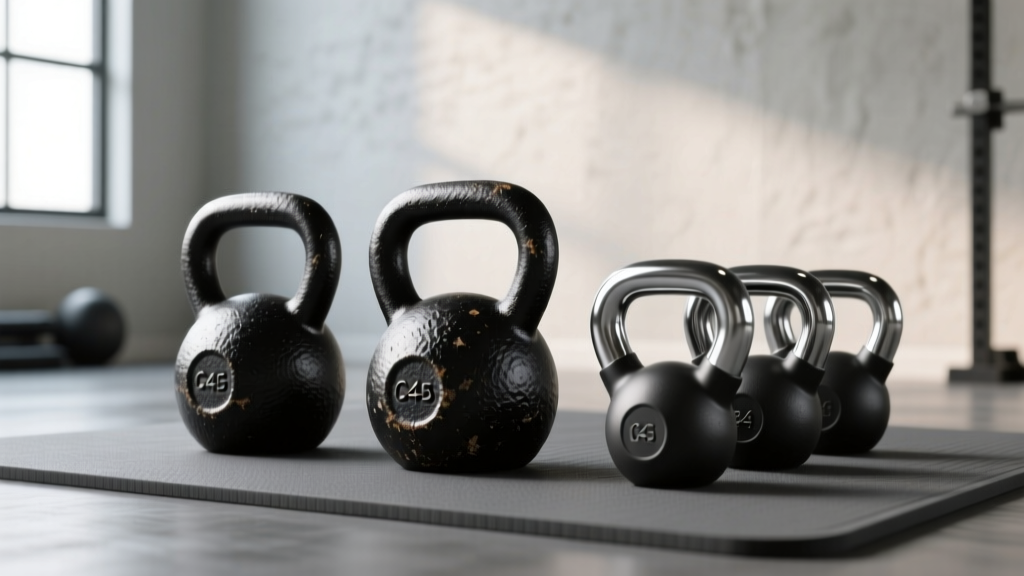
Cast iron kettlebells (often finished in powder coat, e-coat, or enamel) are the traditional choice for home gyms. Their defining spatial characteristic is variable geometry. As the weight increases, the physical volume of the bell increases. A 12kg cast iron bell is significantly smaller than a 24kg bell.
Pros and Cons for Compact Layouts
- Pro (Nested Storage): Because smaller bells have a smaller footprint, they can be "nested" or tucked beneath larger bells on shallow shelving units, maximizing vertical space.
- Pro (Compact Light Weights): For rehabilitation or high-rep endurance work, an 8kg or 12kg cast iron bell takes up minimal shelf depth (usually under 7 inches).
- Con (Rack Inconsistency): You cannot build a uniform, flush-mounted wall rack. The varying widths and handle heights mean heavier bells will protrude further or sit awkwardly next to lighter ones.
- Con (Handle Variance): Handle thickness scales with weight. A 16kg bell might have a 32mm handle, while a 32kg bell jumps to 40mm, altering your grip mechanics across different exercises.
Top-tier models like the Rogue E-Coat Kettlebells offer a rugged, space-efficient profile, but their inconsistent sizing demands flexible, tiered floor stands rather than sleek, uniform wall layouts.
Competition Kettlebells: The Uniformity Advantage
Originally forged for the sport of kettlebell lifting (Girevoy Sport), competition kettlebells adhere to strict dimensional standards regardless of weight. Whether you are holding an 8kg or a 32kg bell, the physical dimensions remain exactly the same: 280mm in height and 203mm in width, with a standardized 33mm handle diameter.
"The uniformity of competition bells isn't just about sporting fairness; it's a masterclass in spatial predictability. For a home gym owner, this means you can design a custom storage solution once, and it will perfectly accommodate any weight you add to your arsenal in the future." — StrongFirst Instructors Manual
Why Uniformity Wins in Space Optimization
Because every competition bell shares the exact same outer shell dimensions, you can install a single-tier, flush-mounted wall rack. A standard 36-inch wide heavy-duty steel wall bracket can hold four competition bells perfectly aligned, protruding exactly 8.5 inches from the wall. This eliminates floor stands entirely, freeing up the ground space for mobility work or yoga—a critical advantage when replacing a bulky full body dumbbell rack.
Dimensional Data & Footprint Matrix
To truly understand how these tools impact your room's layout, we must look at the raw spatial data. Below is a comparison of how a standard 4-bell set (12kg, 16kg, 20kg, 24kg) impacts your storage footprint.
| Metric | Cast Iron Set (Powder Coat) | Competition Set (Steel) |
|---|---|---|
| 12kg Dimensions (H x W) | 215mm x 185mm | 280mm x 203mm |
| 24kg Dimensions (H x W) | 285mm x 245mm | 280mm x 203mm |
| Handle Diameter Range | 30mm to 38mm | Strictly 33mm |
| Rack Type Required | Tiered Floor Stand (A-Frame) | Single-Tier Wall Mount |
| Total Floor Footprint (4 Bells) | ~3.5 sq. ft. (Floor Stand) | 0 sq. ft. (Wall Mounted) |
| Wall Protrusion Depth | N/A (Floor based) | 8.5 inches |
Designing Your Space-Optimized Kettlebell Zone
When replacing a full body dumbbell set, the goal is to maintain exercise versatility while reclaiming square footage. Here is a step-by-step framework for designing your kettlebell layout.
Step 1: Wall-Mounted vs. Floor Stands
If you choose Competition Bells, invest in a heavy-duty wall-mounted rack. Ensure the rack is bolted directly into wood studs or masonry, as four 24kg bells plus the steel rack will exert over 250 lbs of shear force. Position the rack at waist height (approx. 36 inches from the floor) to allow for safe, ergonomic cleaning of the bells off the rack without straining the lower back.
If you opt for Cast Iron Bells, avoid cheap plastic tiered stands that warp under load. Look for a welded steel 3-tier triangle stand with a footprint no larger than 24" x 24". Place this in a dead corner of the room to prevent toe-stubbing and maintain clear pathways for dynamic movements like swings and snatches.
Step 2: The "Full Body Dumbbell" Exercise Translation
Transitioning from dumbbells to kettlebells requires minor biomechanical adjustments, heavily influenced by the "horns" (the sides of the handle).
Expert Insight: Horn Width & The Front Rack
Competition bells feature a wider, flatter horn and a larger "window" (the space between the handle and the bell). This makes resting the bell in the front rack position significantly more comfortable for the forearm compared to the narrow, rounded horns of cast iron bells. If your full body routine includes high-volume cleans, thrusters, or squats, competition bells will reduce wrist bruising and allow for cleaner, more space-efficient movement patterns in tight rooms.
2026 Pricing and Value per Square Foot
Space optimization is an investment, and the financial cost per square foot saved varies wildly between the two styles. As of early 2026, the market pricing reflects the manufacturing complexity of competition bells.
- Cast Iron (e.g., Kettlebell Kings Powder Coat): Averaging $1.75 to $2.50 per pound. A 4-bell set (approx. 158 lbs total) will cost between $275 and $395. You will also need to purchase a floor stand ($80-$120).
- Competition (e.g., Rogue Fitness Competition): Averaging $3.50 to $5.00 per pound due to the hollow steel shell and internal ballast. The same weight spread will cost between $550 and $790, plus a wall-mount rack ($150).
While competition bells carry a higher upfront cost, their ability to completely eliminate floor stands and integrate seamlessly into vertical wall layouts offers a superior "value per square foot" for apartment dwellers and garage gym owners alike. According to biomechanical analyses by the American Council on Exercise (ACE), the standardized grip of competition bells also promotes better neuromuscular consistency when switching between heavy and light loads, a factor often overlooked in home gym design.
Final Verdict for Compact Home Gyms
If your primary objective is to replicate the versatility of a full body dumbbell routine while aggressively minimizing your gym's physical footprint, Competition Kettlebells paired with a wall-mounted rack are the undisputed champions of spatial efficiency. Their uniform dimensions allow for precise, predictable layout planning, and the standardized 33mm handle ensures your grip mechanics remain consistent across every exercise.
However, if budget constraints are tight and you don't mind a small floor stand tucked into a corner, Cast Iron Kettlebells remain a highly effective, rugged alternative. Just be prepared to adapt your storage layout as your strength grows and you inevitably add larger, heavier bells to your collection.
For more detailed specifications on load-bearing wall mounts and exact product dimensions, always consult the manufacturer guides at Rogue Fitness before finalizing your home gym blueprint.
More gear to consider
All reviews
Barbell Clamp Guide: Setup for a 30 Minute Home Dumbbell Workout

Alternating Dumbbell Snatches: Rubber Hex vs Urethane Review

Power Rack vs Squat Rack vs Stand: Dumbbell Woodchop Workout

Power Rack vs Squat Rack vs Stand: 50 lb Dumbbell Curl Clearance
Power Rack vs Squat Rack vs Stand: Best Dumbbell Chest Exercise Setup
