
Power Rack vs Squat Rack & Dumbbell to Barbell Converter Calculator
Compare power racks, squat racks, and stands. Plus, use our step-by-step dumbbell to barbell converter calculator to transition your home gym lifts.

Step 1: Define Your Footprint (Power Rack vs Squat Rack vs Squat Stand)
Building a home gym in 2026 requires balancing spatial constraints, budget, and safety. If you are transitioning from a dumbbell-only routine to barbell training, your first major equipment investment is a rack. But the terminology can be confusing. Let's break down the three primary categories before we calculate your new barbell working weights.
1. The Squat Stand
Squat stands are essentially two independent uprights designed to hold a barbell. The Rogue SML-2 90" Monster Lite Squat Stand is the industry benchmark here. Constructed from 11-gauge 3x3" steel, it offers a 49" x 49" footprint and costs around $495. Best for: Garages with low ceilings, tight spaces, and Olympic weightlifters who need an open layout to drop the bar forward during missed snatches or cleans. Drawback: They require bolt-down or heavy banding for safety, and spotter arms must be purchased separately.
2. The Squat Rack (Half Rack)
Half racks feature two main uprights connected by a crossmember, with safety spotter arms that extend forward 18" to 24". The Titan T-3 Half Rack (approx. $649) is a prime example. Best for: Lifters who want more stability than a stand but prefer an open top for easy barbell un-racking and overhead press variations. Drawback: The extended spotter arms increase the total depth footprint to nearly 70 inches.
3. The Power Rack (Full Cage)
A power rack encloses the lifter within four to six uprights. The Rep Fitness PR-4000 Power Rack (starting at $699) features 1" Westside hole spacing in the bench zone and 86" uprights. Best for: Solo home gym owners. The enclosed cage allows you to fail safely on squats and bench presses without a spotter. Drawback: Requires a minimum 8-foot ceiling clearance and takes up a 48" x 48" internal footprint.
| Feature | Squat Stand | Half Rack | Power Rack |
|---|---|---|---|
| Avg. Price Range | $350 - $550 | $550 - $750 | $650 - $1,200+ |
| Safety for Solo Lifters | Low (Requires spotter arms) | Medium-High | Maximum (Full cage) |
| Pull-Up Bar Integration | Rare / Unstable | Standard | Standard / Multi-grip |
| Weight Storage | None (Horns only) | Front or Rear horns | Rear & Side plate storage |
Step 2: The Biomechanics of Switching to a Barbell
Once your rack is bolted down, you face a programming challenge: How much weight should I load on the barbell based on my dumbbell maxes?
You cannot simply add your two dumbbells together. According to strength research analyzing the bilateral deficit and stabilization requirements, the central nervous system handles load distribution differently between unilateral (dumbbell) and bilateral (barbell) movements. Dumbbells require immense rotator cuff and core stabilization to prevent the weights from drifting apart. A barbell fixes your hands to a single axis, reducing the stabilization demand and allowing for greater absolute force production.
💡 The Information Gain: Why You Lift More with a Barbell
On pressing movements, lifters typically move 10% to 20% more total weight with a barbell than the combined weight of their dumbbells. However, on lower-body movements like lunges or split squats, the barbell introduces a higher spinal compression and balance penalty, which can actually decrease your working weight compared to holding dumbbells at your sides.
Step 3: How to Use a Dumbbell to Barbell Converter Calculator
As a beginner, jumping straight to your theoretical barbell max is a recipe for tendonitis or muscle strains. Use this step-by-step calculator framework to find your starting working weight.
- Identify your Dumbbell Working Weight: What is the heaviest dumbbell you can hold in ONE hand for 8 reps with perfect form? (e.g., 50 lbs).
- Calculate the Raw Bilateral Total: Multiply by 2. (50 x 2 = 100 lbs).
- Apply the Stabilization Offset Multiplier:
- Bench Press / Overhead Press: Multiply by 1.15 (15% stability bonus).
- Barbell Row: Multiply by 1.10 (10% stability bonus).
- Front Squat: Multiply by 1.05 (Core bracing limits the bilateral bonus).
- Add the Barbell Weight: Don't forget the bar! A standard Olympic barbell weighs 45 lbs (20 kg).
- Determine the Starting Load: Subtract 10% from your final calculated number for your first week to account for neurological adaptation to the new equipment.
Example Calculation: Dumbbell Bench to Barbell Bench
Let's say your 8-rep max dumbbell bench press is 60 lbs per hand.
- Raw Total: 60 x 2 = 120 lbs.
- Stability Offset (x 1.15): 120 x 1.15 = 138 lbs.
- Round to nearest 5 lb plate: 140 lbs (This is your estimated 8-rep max on the barbell).
- Week 1 Working Weight: Load 125 lbs on the bar (including the 45 lb bar) for 3 sets of 8.
Step 4: Real-World Conversion Scenarios
Below is a quick-reference conversion chart based on the 15% stabilization offset rule for upper body pressing movements. Remember, these are estimates for an 8-10 rep range, not 1-Rep Maxes.
| Dumbbell Weight (Per Hand) | Combined DB Total | Estimated Barbell Working Weight | Plate Loading (Per Side) |
|---|---|---|---|
| 25 lbs | 50 lbs | 65 lbs | One 10 lb plate |
| 35 lbs | 70 lbs | 85 lbs | Two 10 lb plates |
| 50 lbs | 100 lbs | 120 lbs | One 25 + One 10 lb plate |
| 70 lbs | 140 lbs | 165 lbs | Three 20 lb plates |
| 90 lbs | 180 lbs | 210 lbs | Four 20 lb + One 5 lb plate |
Step 5: Safety First (Setting Spotter Arms in Your Rack)
Using a dumbbell to barbell converter calculator is useless if you don't know how to fail safely inside your new power rack or squat stand.
Setting Up for the Barbell Squat
Perform an empty-bar squat inside your rack. Lower yourself to the absolute bottom of your range of motion (the 'hole'). Set the safety spotter arms or straps exactly 2 inches below the barbell's resting position at the bottom of the squat. This ensures that if you fail, you only have to drop the weight a fraction of an inch, preventing spinal compression injuries.
Setting Up for the Barbell Bench Press
When transitioning from dumbbells to the barbell bench, your elbows will travel deeper than they did with dumbbells (which stop at your chest). Lie on the bench, arch slightly, and bring the empty bar to your chest. Set the safety pins 1 inch above your sternum. You must be able to exhale and flatten your chest to escape the bar if you fail a rep.
⚠️ Beginner Warning: Never use the J-cups as your safety mechanism. J-cups are designed to hold the bar during un-racking. If you fail a rep and drop the bar onto the J-cups from a height, the kinetic energy can snap the pins or damage the uprights, especially on lighter 2x2" budget squat stands.Frequently Asked Questions
Can I use a dumbbell to barbell converter for deadlifts?
No. Dumbbell Romanian Deadlifts (RDLs) are limited by grip strength and the awkwardness of holding heavy weights at your sides. The barbell deadlift is a completely different biomechanical lever system. Beginners should start the barbell deadlift with just the 45 lb bar or bumper plates to learn the hip hinge, ignoring previous dumbbell maxes entirely.
What if my home gym ceiling is only 7 feet tall?
Standard power racks are 80" to 90" tall. If you have a 7-foot (84") ceiling, look for 'Short' power racks (usually 72" tall) like the Rep Fitness PR-1100 Short, or opt for a squat stand where the barbell rests at 60" and you can still perform pull-ups without hitting the ceiling.
Why do my wrists hurt when switching to the barbell bench?
Dumbbells allow your wrists to rotate naturally into a neutral or semi-pronated grip. A barbell forces full pronation. Ensure the bar rests low in the palm, directly over the forearm bones (the radius and ulna), rather than high up near the fingers, which causes wrist extension strain.
More gear to consider
All reviews
Neoprene Dumbbell Mistakes Ruining Your Dumbbell Workout for Men
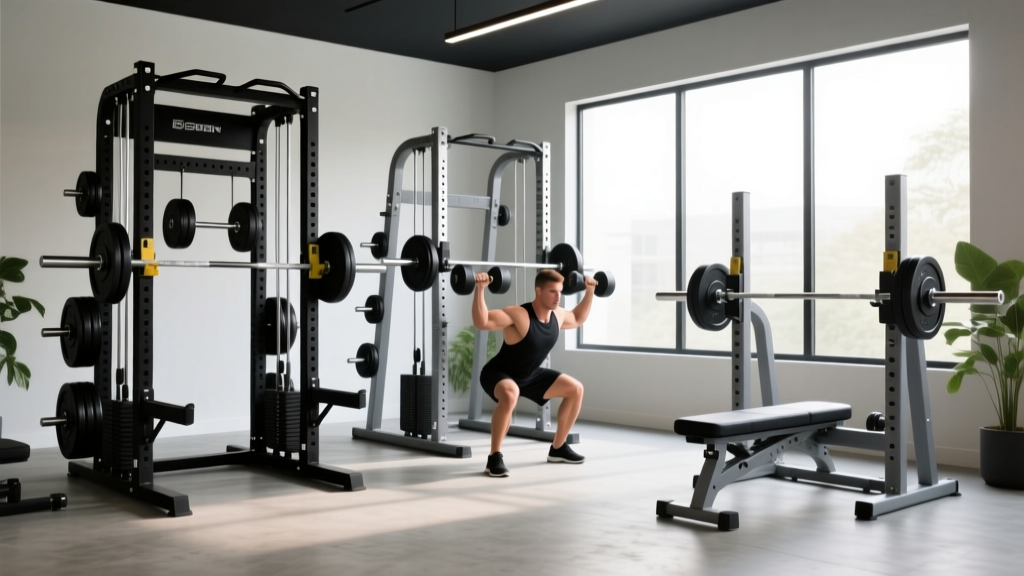
Power Rack vs Squat Rack vs Stand for Compound Dumbbell Exercises

Budget Dumbbell Racks: Perfecting One Arm Dumbbell Row Form
Best Adjustable Weights for a Workout Routine With Dumbbells (2026)

Beyond the One Arm Dumbbell: Olympic Barbell Weight & Knurling Guide
