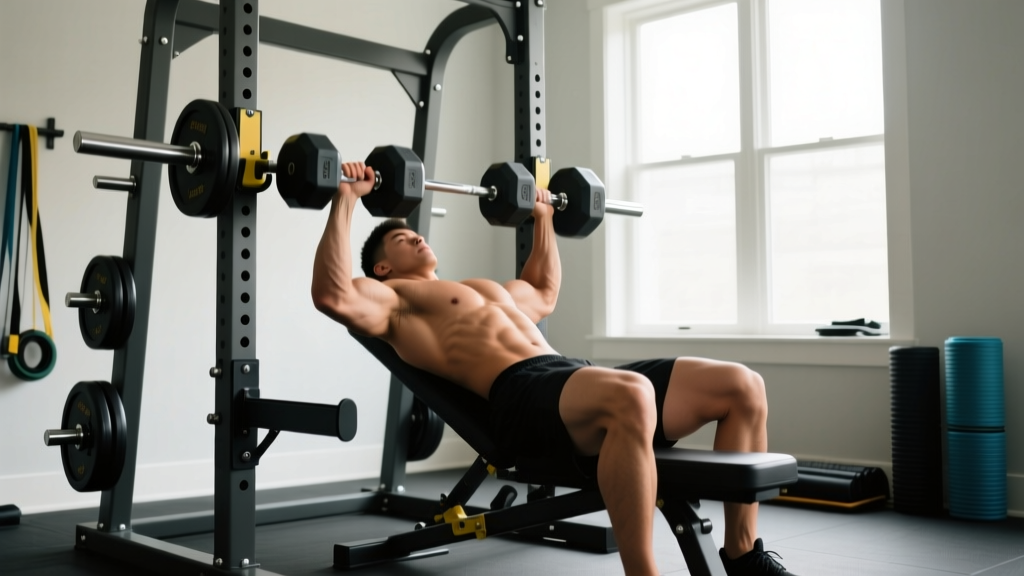
Incline Dumbbell Press for Upper Chest: Rack Setup Mistakes
Troubleshoot common setup mistakes for the incline dumbbell press for upper chest. Learn how power racks, squat racks, and squat stands impact your lift.

The Biomechanical Reality: Why Your Rack Dictates Your Press
When building a home gym, most lifters obsess over barbell compatibility, floor spacing, and plate storage. However, a massive blind spot emerges when athletes attempt to isolate the clavicular head of the pectoralis major. Perfecting the incline dumbbell press for upper chest development requires a specific range of motion that directly conflicts with the physical geometry of many popular squat racks and stands. If you have ever felt your dumbbells clanking against steel uprights, or worse, felt a dangerous shift in your bench's center of gravity mid-rep, you are experiencing a rack-geometry failure.
According to the ExRx Kinesiology Directory, the incline dumbbell press demands a deep stretch at the bottom of the movement and a natural, slightly converging arc toward the top. This arc moves the weight backward toward your head. When you trap this movement pattern inside a poorly configured rack, you compromise both muscle activation and physical safety. In this 2026 troubleshooting guide, we break down the most common setup mistakes lifters make when pairing their adjustable benches with power racks, squat racks, and squat stands.
⚠️ Safety Alert: The Independent Weight Hazard
Unlike a barbell, dumbbells move independently. If you fail a rep on the right side, the left side does not automatically stop. Standard barbell safety spotter arms are virtually useless for catching a single dropped dumbbell, making your rack's open space and bench stability the only things preventing a severe shoulder or rib injury.
Mistake #1: Upright Interference on Squat Stands
Squat stands, such as the popular Rogue SML-1 90" Monster Lite Squat Stand (retailing around $425), are fantastic for open-air squatting and bench pressing with a barbell. However, they are notoriously hostile to the incline dumbbell press for upper chest.
The Arc Path Problem
When you set an adjustable bench (like the Rep Fitness AB-3100 2.0) to a 30-degree incline, the backrest extends significantly behind the base. If you slide this bench into a pair of squat stands, the uprights often end up directly adjacent to your ears. As you lower 80-pound urethane dumbbells into the bottom stretch position, the large heads of the dumbbells will physically collide with the steel uprights before your pectorals reach a full stretch.
The Fix: You must pull the bench entirely out in front of the squat stands. This solves the clearance issue but introduces a new problem: you lose the ability to use the uprights as a makeshift spotter or dumbbell holster. You are now pressing heavy, independent weights over your face with zero overhead steel protection. If your gym footprint allows, squat stands are the least optimal choice for heavy incline dumbbell work.
Mistake #2: Miscalculating Safety Spotter Heights in Power Racks
Full power racks, like the Rogue R-3 (with a 43-inch interior depth and a price tag hovering near $3,500 in 2026), offer the safest environment for heavy lifting. But lifters frequently misuse the safety spotter straps or pin-and-pipe safeties when transitioning to dumbbells.
Many athletes set the safety bars just two inches below their chest, exactly as they would for a barbell bench press. When performing the incline dumbbell press for upper chest, this is a critical error. Because the dumbbells are held outside the plane of the safety bars, a failed rep will result in the dumbbell dropping straight down onto your bicep, shoulder joint, or the bench itself—completely bypassing the safety bar. Furthermore, if the safety bars are set too high, they will block your elbows from achieving the deep stretch required to activate the upper chest fibers.
Expert Biomechanics Tip: Studies on muscle activation show that a 30-degree bench angle optimally targets the upper chest, while a 45-degree angle shifts excessive load to the anterior deltoids. Ensure your rack depth accommodates a true 30-degree bench lay-back without hitting the rear crossmembers.
Mistake #3: Bench Footprint and Tipping Hazards on Squat Racks
Open-front squat racks (often called half-racks), such as the Titan T-2 Series Power Rack, offer a great middle ground. They provide the depth of a cage but leave the front open for easy bench sliding. The mistake here lies in bench placement and weight distribution.
When you sit on the end of an adjustable bench to kick up a pair of 100-pound dumbbells, your body weight and the momentum of the kick shift the center of mass backward. If the bench is not heavily loaded with weight plates on its rear feet, or if it is positioned on an uneven rubber mat inside the rack, the entire setup can tip backward. We have seen countless home gym owners scrape their heads against the interior J-cups of their squat racks because they failed to secure the bench footprint before initiating a heavy incline press.
Equipment Comparison Matrix: Incline DB Press Suitability
| Rack Type | Model Example (2026) | Interior Depth / Footprint | Incline DB Suitability | Primary Failure Mode |
|---|---|---|---|---|
| Power Rack | Rogue R-3 | 43" Interior Depth | Excellent | Elbows hitting safety straps if set too high |
| Squat Rack (Half) | Titan T-2 Series | 24" Depth (Open Front) | Very Good | Bench tipping backward during the dumbbell kick-up |
| Squat Stand | Rogue SML-1 | Single Uprights (49" H) | Poor | Uprights blocking the bottom stretch arc of the press |
Troubleshooting Your Setup: A Step-by-Step Guide
If you are currently struggling with your rack configuration, follow this exact troubleshooting sequence to optimize your incline dumbbell press for upper chest hypertrophy.
- Verify the Bench Angle: Use a digital angle finder on your bench backrest. If it reads 45 degrees or higher, lower it to the 30-degree notch. This immediately shortens the horizontal footprint required behind your head.
- Adjust Rack Depth Placement: If using a 43-inch deep power rack, pull the front legs of your bench exactly 4 inches outside the front uprights. This allows the backrest to sit comfortably inside the cage while giving your elbows room to drop below the torso line without hitting the rear safety bars.
- Remove Barbell Safeties: Take out the pin-and-pipe safeties or strap safeties entirely when using dumbbells. They provide a false sense of security and only serve as obstacles that restrict your elbow path. Rely on a spotter or the 'knee-tuck' drop method instead.
- Anchor the Bench: If your adjustable bench lacks a heavy rear stabilizer, place a 45-pound bumper plate on the rear base of the bench before sitting down to kick up your dumbbells.
Final Verdict: Designing the Ideal Upper Chest Station
As highlighted by equipment analysts at BarBend Home Gym Equipment Reviews, the modern home gym is shifting toward highly modular, open-front squat racks. For the specific task of heavy incline dumbbell pressing, an open-front squat rack paired with a commercial-grade adjustable bench remains the gold standard in 2026. It provides enough overhead clearance to safely kick up heavy weights, eliminates the claustrophobic upright interference of squat stands, and allows you to bail safely to the sides if a rep fails. Stop forcing your biomechanics to adapt to your steel cage; adjust the cage to respect the arc of the press, and watch your upper chest development finally take off.
More gear to consider
All reviews
Space-Saving Loadable Dumbbells: Choosing the Right Dumbbell Spring

Best Neoprene Dumbbells for Home Use & Dumbbell Flys GIF Guide

Rack Guide: Power Rack vs Squat Stand for Biceps Dumbbell Workouts

EZ Curl vs Straight Bar Care: Longevity & Dumbbell Routine Tips
Troubleshooting Dumbbell RDL Form With Neoprene Weights
