EZ Bar vs Straight Bar: Better Than a Biceps Exercise With Dumbbells?
Compare EZ curl bar vs straight bar for small home gyms. Discover space-saving layouts, storage metrics, and if a biceps exercise with dumbbells is better.

The Spatial Dilemma: Designing the Compact Arm Station
As urban home gyms and garage conversions continue to evolve in 2026, ruthless space optimization has become the cornerstone of functional layout design. When lifters dedicate a zone for arm development, the immediate instinct is often to accumulate multiple pairs of hex or adjustable dumbbells. The logic seems sound: a biceps exercise with dumbbells allows for independent limb movement, unilateral correction, and a natural wrist rotation that reduces joint strain. However, from a pure spatial and layout design perspective, the cumulative footprint of a progressive dumbbell set is notoriously inefficient.
This brings us to a critical equipment comparison for the space-conscious lifter: the EZ curl bar versus the traditional straight barbell. Both offer distinct biomechanical advantages, but their impact on your gym's floor plan, lateral clearance requirements, and storage infrastructure varies wildly. To build a truly optimized home gym, we must evaluate these bars not just by muscle activation, but by their cost-to-space ratio, storage versatility, and integration into modern power rack ecosystems.
Quick Space Metric Summary
- 5-Pair Dumbbell Set (15-35 lbs): Requires ~7.5 sq ft of floor space on a 3-tier rack.
- 71" Olympic Straight Bar: Requires 85+ inches of lateral swing clearance; difficult to store vertically.
- 52" Olympic EZ Curl Bar: Requires 65 inches of lateral clearance; can be stored vertically in a 12"x12" corner footprint.
Biomechanics Meets Floor Plan: Clearance and Joint Angles
Before mapping out wall hangers and plate trees, we must address why you are choosing a barbell over dumbbells in the first place. According to ExRx.net's biomechanics directory, the primary drawback of the straight barbell curl is the forced full supination (palms facing entirely up) of the wrist. This places the forearm in a state of valgus stress, which can lead to medial epicondylitis (golfer's elbow) over time, especially when lifting heavy loads in a cramped space where form breakdown is common.
The Straight Bar Reality
A standard 71-inch Olympic straight bar demands a massive lateral footprint. When performing standing curls, the barbell extends nearly 3 feet in either direction from your centerline. In a compact 10x10 apartment gym or a narrow garage bay, this means you cannot perform straight bar curls near walls, squat racks, or doorways. Furthermore, storing a 71-inch bar horizontally requires specialized wall brackets that span over 6 feet, eating up valuable vertical wall real estate that could be used for mirror installations or resistance band anchors.
The EZ Curl Bar Advantage
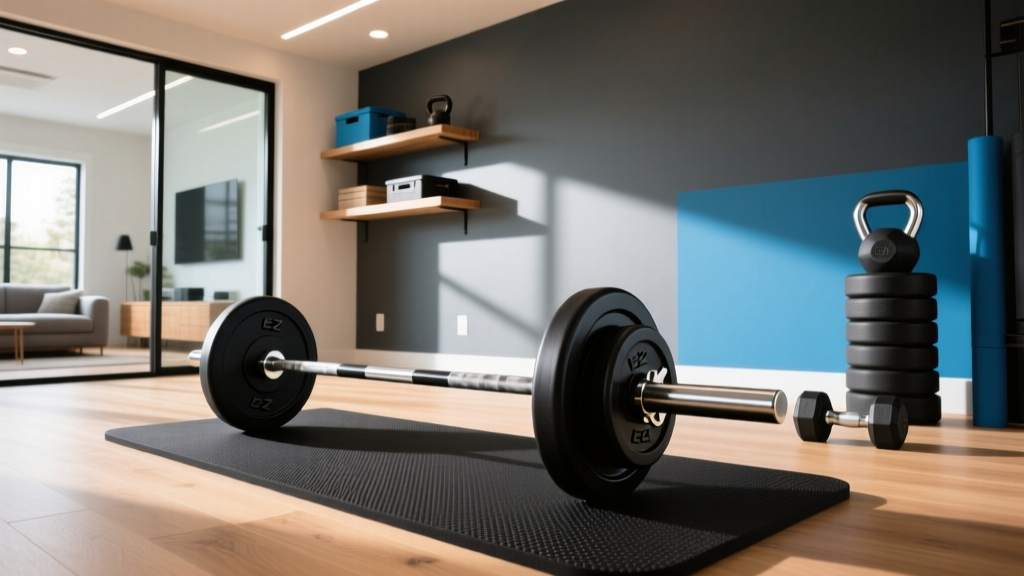
The Olympic EZ curl bar typically measures between 47 and 52 inches. The angled grips place the wrists in a semi-supinated position, drastically reducing joint strain while allowing for heavy, progressive overload. From a layout perspective, those 20 missing inches are transformative. You can comfortably perform EZ bar curls inside a standard 48-inch wide power rack, utilizing the safety straps as a fail-safe without the barbell ends clipping the uprights. For detailed spatial planning, the ExRx.net Weight Room Dimensions guide highlights how reducing equipment width allows for tighter, safer multi-user or multi-station workflows.
| Equipment Setup | Lateral Clearance Required | Storage Footprint | Avg. Cost (2026) | |
|---|---|---|---|---|
| 71" Straight Bar | 85 inches | 71" x 3" (Horizontal Wall) | $150 - $295 | |
| 52" Olympic EZ Bar | 65 inches | 12" x 12" (Vertical Corner) | $95 - $135 | |
| 5-Pair Dumbbell Set | 40 inches (per user) | 49" x 22" (Floor Rack) | $450 - $800 |
Layout Configurations: Rack Integration and Dead-Space Utilization
The true test of space optimization is how well equipment integrates into your existing layout without requiring dedicated, single-use floor stands. In modern home gym design, 'dead-space'—the unused vertical and horizontal gaps within a power rack or against structural pillars—is prime real estate.
- Vertical Corner Storage: Unlike a straight bar, which is top-heavy and awkward to stand upright, an EZ curl bar has a compact center of gravity. By using a $25 wall-mounted vertical bar holder or simply leaning it securely in the corner of your plate tree, you reduce its floor footprint to a mere 12x12 inch square.
- In-Rack J-Cup Holstering: If you own a power rack, you can dedicate a pair of J-cups at the 70-inch mark specifically for EZ bar storage. This keeps the bar suspended and out of the way of your deadlift or squat zones, entirely eliminating the need for a separate floor stand.
- Plate Tree Synergy: A major advantage of the EZ bar over dumbbells is micro-loading. To progress a biceps exercise with dumbbells from 25 lbs to 30 lbs, you must purchase and store an entirely new 5-pound pair, adding 10 lbs of steel and significant bulk to your rack. With an EZ bar, you simply add 1.25 lb or 2.5 lb fractional plates to the sleeves. A single set of fractional plates takes up less than 2 inches of space on a standard plate tree, offering infinite progression without spatial bloat.
Expert Layout Insight: 'When designing a sub-200-square-foot home gym, every piece of equipment must serve a dual purpose or share storage infrastructure. An EZ curl bar shares plates with your deadlift setup and stores vertically, whereas a dedicated dumbbell arm station requires redundant weight increments and exclusive floor space.'
Cost-to-Space Ratio Analysis
Financial investment must be weighed against spatial consumption. As of 2026, high-quality urethane dumbbells average $2.00 to $3.50 per pound. Building a functional arm station with pairs of 15, 20, 25, 30, and 35 lb dumbbells requires an initial outlay of roughly $500 to $800, not including the $150+ cost of a heavy-duty 3-tier rack to hold them. The Rogue Fitness equipment specifications for their standard Curl Bar price it around $115, and even premium Cerakote options rarely exceed $185.
When you factor in the cost of a basic set of iron bumper or fractional plates (which you likely already own for compound lifts), the EZ curl bar setup costs approximately 75% less and consumes 85% less dedicated floor space than a comprehensive dumbbell arm station. While adjustable dumbbells (like PowerBlocks or Bowflex) attempt to bridge this gap by condensing weight into a single block, they often suffer from bulky, blocky end-caps that restrict the natural range of motion during close-grip hammer curls or preacher curls.
Final Verdict: Designing Your Arm Station
If your home gym layout features narrow corridors, low ceilings, or a multi-use living space where equipment must be tucked away, the 52-inch Olympic EZ curl bar is the undisputed champion of spatial efficiency. It provides the heavy, progressive overload necessary for brachialis and biceps brachii hypertrophy while respecting the ergonomic limits of your wrists and the physical limits of your floor plan.
While a targeted biceps exercise with dumbbells remains a staple for isolation and unilateral balancing, relying on them as your primary curling modality introduces severe storage and financial inefficiencies. By anchoring your arm station around an EZ curl bar, utilizing vertical dead-space for storage, and leveraging fractional plates for micro-progression, you can build an elite-level bodybuilding station that leaves your floor open for what really matters: the heavy compound lifts.
More gear to consider
All reviews
EZ Bar vs Straight Bar Care: Longevity & The Dumbbell Graph

Olympic vs Standard Plates: Setup and Dumbbell Row Guide for Women
Loadable Dumbbells vs Barbell Chest Press Machine: 2026 Guide

Rubber Hex vs Urethane: 2026 Gear for Bicep and Back Dumbbell Workouts
Cast Iron vs Competition Kettlebells: Dumbbell Lateral Squats Guide
