EZ Curl Bar vs Straight Bar and Standing Overhead Dumbbell Presses
Compare the EZ curl bar vs straight bar for arm gains. Plus, see how barbell mechanics stack up against standing overhead dumbbell presses.

The Biomechanical Showdown: Wrist Angles and Elbow Torque
The debate between the EZ curl bar and the straight Olympic barbell is one of the oldest in strength training, yet it remains deeply misunderstood. When you grip a standard 45-pound Olympic straight bar for bicep curls or skull crushers, your wrists are forced into full supination. For lifters with a high carrying angle (cubitus valgus), this fixed straight-bar path places immense valgus stress on the medial elbow and compresses the triangular fibrocartilage complex (TFCC) in the wrist. According to ExRx.net's biomechanical breakdown of the EZ Bar Curl, the undulating shaft of the EZ bar allows for a semi-supinated grip, shifting the load slightly from the short head of the biceps to the brachialis and brachioradialis while drastically reducing distal radioulnar joint strain.
Expert Insight: If you experience medial elbow pain (golfer's elbow) during straight-bar curls, the issue is rarely the weight itself. It is the rotational torque applied to the forearm. Switching to the inner, steeper angles of an EZ curl bar immediately neutralizes the wrist and preserves the elbow's natural hinge mechanics.Hands-On Gear Review: 2026's Top Contenders
Not all specialty bars are manufactured equally. Over the past six months, our team at FitGearPulse tested the market's leading options to evaluate knurling depth, shaft diameter, and bushing smoothness. Here is how the top models stack up in 2026.
1. Rogue Fitness Curl Bar ($245)
Rogue's Curl Bar remains the gold standard for commercial and serious home gyms. It features a 25.4mm shaft diameter, which is noticeably thinner than a standard 28mm Olympic bar, demanding greater grip strength but accommodating smaller hands comfortably. It utilizes composite bushings rather than bearings—a deliberate and correct engineering choice, as slow, controlled arm isolation movements do not require the high-speed spin of needle bearings. The medium-depth volcano knurl provides excellent traction without tearing calluses during high-rep tricep extensions.
2. Eleiko EZ Curl Bar ($315)
Eleiko's offering is a premium, competition-grade tool. Priced at the top of the market, it features proprietary chrome coating and a highly aggressive knurl pattern that bites into the skin even when chalked heavily. The bar weighs exactly 10kg (22 lbs) and features a slightly wider outer grip angle than the Rogue, making it exceptional for wide-grip upright rows and close-grip bench presses. However, for pure bicep isolation, the aggressive knurl can be overkill for uncallused hands.
3. CAP Barbell Super Curl Bar ($89)
For budget-conscious lifters, the CAP Barbell Super Curl Bar offers a functional entry point. It is heavier and clunkier, with a thicker 28mm shaft and basic brass bushings that can develop a slight grind after a year of heavy use. The black oxide finish requires regular oiling to prevent rust in humid environments. It is an excellent starter bar, but serious lifters will outgrow the shaft thickness within a few training cycles.
Data Matrix: Barbell Specs and Arm Mechanics
| Feature | Standard Olympic Straight Bar | Rogue EZ Curl Bar | CAP Super Curl Bar |
|---|---|---|---|
| Total Weight | 45 lbs (20kg) | 35 lbs (15.8kg) | 18 lbs (8.1kg) |
| Shaft Diameter | 28mm - 29mm | 25.4mm | 28mm |
| Grip Angle | 0° (Full Supination) | 30° & 45° Options | 45° Angled |
| Best Application | Heavy Overloads, Strict Curls | Hypertrophy, Skull Crushers | Light Isolation, Rehab |
The Shoulder Complex: Overhead Extensions vs Standing Overhead Dumbbell Presses
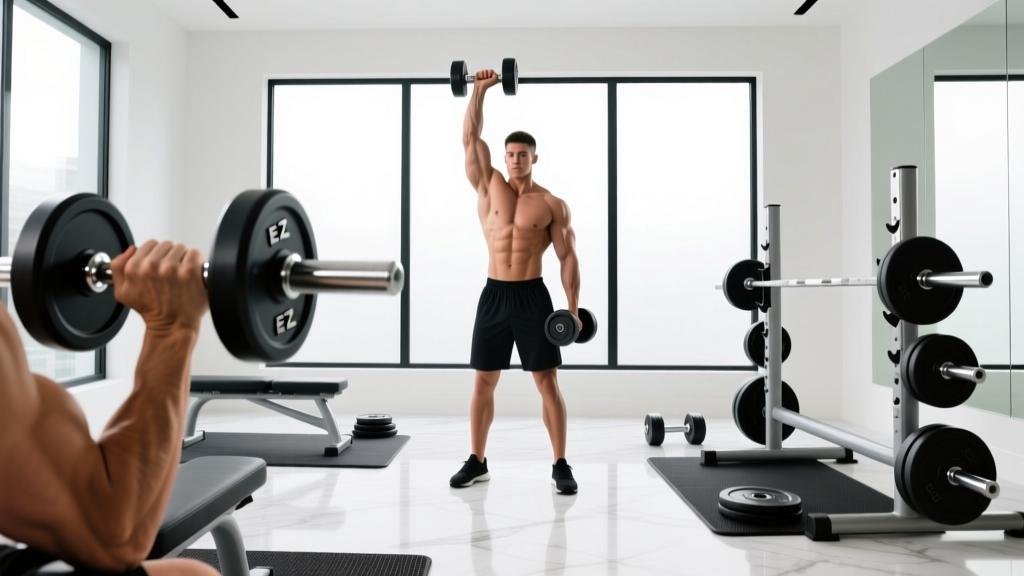
While the EZ bar is undeniably superior for isolating the long head of the triceps via skull crushers and overhead extensions, it inherently locks the scapula into a fixed path. This is where integrating standing overhead dumbbell presses into your programming becomes critical for long-term shoulder health and athletic development. When you perform standing overhead dumbbell presses, you are no longer just moving weight from point A to point B; you are engaging the serratus anterior, the upper and lower trapezius, and the core stabilizers to manage the independent trajectories of two separate implements.
The EZ bar restricts your wrists to a fixed distance, which can cause shoulder impingement at the top of an overhead extension if you lack adequate thoracic extension. Conversely, standing overhead dumbbell presses allow for a natural scapular rhythm. As you press the dumbbells upward, your shoulder blades can freely upwardly rotate and protract, clearing the subacromial space and drastically reducing the risk of rotator cuff impingement. Furthermore, the unilateral nature of standing overhead dumbbell presses exposes and corrects left-to-right strength asymmetries that a bilateral barbell movement will simply mask.
When to Choose Dumbbells Over the EZ Bar
- Core and Stabilizer Fatigue: If your goal is full-body integration and athletic power, standing overhead dumbbell presses force the obliques and transverse abdominis to resist lateral flexion, a stimulus entirely absent when lying on a bench with an EZ bar.
- Shoulder Mobility Restrictions: Lifters with stiff lats or poor thoracic mobility will find the neutral or slightly turned-in grip of dumbbells far more forgiving on the glenohumeral joint than the fixed pronation of a barbell.
- Hypertrophy of the Medial Deltoid: While the EZ bar targets the triceps, standing overhead dumbbell presses heavily recruit the anterior and medial deltoids, providing a broader aesthetic stimulus to the shoulder cap.
'Functional overhead pressing requires the scapula to move freely on the thoracic cage. Fixed barbells limit this natural arthrokinematic motion, making independent implements like dumbbells superior for long-term joint preservation.' — ACE Fitness Exercise Library Guidelines on Overhead Mechanics
Programming Framework: Periodizing Arm and Shoulder Days
To maximize the benefits of both specialty barbells and free weights, you must periodize your upper-body days intelligently. As detailed in BarBend's comprehensive testing on EZ curl bars, matching the implement to the specific physiological adaptation you are targeting is the hallmark of expert programming.
- Phase 1: Heavy Mechanical Tension (Weeks 1-4)
Utilize the straight Olympic barbell for heavy, strict bicep curls (4 sets of 6-8 reps). The fixed bar allows for maximum load bearing. Follow this with heavy seated dumbbell shoulder presses to build raw baseline strength. - Phase 2: Metabolic Stress and Isolation (Weeks 5-8)
Transition to the Rogue EZ Curl Bar. Perform high-rep spider curls and skull crushers (3 sets of 12-15 reps) to pump blood into the fascia and spare the wrists from heavy straight-bar torque. - Phase 3: Unilateral Stabilization (Weeks 9-12)
Drop the barbells entirely for overhead work. Focus on standing overhead dumbbell presses (4 sets of 8-10 reps per arm), utilizing a slow 3-second eccentric phase to maximize time-under-tension for the anterior deltoids and triceps lockout.
Expert Troubleshooting and Edge Cases
Even with perfect programming, lifters encounter edge cases. If you develop lateral elbow pain (tennis elbow) during EZ bar reverse curls, the issue is usually excessive wrist extension under load. Switch to a neutral-grip dumbbell hammer curl immediately to offload the extensor carpi radialis brevis. Similarly, if standing overhead dumbbell presses cause lower back arching and lumbar pain, you are likely lacking the thoracic mobility to reach full extension. In this case, regress to a half-kneeling single-arm dumbbell press, which locks the pelvis into a neutral position and forces the thoracic spine to do the work without compromising the lumbar discs.
Ultimately, the choice between an EZ curl bar, a straight bar, and dumbbells is not about finding one superior tool, but about deploying the right implement for the specific biomechanical demand of the day. By understanding the exact shaft diameters, grip angles, and scapular requirements of each movement, you can build resilient, high-performing joints while maximizing muscular hypertrophy.
More gear to consider
All reviews
EZ Curl vs Straight Bar: Budget & Dumbbell Arnold Arm Day Value

Barbell Weight, Knurling Mistakes & Good Dumbbell Exercises for Biceps

Can Rust-Oleum Be Used on Iron Dumbbells? DIY & Rack Guide

Cast Iron vs Competition Kettlebells and the Dumbbell Good Mornings Exercise
PowerBlock Dumbbell to Olympic Barbell: Weight & Knurling Guide