
EZ Curl Bar vs Straight Bar & Dumbbell Lateral Raises GIF Guide
We break down the biomechanics of the EZ curl bar vs straight bar for bicep growth, plus a form guide with our dumbbell lateral raises GIF.

If you found your way to this guide after watching our viral dumbbell lateral raises gif on social media, you already know the FitGearPulse team obsesses over joint angles, equipment biomechanics, and hypertrophy optimization. While lateral raises dominate medial deltoid development, building a complete upper-body physique requires equal attention to the biceps and brachialis. This brings us to one of the most fiercely debated equipment matchups in the weight room: the EZ curl bar vs straight bar.
As of 2026, the market is flooded with specialty bars, but understanding the anatomical implications of shaft geometry is crucial for longevity and muscle activation. In this expert hands-on review, we dissect the biomechanics of both bars, review the top models currently available, and bridge the gap to shoulder isolation with a detailed breakdown of adjustable dumbbells for lateral raises.
The Biomechanics of Bicep Curls: EZ Bar vs. Straight Bar
To understand why equipment choice matters, we must look at the human arm's natural resting position. According to ExRx Kinesiology guidelines, the biceps brachii functions primarily as a forearm supinator and elbow flexor. However, the skeletal structure of the arm features a natural outward angulation known as the 'carrying angle' or cubital valgus.
The Straight Bar Dilemma
A standard 1.2-meter straight bar forces your wrists and elbows into a fixed, fully supinated position that ignores the carrying angle. For lifters with a pronounced valgus angle, this forces the wrists into ulnar deviation and places immense torque on the medial epicondyle. Over time, heavy straight-bar curling is a primary culprit behind medial epicondylitis (golfer's elbow) and wrist impingement.
The EZ Bar Camber Advantage
The EZ curl bar introduces strategic bends (cambers) into the shaft. By gripping the inner or outer angled segments, you allow the wrists to adopt a semi-supinated or neutral grip. This slight modification drastically reduces joint shear force. Furthermore, shifting to a semi-supinated grip transfers a portion of the load to the brachialis and brachioradialis, promoting overall arm thickness rather than just targeting the biceps peak.
Expert Insight: The inner grips on an EZ bar (usually angled at 30 degrees) are optimal for bicep isolation with reduced wrist strain. The outer grips (angled closer to 45 degrees) heavily recruit the brachioradialis, making them an excellent hybrid movement for forearm and lower-arm development.Hands-On Review: Top 2026 Barbell Picks
We tested the most popular curl bars on the market, evaluating knurling depth, tensile strength, and sleeve rotation. Below is our comparative matrix.
| Model | Tensile Strength | Shaft Diameter | Knurl Type | Est. Price (2026) |
|---|---|---|---|---|
| Rogue Curl Bar | 150,000 PSI | 28.5mm | Medium Volcano | $225.00 |
| Eleiko EZ Curl Bar | 130,000 PSI | 28.0mm | Aggressive Olympic | $385.00 |
| CAP Super Curl Bar | Not Rated (Std) | 25.0mm | Light/Flat | $55.00 |
Rogue Curl Bar: The Gold Standard
The Rogue Curl Bar remains our top pick for serious home and commercial gyms. The 150K PSI tensile strength ensures the bar will not permanently deform under heavy eccentrics, while the composite bushings provide smooth, quiet rotation. The medium volcano knurl is aggressive enough to hold chalk during heavy sets of 6-8 reps, but not so sharp that it tears your calluses during high-volume pump work.
Eleiko EZ Curl Bar: The Premium Contender
Eleiko's offering is a masterpiece of Swedish engineering. The 130K PSI steel is specifically chosen to provide a slight 'whip' or yield at the top of the concentric phase, which American Council on Exercise (ACE) biomechanics research suggests can enhance peak contraction feedback. However, the aggressive Olympic knurl is overkill for casual lifters and demands rigorous hand care.
CAP Barbell Super Curl Bar: The Budget Reality
At roughly $55, the CAP bar is an entry-level staple. The 25mm shaft feels thin in the hands, and the lack of internal bushings means the sleeves grind against the shaft under heavy loads. It is acceptable for beginners, but we highly recommend saving for the Rogue if you plan to progress past 100 lbs of working weight.
Pros and Cons Breakdown
Using an EZ Curl Bar
- Pros: Ergonomic grip angles; reduces wrist and elbow strain; excellent for targeting the brachialis; compact storage footprint.
- Cons: Limits maximum bicep supination; fixed grip widths may not suit all limb lengths; typically limited to 2-inch Olympic sleeves.
Using a Straight Bar
- Pros: Forces maximum supination for peak bicep activation; versatile for drag curls and reverse curls; standard 28-29mm shaft feels familiar.
- Cons: High risk of medial epicondyle strain; forces unnatural wrist angles; longer overall length requires more clearance space.
Shoulder Isolation: Perfecting the Lateral Raise
You cannot build a complete upper body with curls alone. This is where our famous dumbbell lateral raises gif comes into play. When performing lateral raises, the goal is to isolate the medial deltoid while avoiding impingement of the supraspinatus tendon against the acromion process.
The Scapular Plane (Scaption) Rule
As demonstrated in our visual guides, lifting the dumbbells directly out to the sides (the frontal plane) is a biomechanical error. Instead, you must raise the weights in the 'scapular plane'—roughly 15 to 30 degrees anterior to your torso. This aligns the humerus with the scapula, providing a clear path of motion and maximizing medial deltoid tension.
'Equipment selection for lateral raises is just as critical as the bar you use for curls. Bulky adjustable dumbbells can alter your lever arm and cause the weights to clash at the bottom of the movement.' - FitGearPulse Biomechanics Team
Top Adjustable Dumbbells for Lateral Raises (2026)
For lateral raises, you need a compact profile. We recommend the Nuobell 80 over the PowerBlock Pro series for this specific movement. The Nuobell features a traditional dumbbell silhouette with a 1.5mm knurl depth, allowing for a secure grip without the wrist interference caused by the cage-like design of dial or pin-lock adjustable dumbbells. At $449 for a pair, they are an investment, but their seamless weight transitions (in 5lb increments) make them perfect for drop-set lateral raises.
Storage and Maintenance for Specialty Bars
Specialty bars like the EZ curl bar are notoriously difficult to store on standard horizontal barbell racks due to their cambered shafts. Attempting to rest an EZ bar on a standard J-cup will result in the bar rolling off or scratching the knurling.
Storage Solution: Invest in a dedicated vertical barbell holder or a wall-mounted specialty bar hanger. The Rogue Vertical Barbell Holder ($95) features UHMW plastic-lined cradles that protect the cambers and knurling of your EZ bar, while keeping your gym floor clear for heavy compound movements.For maintenance, specialty bars with bushings require occasional lubrication. Every six months, apply a few drops of 3-in-One oil or synthetic barbell oil to the sleeve seams and rotate the sleeves to distribute the lubricant. This prevents the metallic grinding sound that plagues neglected budget curl bars.
Expert FAQ
Can I build massive biceps using only an EZ curl bar?
Yes. While the straight bar provides maximum supination, the EZ bar allows you to lift heavier loads with less joint pain. Progressive overload on the EZ bar, combined with strict eccentrics, will yield massive bicep and brachialis hypertrophy over time.
Why do my shoulders click during lateral raises?
Clicking or impingement usually occurs when you lift strictly in the frontal plane or internally rotate your humerus (the 'pouring the pitcher' cue, which modern biomechanics has largely debunked for most lifters). Keep your thumbs slightly higher than your pinkies and raise the dumbbells in the scapular plane to eliminate the click.
Is a curl bar worth the investment for a small home gym?
Absolutely. An EZ curl bar is highly versatile. Beyond standard curls, it is the premier tool for skull crushers (triceps extensions), upright rows, and even front squats for lifters with poor wrist mobility. Its compact 47-inch length makes it ideal for tight spaces.
Final Verdict
The EZ curl bar vs straight bar debate ultimately comes down to your joint health and anatomical carrying angle. For 90% of lifters in 2026, the EZ curl bar is the superior, safer choice for long-term arm development, with the Rogue Curl Bar standing out as the undisputed champion of build quality. Pair your bicep training with strict scapular-plane lateral raises using compact adjustable dumbbells, and you will have a complete, joint-friendly blueprint for upper-body hypertrophy. For more visual form breakdowns, be sure to check out our complete exercise library and the original dumbbell lateral raises gif in our app.
More gear to consider
All reviews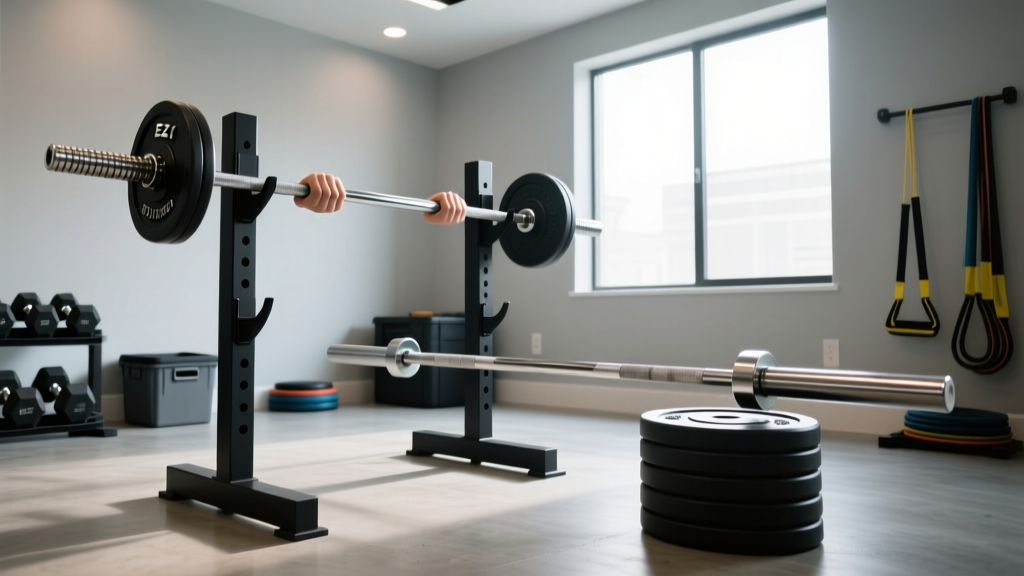
EZ Curl Bar vs Straight Bar: Boosting Dumbbell Shoulder Press Weight
Mastering Incline Dumbbells Curls: Adjustable Dumbbell Review
EZ Curl Bar vs Straight Bar & Neutral-Grip Dumbbell Bench Press

Barbell Collar Types & Bench Supported Dumbbell Rows: Mistakes

Obliques Exercises with Dumbbells: Beginner Guide & 2026 Review
