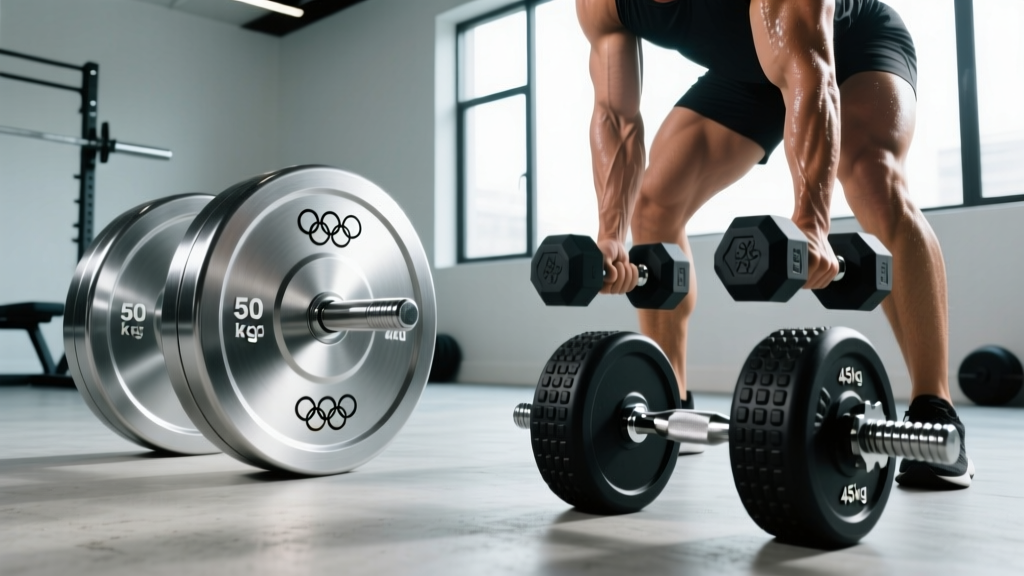
Olympic vs Standard Plates for the CrossFit Dumbbell Push Press
Compare Olympic vs standard weight plates for the CrossFit dumbbell push press. Discover which setup survives high-rep WODs, heavy drops, and max loads.

The Biomechanical Reality of the Dumbbell Push Press
When programming for high-volume metabolic conditioning, the CrossFit dumbbell push press is a staple movement. It demands explosive hip extension, precise overhead lockout, and rapid eccentric lowering. However, while athletes obsess over programming and recovery, the hardware itself—specifically the weight plates and loadable dumbbell handles used to execute the movement—is often an afterthought until a catastrophic equipment failure occurs mid-WOD.
As we navigate the 2026 home gym and affiliate landscape, the debate between Olympic weight plates (50mm center hole) and Standard weight plates (25mm center hole) remains highly relevant for budget-conscious athletes building loadable dumbbell setups. According to ExRx.net biomechanics data, the push press generates significant vertical force during the drive phase, but it is the repeated eccentric lowering and overhead drops that place extreme shear stress on dumbbell sleeves, collars, and plate hubs.
In this head-to-head comparison, we will dissect Olympic versus standard plates specifically through the lens of the dumbbell push press, evaluating sleeve interference, drop survivability, collar security, and long-term cost efficiency.
⚠️ Equipment Warning: Never drop standard cast iron plates from an overhead lockout position. The 1-inch center hubs on standard plates are not engineered for dynamic impact loading and will fracture, potentially causing severe injury or floor damage.Head-to-Head Comparison Matrix
Before diving into the nuanced edge cases, let us look at the raw data comparing an Olympic loadable dumbbell setup versus a standard spin-lock setup for high-repetition push press workouts.
| Feature | Olympic Setup (2-inch) | Standard Setup (1-inch) |
|---|---|---|
| Handle Cost (Pair) | $195 - $250 (e.g., Rogue Loadable) | $35 - $60 (e.g., CAP Spin-Lock) |
| Plate Cost (per lb) | $2.00 - $4.50 (Urethane/Bumper) | $1.20 - $2.00 (Cast Iron/Rubber) |
| Max Safe Load (Per Hand) | 150+ lbs | 65 - 80 lbs (Sleeve deflection risk) |
| Drop Survivability | Excellent (with bumpers/urethane) | Poor (Hub fracture / Nut failure) |
| Collar Security in WODs | High (Spring/Lock-Jaw collars) | Low (Spin-nuts vibrate loose) |
| Front Rack Comfort | Moderate (Thick sleeves can dig in) | High (Slim profile) |
Deep Dive: The Olympic Plate Advantage for CrossFit
When performing the dumbbell push press in a metcon like a heavy "Karen" variation or a couplet, the ability to drop the weight from overhead is non-negotiable for maintaining workout intensity and protecting the rotator cuff. Olympic plates—specifically urethane friction plates or technique bumpers paired with Olympic loadable handles—dominate this category.
Sleeve Integrity and Load Capacity
Olympic dumbbell handles, such as the Rogue Loadable Dumbbell Handles, feature a 50mm (approx. 2-inch) sleeve machined from solid steel. This thickness eliminates sleeve deflection (bending) even when loaded with 100+ lbs per hand. During the aggressive dip-and-drive of the push press, the rigid sleeve ensures that the kinetic energy transfers directly from the hips through the implement, without the 'whip' or wobble experienced in thinner standard handles.
The Collar Conundrum in High-Rep WODs
Standard spin-lock nuts are notorious for vibrating loose during high-rep overhead work. The repetitive impact of the dumbbell returning to the shoulder (or the floor) creates micro-vibrations that unscrew standard collars. Olympic setups utilize smooth sleeves paired with heavy-duty spring collars or clamp-style collars (like Lock-Jaws). These remain flush and secure regardless of the rep scheme, eliminating the mid-WOD safety hazard of a sliding plate.
Expert Insight: If you are using Olympic bumper plates on loadable dumbbells for the push press, be mindful of the overall diameter. A 10lb technique bumper has the same 450mm diameter as a 45lb competition plate. This can cause the plates to collide at the bottom of a deep squat clean before the push press, altering your starting mechanics.
Deep Dive: The Standard Plate Setup (Budget vs. Biomechanics)
Standard plates (1-inch center hole) remain the entry point for millions of home gyms. Paired with 14-inch standard spin-lock dumbbell handles, they offer an incredibly cheap way to load weight. But how do they hold up to the specific demands of the CrossFit dumbbell push press?
The Front Rack Advantage
One area where standard setups quietly win is the front rack position. Because 1-inch sleeves are significantly thinner than Olympic sleeves, the overall profile of the dumbbell is more compact. When you clean the dumbbells to your shoulders to prepare for the push press, standard handles rest comfortably on the anterior deltoids without the thick steel end-caps of Olympic handles digging into the clavicle or collarbone.
Critical Failure Modes Under Stress
Despite the ergonomic advantage in the rack position, standard setups exhibit severe failure modes under CrossFit conditions:
- Sleeve Bending: Most standard handles are made from hollow or low-grade steel tubing. Once you exceed 65 lbs per hand, the leverage of the plates during the eccentric lowering phase of the push press can permanently bend the sleeve downward.
- Hub Shattering: Standard cast iron plates feature a small, unmachined 1-inch center hole. If dropped from a 7-foot overhead lockout, the sheer force concentrates entirely on this small iron ring, frequently causing the plate to crack or shatter.
- Thread Stripping: The threaded ends of standard handles are prone to cross-threading and stripping if the spin-lock nut is slammed against the floor during a drop.
The IWF Standard and Plate Tolerances
While the International Weightlifting Federation (IWF) strictly governs Olympic barbell and plate tolerances for competition, the commercial fitness industry has adopted the 50mm standard as the universal benchmark for durable, drop-rated equipment. Standard 1-inch plates lack any governing body for impact testing because they are fundamentally designed for static, controlled environments (like traditional bodybuilding or machine-based isolation), not dynamic, high-velocity Olympic or CrossFit movements.
💡 2026 Buying Tip: If you already own a massive collection of standard 1-inch iron plates but want to perform CrossFit WODs safely, do not attempt to adapt them for overhead drops. Instead, invest in a pair of fixed-weight urethane dumbbells (e.g., 35lb and 50lb pairs) specifically for push press and snatch movements, and reserve your standard loadable handles for floor-based movements like heavy goblet squats or renegade rows.Decision Framework: Which Setup Should You Buy?
Choosing between Olympic and standard plates for your dumbbell push press ultimately comes down to your training intent, budget, and environment.
Choose the Olympic Setup If:
- You Drop Your Weights: Your programming includes high-rep metcons where lowering 70lb dumbbells from overhead under control would fry your grip and CNS.
- You Lift Heavy: Your push press 1-rep max or heavy 5x5 working sets exceed 75 lbs per hand.
- You Value Longevity: You are willing to spend $400+ upfront on handles and urethane plates for a setup that will easily outlast a decade of daily abuse.
Choose the Standard Setup If:
- You Train in an Apartment: You need a quiet, compact setup and will strictly control the eccentric lowering phase of every single rep (no drops).
- Budget is the Primary Constraint: You need to build a functional home gym for under $150 total.
- You Focus on Hypertrophy: Your push press variations are performed strictly for time-under-tension and muscle building, utilizing slow, controlled eccentrics where drop-rating is irrelevant.
Frequently Asked Questions
Can I use Olympic bumper plates on a standard 1-inch dumbbell handle?
No. Olympic plates have a 50mm (approx. 2-inch) center hole, while standard handles have a 25mm (1-inch) diameter sleeve. The plates will simply slide off the handle. Adaptor sleeves exist, but they add dangerous wobble and are highly discouraged for dynamic movements like the push press.
Why do my standard spin-lock nuts keep coming loose during push presses?
The vertical acceleration and deceleration of the push press create harmonic vibrations that travel down the sleeve. Standard spin-lock nuts lack a secondary locking mechanism (like a spring or rubber O-ring) to counteract this vibration. To mitigate this, wrap a small piece of athletic tape around the threads before screwing the nut on, or upgrade to an Olympic setup with clamp collars.
What is the best plate type for an Olympic loadable dumbbell push press?
For the push press, Urethane Friction Plates are superior to rubber bumpers. Urethane is denser, meaning you can fit more weight onto the 6.5-inch loadable sleeve of an Olympic dumbbell handle before running out of space. They also emit significantly less odor and degrade slower than virgin rubber bumpers when exposed to UV light and sweat.
More gear to consider
All reviews
Beyond the Chest and Biceps Workout with Dumbbells: Barbell Guide

Cast Iron vs Competition Kettlebells & Black Hex Dumbbells Care

Rack vs Stand Troubleshooting: Squats and the Dumbbell French Curl

Loadable Dumbbell Care for Rear Delt Workouts with Dumbbells
Olympic vs Standard Plates: Sizing Your Dumbbell Preacher Curl Bench
