EZ vs Straight Bar: Layouts & Dumbbell Hollow Hold Space Tips
Optimize your home gym layout by comparing EZ curl bar vs straight bar footprints, creating dedicated floor space for the dumbbell hollow hold.

The Spatial Reality: EZ Curl Bar vs. Straight Bar Footprints
When designing a micro-gym or optimizing a garage workout space, the debate between an EZ curl bar and a standard straight barbell is usually framed around biomechanics and wrist comfort. However, from a space optimization and layout design perspective, the differences are profound. The physical footprint of your barbells dictates your rack placement, wall clearance, and ultimately, how much open floor space you have left for ground-based core work like the dumbbell hollow hold.
A standard Olympic straight bar, such as the Rogue Ohio Bar, measures 86 inches in total length with a 51.5-inch shaft between the sleeves. This allows it to rest comfortably on standard power racks with 43-inch or 49-inch inside upright widths. In contrast, a typical EZ curl bar measures between 47 and 52 inches in total length, with a shaft distance of roughly 24 to 28 inches. This creates a massive, often overlooked spatial conflict: an EZ curl bar will not safely reach the J-cups of a standard 43-inch wide power rack. It requires a narrower squat stand (like 24-inch or 30-inch uprights), dedicated wall-mounted storage, or vertical barbell racks.
Storage & Layout Matrices
Understanding the exact dimensions of your equipment is the first step in reclaiming wasted square footage. Below is a spatial comparison of standard arm-isolation bars and their layout requirements.
| Equipment Type | Total Length | Shaft Length | Rack Compatibility | Storage Footprint |
|---|---|---|---|---|
| 7ft Straight Bar (20kg) | 86 inches | 51.5 inches | Fits 43' and 49' racks | Requires 86' horizontal clearance or 90' vertical ceiling height |
| Standard EZ Curl Bar | 47 - 52 inches | 24 - 28 inches | Fits 24' - 30' stands only | Compact; ideal for vertical wall mounts or 2-tier horizontal racks |
| 5ft Compact Straight Bar | 60 inches | 38 inches | Fits 36' and 43' racks | Moderate; saves 26' of lateral wall space vs 7ft bar |
Reclaiming Floor Space for Core Zones
By auditing your barbell collection and making strategic swaps, you can dramatically alter your gym's floor plan. If you primarily use a straight bar for squats and deadlifts, but keep a second 7ft bar dedicated to arm work, you are wasting valuable lateral space. Swapping that secondary 7ft bar for a 47-inch EZ curl bar—and storing it vertically on a wall-mounted cradle—frees up the floor space that a horizontal barbell rack would occupy.
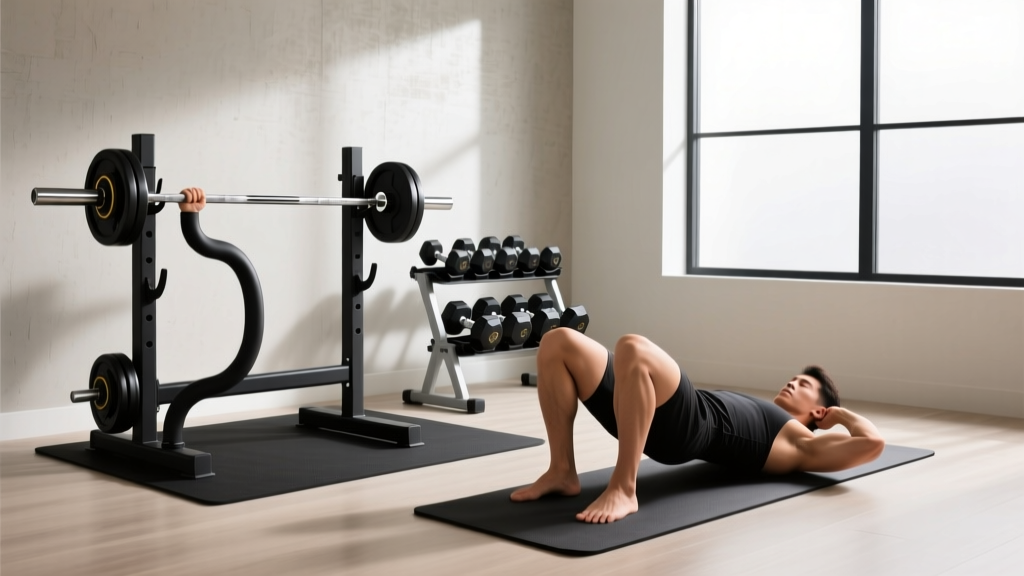
This reclaimed space is critical for establishing a dedicated 'drop zone' or core station. Ground-based anti-extension exercises require uninterrupted longitudinal and lateral clearance. When you transition from heavy barbell isolation to core stabilization, your layout must support the full wingspan of the human body in motion.
Designing the Dumbbell Hollow Hold Station
The dumbbell hollow hold is an advanced core anti-extension movement that demands strict spatial awareness. To perform it correctly, you lie supine, press your lower back into the floor, and extend your arms overhead while gripping dumbbells (typically 15 to 25 lbs, such as Rep Fitness Rubber Hex dumbbells). Your legs remain extended and hovering just inches off the ground.
Layout Pro-Tip: The 8-Foot Rule
Because the arms are extended overhead holding weights, the total longitudinal space required for a 6-foot-tall individual is roughly 8 feet. If your core station is placed too close to a power rack upright or a wall, you risk striking the dumbbells against the steel when fatigue sets in and your form breaks. Always position your core mats at least 4 feet away from the nearest vertical rack obstacle.
To optimize this zone, invest in a 4x6 foot, 3/4-inch thick horse stall mat. This provides a dense, non-slip surface that protects your flooring if you need to drop the dumbbells quickly during a failed rep. According to this Men's Health guide on hollow body mechanics, maintaining a rigid posterior pelvic tilt is the primary goal of the movement; having a dedicated, uncluttered mat space allows you to focus entirely on core tension rather than spatial awareness.
Biomechanics & Equipment Synergy in Micro-Gyms
Pairing EZ curl bar work with the dumbbell hollow hold is not just a space-saving layout strategy; it is a highly effective biomechanical superset. The EZ curl bar places the wrists in a semi-supinated, ergonomically neutral position, heavily targeting the brachialis and biceps brachii. Following this with an overhead dumbbell hollow hold forces the anterior deltoids and rectus abdominis to stabilize the exact same shoulder joint angle under isometric tension.
'The integration of overhead isometric holds with dynamic arm flexion creates a comprehensive anterior chain stimulus. By utilizing compact equipment like EZ bars and modular dumbbells, athletes can maximize training density in restricted square footage without sacrificing joint health or core engagement.' - Strength & Conditioning Layout Principles, 2025
From a layout perspective, keeping your 15-25 lb dumbbells on a low-profile, 3-tier vertical rack directly adjacent to your core mat minimizes transition time. A compact vertical dumbbell rack occupies less than 2 square feet of floor space, compared to a traditional A-frame rack which can consume up to 12 square feet and block sightlines across the gym.
Actionable Layout Blueprints for a 10x10 Room
If you are working within a standard 10x10 foot (100 sq ft) spare room, every inch matters. Here is a proven spatial blueprint that accommodates a power rack, barbell storage, and a dedicated dumbbell hollow hold zone:
- Zone 1: The Rack (Front-Left Corner) - Position a 43-inch wide rack (like the Titan T-2 Series Power Rack) flush against the front and left walls. This anchors the room and leaves the center open.
- Zone 2: Vertical Bar Storage (Right Wall) - Mount a 5-bar vertical storage unit on the right wall. Store your 7ft straight bar and your EZ curl bar here. This eliminates the need for horizontal floor racks, saving roughly 8 square feet.
- Zone 3: The Core Drop Zone (Center-Right) - Lay your 4x6 foot horse stall mat in the center-right of the room, running parallel to the rack. This provides the necessary 8-foot longitudinal clearance for the dumbbell hollow hold, ensuring your overhead dumbbells never collide with the rack uprights.
- Zone 4: Compact Dumbbell Storage (Back-Right) - Place a 3-tier vertical dumbbell rack at the foot of the core mat. This keeps your 15-25 lb hex dumbbells within arm's reach of the hollow hold starting position, streamlining your workout flow.
Frequently Asked Questions
Can I use an EZ curl bar on a standard 49-inch power rack?
No, standard EZ curl bars have a shaft length of only 24 to 28 inches, meaning they cannot span the 49-inch gap between uprights. To use an EZ curl bar safely, you must either use a narrower squat stand (24-30 inches wide), purchase a specialized rack-able EZ curl bar (which features extended sleeves and a 51-inch shaft but is much heavier and more expensive), or perform your curls outside the rack using a freestanding barbell jack.
What weight dumbbells are best for the dumbbell hollow hold?
For most intermediate lifters, 15 to 25 lb rubber hex dumbbells are ideal. The goal of the dumbbell hollow hold is anti-extension core stability, not shoulder hypertrophy. Heavier weights (30+ lbs) often cause the lifter to arch their lower back, breaking the hollow position and shifting the tension away from the rectus abdominis and onto the lumbar spine.
How do I store a 7ft straight bar if I have low ceilings?
If your ceiling height is under 90 inches, vertical storage is impossible. You must utilize horizontal wall-mounted bar hangers. Mount the hangers high on the wall (at least 7 feet off the ground) to ensure the barbell clears your head and your power rack's pull-up bar. This keeps the floor entirely clear for your core mat and dumbbell hollow hold station.
More gear to consider
All reviews
Adjustable Dumbbells vs BalanceFrom Rubber Encased Hex Dumbbells Setup

What Does Dumbbell Fly Work? Barbell Collars & Clamps Compared

Hex vs Urethane: Gear for a 4 Week Dumbbell Workout Plan PDF
Best Neoprene Dumbbells for the Dumbbell Pendlay Row (2026)
Beyond the Dumbbell Snatch WOD: Olympic Barbell Weight & Knurl Guide
