EZ Curl Bar vs Straight Bar Budget & Dumbbell Lunges Form Guide
Compare EZ curl bar vs straight bar costs for your 2026 home gym. Plus, learn how reallocating funds improves your dumbbell lunges form and leg gains.

The Home Gym Budget Dilemma: Upper Body Steel vs. Lower Body Mechanics
Building a functional home gym in 2026 requires ruthless budget optimization. With inflation driving up the cost of raw steel and shipping, the days of outfitting a complete garage gym for under $500 are behind us. When lifters are forced to prioritize their equipment purchases, a common debate emerges in the "Free Weights & Racks" category: should you invest in a specialized EZ curl bar, or stick strictly to a standard straight Olympic barbell?
While upper body arm development often steals the spotlight, a true value analysis requires looking at the entire training ecosystem. In this comprehensive budget breakdown, we will compare the ROI of an EZ curl bar versus a straight bar, and explore how skipping the redundant specialty bar can free up capital to invest in adjustable dumbbells—ultimately allowing you to master your dumbbell lunges form for superior lower-body hypertrophy without the need for a $400 squat rack.
The Straight Barbell: The Ultimate ROI King
The standard 7-foot Olympic barbell is the undisputed cornerstone of any serious lifting setup. From a pure cost-per-exercise perspective, no other piece of equipment comes close to its versatility.
Pricing and Specifications (2026 Market)
- Rogue Ohio Bar: Priced at $205, this remains the gold standard. It features a 205,000 PSI tensile strength shaft, dual knurl marks (powerlifting and weightlifting), and a 28.5mm diameter that is comfortable for both pressing and curling.
- Titan Fitness Performance Olympic Bar: A budget-friendly alternative at $149. It offers a 165,000 PSI tensile strength and basic bushings, making it perfectly adequate for beginners and intermediate lifters.
The straight bar forces your wrists into full supination (palms facing directly upward) during bicep curls. While this maximizes the activation of the short head of the biceps brachii, it can place excessive valgus stress on the medial epicondyle, potentially leading to golfer’s elbow in lifters with a high carrying angle (cubitus valgus) or limited radioulnar joint mobility.
The EZ Curl Bar: Ergonomic Luxury or Budget Drain?
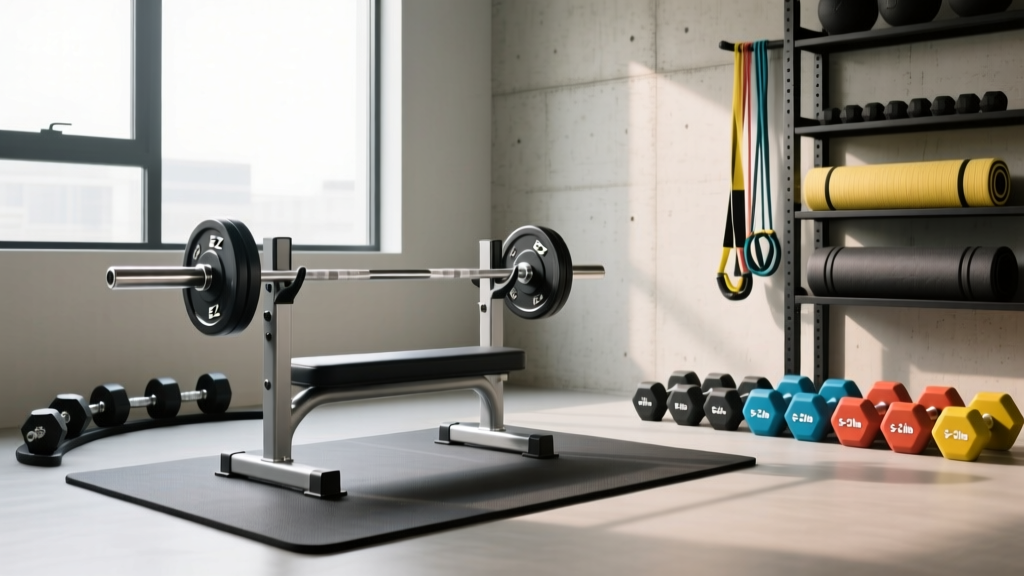
The EZ curl bar features angled grips (typically set at 30 to 45 degrees) that allow for a semi-supinated grip. This subtle shift dramatically reduces torque on the wrists and elbows, making it a favorite for heavy skull crushers and preacher curls.
Pricing and Specifications
- CAP Barbell Super Curl Bar: At $59, this 35-pound solid steel bar is the most common entry-level option. However, its lower tensile strength and aggressive knurling can be harsh on the hands during high-rep sets.
- XMark Elite EZ Curl Bar: Priced around $99, it offers superior chrome finishing, smoother sleeve rotation, and more ergonomic grip angles.
Biomechanical Insight: According to ExRx.net's analysis of EZ bar bicep curls, the semi-supinated grip shifts a minor degree of the load from the biceps brachii to the brachialis and brachioradialis. While this is excellent for overall arm thickness, it is not strictly necessary for beginners who can achieve similar results with neutral-grip dumbbell hammer curls.
Head-to-Head Budget & Value Matrix
To visualize the true value proposition, let us break down the financial and functional footprint of both bars in a standard home gym environment.
| Equipment | Avg Cost (2026) | Cost-Per-Exercise Ratio | Wrist Ergonomics | Space Footprint |
|---|---|---|---|---|
| Straight Olympic Bar | $149 - $205 | Extremely Low (Used in 80% of lifts) | Poor for heavy isolation curls | 7' x 2' (Requires wide clearance) |
| Standard EZ Curl Bar | $59 - $99 | High (Limited to arms/triceps) | Excellent (Reduces medial stress) | 4' x 1' (Highly compact) |
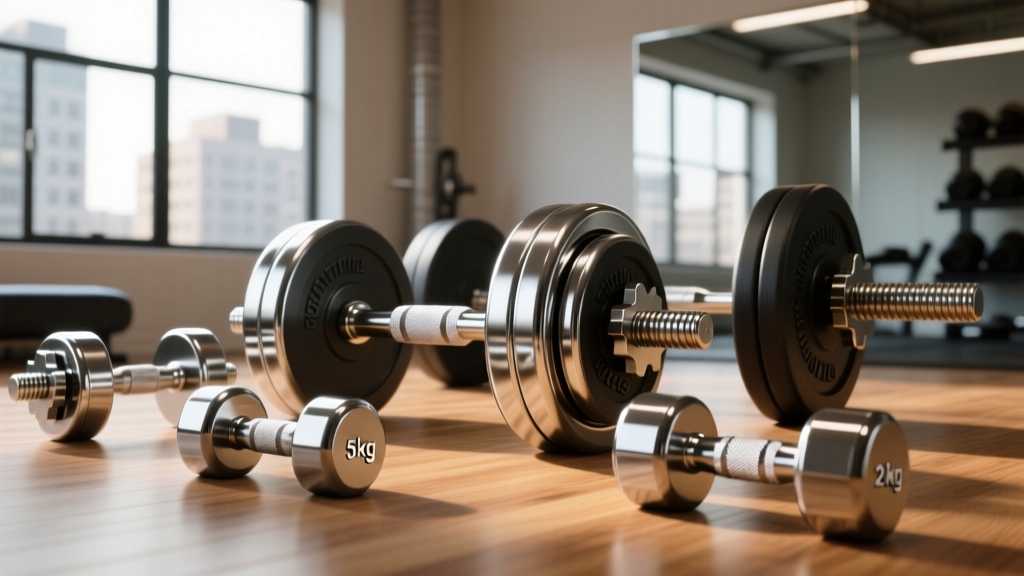
| Adjustable Dumbbells (Pair) | $349 - $429 | Very Low (Full body unilateral) | Neutral grip options available | 1.5' x 1' (Minimal footprint) |
The Budget Pivot: Reallocating Funds to Master Dumbbell Lunges Form
Here is where the value analysis shifts from upper body isolation to full-body functional hypertrophy. If you are on a strict $400 budget, purchasing a $149 Titan straight bar and $150 worth of bumper plates leaves you with roughly $100. Instead of blowing that remaining cash on an EZ curl bar (which you can supplement with cheap $25 dumbbell hammer curls anyway), you should roll that $100 into a savings fund for a high-quality adjustable dumbbell set, like the Nuobell 80s ($349).
Why? Because adjustable dumbbells unlock the most effective rack-free leg builder in existence: the walking lunge. Without a squat rack, barbell back squats are impossible. But with a pair of heavy dumbbells, you can build massive quadriceps and glutes—provided your dumbbell lunges form is dialed in perfectly to prevent knee shear and maximize muscle tension.
Step-by-Step Dumbbell Lunges Form Breakdown
Proper execution is critical. According to ExRx.net's biomechanical breakdown of the dumbbell lunge, the lunge is a closed-kinetic-chain exercise that demands high stabilizer recruitment. Here is how to optimize your form based on your hypertrophy goals:
- The Stance and Step Length: Start with feet hip-width apart. Your step length dictates muscle bias. A shorter step (18-24 inches) with a vertical shin angle biases the quadriceps. A longer step (28-36 inches) with a forward shin angle biases the glutes and hamstrings.
- Torso Angle: For quad development, keep your torso completely upright. For glute development, allow a 15-degree forward hinge at the hips, ensuring your spine remains neutral.
- Knee Tracking: As you descend, your front knee must track directly over your mid-foot. Avoid valgus collapse (the knee caving inward), which places catastrophic stress on the MCL and ACL.
- The Descent and Hover: Lower your body under control for a 2-second eccentric phase. Your rear knee should hover exactly 1 inch above the floor. Do not slam your knee into the ground, and do not use the stretch reflex to bounce back up.
- The Drive: Push through the mid-foot and heel of your front leg to return to the starting position. The rear leg should act purely as a kickstand for balance, not a source of power.
Final Verdict: Where Should Your Money Go?
When analyzing the budget breakdown of free weights, the straight barbell is a non-negotiable investment for progressive overload on compound hinges and presses. The EZ curl bar, while ergonomically superior for heavy triceps extensions and bicep isolation, is a luxury item that offers a poor cost-per-exercise ratio for budget-conscious lifters.
By skipping the $99 EZ curl bar and utilizing your straight bar for basic curls (or investing in cheap hex dumbbells for neutral-grip work), you can redirect your capital toward adjustable dumbbells. This strategic pivot not only saves you money but forces you to master your dumbbell lunges form, ultimately yielding a more balanced, athletic, and aesthetically complete physique in your 2026 home gym setup.
✅ FitGearPulse Recommendation: Buy the Titan Fitness Performance Olympic Bar ($149) and a set of used iron plates. Skip the EZ bar. Put the remaining budget toward a pair of Bowflex SelectTech 552s or Nuobells, and dedicate your next three leg days to perfecting your walking lunge mechanics.More gear to consider
All reviews
Great Bicep Workouts With Dumbbells: 2026 Loadable Plate Review

Power Rack vs Squat Rack vs Stand: Stationary Lunges with Dumbbells

Beyond the Dumbbells PNG: Troubleshooting Neoprene Dumbbells
EZ Bar vs Straight Bar & Seated Bent Over Two Arm Dumbbell Triceps Extension
Tricep Extension Dumbbell Form: Rubber Hex vs Urethane Value