2026 Dumbbell Rack Trends: Storage for Push Presses with Dumbbells
Analyze 2026 dumbbell rack market trends driven by overhead lifts. Discover how ergonomic storage solutions optimize safety for push presses with dumbbells.

The landscape of functional fitness and athletic conditioning has evolved dramatically. As training methodologies increasingly prioritize explosive overhead power, the frequency of athletes performing push presses with dumbbells has surged. However, this shift in training focus has exposed a critical, often overlooked vulnerability in gym infrastructure: the dumbbell rack. In 2026, the market for free weight storage is no longer just about organization; it is fundamentally driven by biomechanical safety, specifically the demands of heavy overhead lifts.
Getting 90-pound hex dumbbells from a flat rack to the shoulders without compromising the lumbar spine or rotator cuff is a notorious challenge. This comprehensive market analysis explores how the rising popularity of push presses with dumbbells is dictating the design, material engineering, and spatial layout of modern dumbbell storage solutions.
The Biomechanical Catalyst: Why Overhead Power Demands Better Storage
To understand the 2026 dumbbell rack market, we must first analyze the movement that is driving it. The push press relies on an aggressive leg drive to propel heavy loads overhead. But the lift does not begin with the press; it begins with the clean-to-shoulder phase. When athletes retrieve heavy dumbbells from traditional, flat-tiered horizontal racks, they are forced into a compromised mechanical position.
Biomechanical research highlighted by the National Strength and Conditioning Association (NSCA) emphasizes that asymmetrical loading and awkward grip transitions during the clean phase drastically increase the risk of acute shoulder and wrist injuries. Furthermore, clinical overviews of shoulder mechanics by the Mayo Clinic note that repetitive internal rotation and overhead compression can lead to severe rotator cuff tendinopathy. Consequently, gym owners and elite home-gym builders in 2026 are abandoning flat racks in favor of ergonomically angled and vertical storage systems that allow for a neutral-grip, scoop-style clean directly into the front rack position.
2026 Market Analysis: The Shift to Angled and Vertical Tiers
According to recent industry data from the Health & Fitness Association, commercial facility investments in specialized, ergonomic free-weight storage grew by over 22% between 2024 and 2025, a trend that has firmly entrenched itself in 2026. Manufacturers have responded by re-engineering the cradle angle and the steel gauge of their racks.
Material and Gauge Evolution
Heavy push presses require heavy dumbbells, which in turn demand higher load-bearing rack capacities. The industry standard has shifted from 12-gauge steel to 11-gauge and even 7-gauge steel for commercial units. Furthermore, the dominance of urethane-coated dumbbells (which are denser and more expensive than traditional rubber) necessitates wider saddle spacing to prevent the bells from grinding against each other, which degrades the urethane over time.
| Rack Configuration | Ergonomic Score for Push Press | 2026 Avg. Market Price | Optimal Steel Gauge |
|---|---|---|---|
| Traditional Flat 3-Tier | Poor (High injury risk) | $250 - $399 | 12-Gauge |
| 45-Degree Angled Cradle | Excellent (Neutral grip scoop) | $450 - $699 | 11-Gauge |
| Vertical A-Frame / Tower | Superior (Deadlift-to-clean) | $600 - $950 | 7 to 11-Gauge |
Heavy-Duty Rack Configurations Dominating the 2026 Market
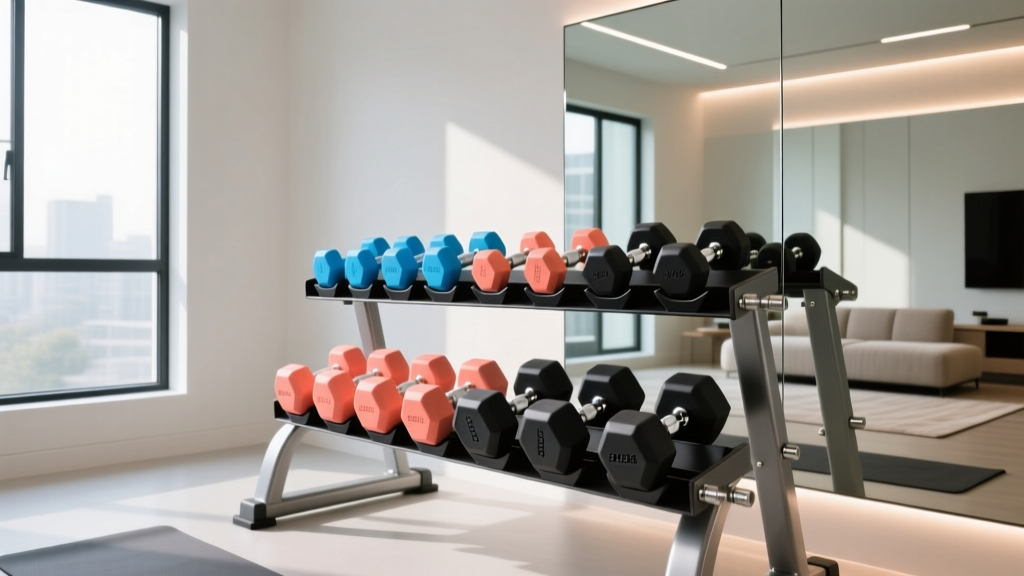
For facilities and serious home gym owners prioritizing overhead power, specific models have emerged as the gold standard. These racks are designed not just to hold weight, but to facilitate the safe initiation of the push press.
- Rogue 3-Tier Dumbbell Rack (Angled Saddle Edition): Priced at approximately $595, Rogue's updated 2026 model features 11-gauge steel and a 15-degree angled shelf specifically designed to keep the dumbbell handle parallel to the floor, allowing for a seamless neutral-grip clean. It holds up to 10 pairs and features integrated rubber saddles to protect urethane coatings.
- Rep Fitness DB-5000 3-Tier Rack: Coming in at a highly competitive $449, the DB-5000 utilizes a steep 45-degree angle on the bottom tier. This aggressive angle allows athletes to hinge at the hips and deadlift the dumbbell directly upward into the clean, entirely bypassing the dangerous lumbar rounding associated with flat bottom shelves.
- Eleiko Olympic Dumbbell Rack: The premium choice for elite athletic facilities, priced around $1,250. Eleiko's rack is engineered with wider cradle spacing to accommodate their large-diameter Olympic dumbbell handles. The ultra-low bottom tier is essentially at floor level, functioning as a deadlift platform to initiate the clean for heavy push presses with dumbbells safely.
"The rack is the first repetition of any dumbbell lift. If your storage solution forces you into a compromised spinal position just to get the weight to your shoulders, you have already lost the biomechanical battle before the push press even begins."
— Dr. Marcus Vance, Sports Biomechanist
Facility Layout: Clearance and 'Bail-Out' Zones
The market analysis of dumbbell racks is incomplete without addressing spatial geometry. When athletes execute heavy push presses with dumbbells, failure is a reality. Unlike a barbell push press where the weight can be safely dumped forward or caught in a rack, dumbbells must be dropped laterally or guided down to the floor. This necessitates a rethinking of how racks are placed on the gym floor.
Calculating the Drop Zone
In 2026, top-tier facility designers adhere to the '36-Inch Rule' for dumbbell rack placement. This framework dictates the minimum safe distance between the rack and the lifting platform.
- The Lateral Bail-Out (36 Inches): When an athlete fails a 90 lb dumbbell push press, they will naturally drop the weights to their sides. If the dumbbell rack is positioned closer than 36 inches to the lifter, the dropped hex or urethane dumbbells will violently collide with the rack's uprights. This not only shatters the expensive urethane bells but can also compromise the structural welds of an 11-gauge steel rack over time.
- The Forward Hinge Clearance (24 Inches): For racks with steep 45-degree angled tiers, athletes need adequate toe-room to hinge forward and grip the bottom-tier dumbbells without their knees striking the shelf above. A minimum of 24 inches of clear floor space directly in front of the rack is mandatory for safe retrieval.
- Platform Integration: The most advanced 2026 gym layouts embed the dumbbell rack directly into the perimeter of the Olympic lifting platform, facing inward, ensuring that the 'drop zone' is always directed toward the center of the rubber platform, away from high-traffic walkways.
Final Verdict: Investing in Ergonomic Infrastructure
The era of treating the dumbbell rack as a mere closet for free weights is over. As the programming of push presses with dumbbells continues to dominate functional fitness, athletic performance, and hypertrophy protocols, the equipment used to store these tools must evolve in tandem. The 2026 market clearly favors 11-gauge steel, 45-degree angled cradles, and wider urethane-friendly spacing. By investing in biomechanically optimized storage solutions, facility owners and home gym enthusiasts are not just organizing their space—they are actively engineering a safer, more powerful environment for overhead excellence.
More gear to consider
All reviews
Bowflex Dumbbells with Bench & The Standard vs Olympic Plate Mistake

Cast Iron vs Competition Bells & Dumbbell Romanian Deadlift GIF Trends

Cast Iron vs Competition KB Care: 30 Min Glute Workout with Dumbbells
Kettlebell Care: Cast Iron vs Competition & the Dumbbell JM Press
Kettlebell Layouts: Cast Iron vs Competition & The Pullover Dumbbell