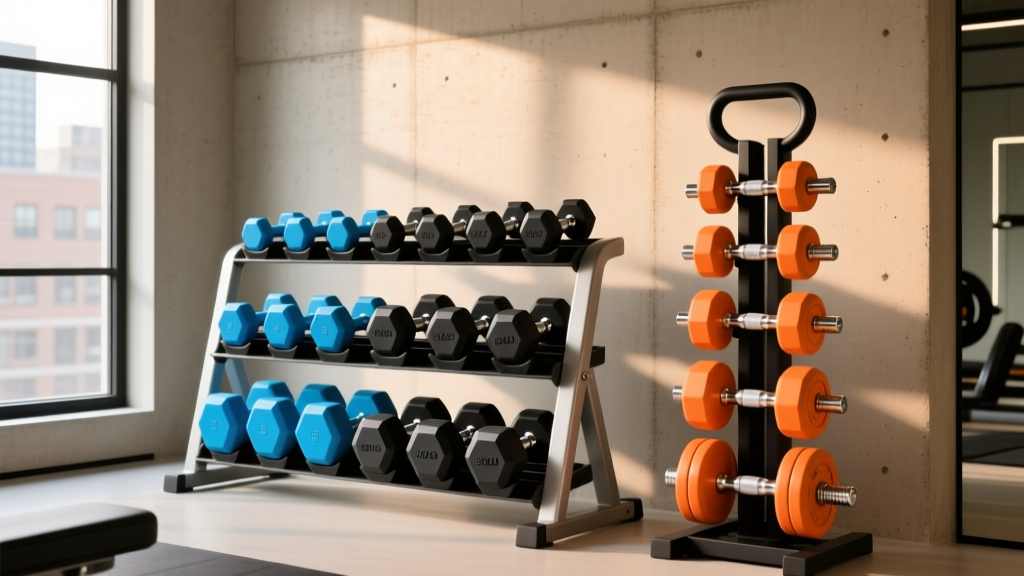
Organizing Your Dumbbell Core: 2026 Rack & Storage Trends
Discover 2026 market trends for dumbbell rack and storage solutions. Compare top tiered, vertical, and adjustable cradle systems for your dumbbell core.

When curating your dumbbell core—the foundational set of weights that anchors your daily programming, whether for high-rep metabolic conditioning or heavy unilateral hypertrophy—storage is rarely the first consideration. Yet, as we navigate the 2026 fitness equipment landscape, the market has decisively shifted. Dumbbell racks are no longer utilitarian afterthoughts; they are engineered load-management systems designed to protect expensive urethane coatings, optimize gym floor footprints, and integrate seamlessly into modern commercial and premium home gym aesthetics.
This trend report analyzes the current state of dumbbell storage, dissecting the engineering upgrades, material standards, and spatial frameworks defining the 2026 market. Whether you are outfitting a boutique functional fitness studio or reorganizing a garage gym, understanding these storage dynamics is critical to protecting your investment.
2026 Market Snapshot: The Storage Shift
According to recent analyses of ACSM Global Fitness Trends, strength training with free weights remains a top-three global fitness staple. Consequently, the peripheral storage market has seen a 14% year-over-year growth in the premium segment. The defining 2026 trend is ergonomic preservation: consumers and gym owners are actively rejecting flat-shelf racks in favor of angled, cradle-style storage that prevents urethane degradation and handle-junction tearing.
The Physics of Rack Failure: Why Flat Shelves Are Obsolete
To understand the 2026 market, we must first examine the failure modes of legacy storage. Historically, budget racks utilized flat, horizontal steel shelves. While adequate for lightweight neoprene or cast-iron sets, flat shelves are catastrophic for modern rubber and urethane hex dumbbells exceeding 40 pounds.
The Urethane Degradation Factor
When a 75-pound urethane dumbbell rests on a flat steel shelf, the entirety of the gravitational load is concentrated on the bottom edge of the hex head. Over a 6-to-12-month period, this localized pressure causes micro-tears in the urethane bond where the head meets the steel handle. Furthermore, the constant rolling and re-seating on flat surfaces accelerates edge rounding. The 2026 industry standard, championed by premium manufacturers like Rogue Fitness, is the 15-degree inclined shelf. This angle forces the dumbbell to rest flush against the backstop, distributing the load across the entire lateral face of the hex head and eliminating edge stress.
Gauge Thickness and Load Bowing
A standard 3-tier rack holding 10 pairs of 50-pound dumbbells must support 1,500 pounds of dynamic load (factoring in the impact force of users dropping weights onto the rack). Budget racks utilizing 14-gauge steel (0.083 inches thick) are highly susceptible to medial bowing and eventual weld fracture at the gusset points. The 2026 baseline for commercial and serious home gym storage is 11-gauge steel (0.120 inches), often reinforced with robotic MIG welding on primary stress joints and TIG welding on intricate cradle seams.
2026 Market Leaders: Tiered Rack Comparison Matrix
The following matrix evaluates the top-tier storage solutions currently dominating the market, specifically focusing on their compatibility with a standard 5-to-50 pound rubber hex dumbbell core.
| Brand & Model | Shelf Angle | Steel Gauge | Max Capacity | 2026 MSRP |
|---|---|---|---|---|
| Rogue Rubber Hex Rack (3-Tier) | 15° Incline | 11-Gauge | 1,500+ lbs | $495.00 |
| Rep Fitness 3-Tier DB Rack | 12° Incline | 11-Gauge | 1,200 lbs | $299.00 |
| Titan Fitness 3-Tier Storage | Flat / 5° Lip | 12-Gauge | 800 lbs | $199.00 |
| Bells of Steel A-Frame | Vertical Pegs | 11-Gauge | 600 lbs | $249.00 |
Market Analysis Note: As highlighted in BarBend's Dumbbell Rack Testing Methodology, the Rep Fitness and Rogue models consistently outperform in long-term deflection tests, whereas budget models with flat shelves or lower-gauge steel show visible sagging within 18 months of heavy commercial use.
The Adjustable Dumbbell Disruption: Cradle Integration
The most significant market disruptor impacting storage in 2026 is the mass adoption of heavy-duty adjustable dumbbells (e.g., Nuobell 80s, PowerBlock Commercial Pro). Traditional tiered racks designed for a standard dumbbell core are fundamentally incompatible with these systems.
- The Width Problem: Standard hex dumbbell racks feature 4.5-inch to 5-inch shelf slots. Adjustable dumbbells with locking cradles often require a 7.5-inch to 8.5-inch clearance. Forcing an adjustable dumbbell into a standard tiered rack risks scraping the selector dial or damaging the base plate.
- The Solution - Modular Cradles: Leading manufacturers are now offering "hybrid" racks. These feature a standard 2-tier base for fixed hex dumbbells, topped with a specialized, wide-gauge adjustable dumbbell cradle tray. When sourcing storage for a mixed dumbbell core, ensure the rack manufacturer offers bolt-on adjustable trays rather than relying on third-party, poorly fitted aftermarket shelves.
Vertical vs. Horizontal: Space Optimization Frameworks
Floor space remains the ultimate premium in both urban home gyms and high-density boutique studios. The decision between horizontal tiered racks and vertical A-frame solutions requires a precise calculation of your spatial geometry.
Expert Warning on Vertical A-Frames: While A-frames reduce the horizontal footprint to roughly 24" x 24", they introduce a severe center-of-gravity hazard. If users pull a 60-pound dumbbell from the top tier without bracing the base, the rack can tip. In 2026, any vertical A-frame rack exceeding 48 inches in height must be bolted to the floor or feature an extended 36-inch stabilizer base to pass commercial safety audits.
Footprint Math for a 10-Pair Dumbbell Core (5-50 lbs)
- Standard 3-Tier Horizontal Rack: Requires approximately 34" (W) x 22" (D) of floor space. Total footprint: 5.2 square feet. Ideal for placement against walls or as a room divider.
- Vertical A-Frame Rack: Requires approximately 24" (W) x 24" (D) of floor space. Total footprint: 4.0 square feet. Ideal for corner placements or tight corridor gyms, provided ceiling height exceeds 60 inches.
- Wall-Mounted Saddle Brackets: Requires 0 square feet of floor space. The 2026 trend for ultra-compact home gyms involves mounting heavy-duty, 11-gauge steel saddle brackets directly into wall studs (requiring 16-inch on-center stud spacing). This is the most cost-effective and space-efficient method, though it limits expansion.
Purchasing Framework: Matching Your Rack to Your Needs
To finalize your storage investment, apply this three-step decision framework to your specific dumbbell core:
Step 1: Audit Your Weight Distribution
If your core consists primarily of lighter weights (5-25 lbs) for functional fitness and core-focused workouts, a 12-gauge 2-tier rack is sufficient and cost-effective. If your core extends into the 50-100 lb range for heavy strength work, 11-gauge steel and a 15-degree incline are non-negotiable to prevent structural failure and equipment damage.
Step 2: Measure the Handle and Head Geometry
Do not assume universal compatibility. Measure the width of your dumbbell handles (standard is 4.5", but some commercial ergonomic grips exceed 5.5"). Ensure the rack's vertical clearance between tiers accommodates the handle height plus 2 inches of clearance for safe extraction.
Step 3: Evaluate the Finish and Environment
For garage gyms subject to humidity and temperature fluctuations, prioritize racks with a textured powder coat over standard gloss paint. Textured powder coat provides a thicker mil barrier (typically 2.0 to 2.5 mils) against oxidation and provides a better grip when adjusting the rack's position.
Expert Verdict & Future Outlook
The era of treating dumbbell storage as a secondary purchase is over. As the 2026 market demonstrates, the integrity of your dumbbell core relies entirely on the engineering of the rack that holds it. By prioritizing 11-gauge steel, 15-degree angled shelves, and hybrid adjustable compatibility, you ensure that your equipment remains pristine, safe, and ready for the demands of modern training. Invest in the storage, and the storage will protect the investment.
More gear to consider
All reviews
Cable Lateral Raises vs Dumbbell Space: Rubber Hex vs Urethane Guide
Olympic vs Standard Plates: Best Brachialis Exercises with Dumbbells
Troubleshoot Dumbbell Draw Grip & Olympic Barbell Knurling

Olympic Barbell Guide: Weight, Knurling & Lateral Lunges Dumbbells

Olympic vs Standard Plates: Best for EZ Bar Dumbbell Curls?
