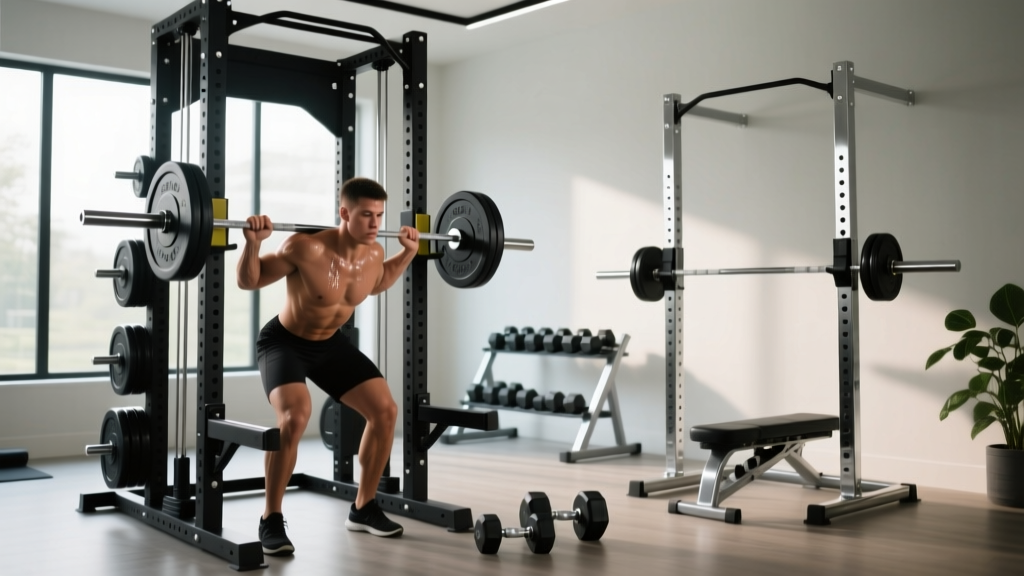
Budget Dumbbell Racks & Storage for Mid Back Exercises with Dumbbells
Optimize your home gym with our budget breakdown of dumbbell racks and storage solutions tailored for mid back exercises with dumbbells.

The Biomechanical Link: Why Storage Impacts Mid Back Training
When outfitting a home gym in 2026, most lifters treat dumbbell storage as an afterthought—tossing their hex or urethane bells into a corner or onto a cheap, wobbly wire shelf. However, if your programming prioritizes mid back exercises with dumbbells, your storage solution is not just about tidiness; it is a critical piece of biomechanical safety equipment.
Consider the setup for an unsupported bent-over dumbbell row. According to ExRx's biomechanical guidelines, the bent-over row requires a rigid hip hinge and a neutral spine to isolate the latissimus dorsi and rhomboids while protecting the lumbar vertebrae. If your 60-pound dumbbells are stored on the floor, you are forced to perform a deep, loaded spinal flexion just to pick them up before the working set even begins. This 'pickup phase' generates massive lumbar shear force, leading to lower back fatigue or injury before you ever pull the weight to your hip.
A properly height-calibrated dumbbell rack (ideally between 36 and 42 inches from the floor) allows you to hinge at the hips, grip the bells, and stand up using a safe, partial Romanian Deadlift (RDL) motion. Below, we break down the budget-friendly rack and storage setups that specifically support the physical demands of mid back training, analyzing their true value, hidden costs, and structural integrity.
2026 Value Matrix: Rack Types vs. Mid Back Applications
Not all racks are created equal. An A-frame serves a completely different logistical purpose than a horizontal 3-tier rack when you are running high-volume back supersets. Here is how the primary storage categories stack up in terms of cost, footprint, and utility for back day.
| Rack Category | Avg Cost (2026) | Footprint | Best Mid Back Application | Primary Drawback |
|---|---|---|---|---|
| A-Frame Rack | $130 - $160 | ~4.5 sq ft | Unilateral Single-Arm Rows, Drop Sets | Harder to read weight markings |
| 3-Tier Horizontal | $150 - $220 | ~12 sq ft | Heavy Chest-Supported Rows, Renegade Rows | Consumes significant wall/floor space |
| Vertical Tower | $180 - $250 | ~3 sq ft | Light Rear Delt Flyes, High-Pull variations | Top-heavy; dangerous for heavy bell storage |
| Bench-Attached | $350 - $450 | ~18 sq ft | Seated Rows, Meadows Rows, Supersets | High upfront cost; limits bench mobility |
Real-World Value Analysis: Top 3 Storage Setups Under $500
Let us look at three specific, budget-conscious configurations that deliver commercial-grade utility for mid back exercises with dumbbells, without requiring a $1,000+ investment.
Setup A: The A-Frame 'Grab-and-Go' (Best for Unilateral Work)
The Rogue Fitness A-Frame retails for approximately $145 and remains the gold standard for budget-conscious lifters who prioritize unilateral mid back exercises with dumbbells, such as single-arm rows and Meadows rows. Constructed from 11-gauge steel, it holds up to 10 pairs of dumbbells.
The Value Proposition: The A-frame's 40-inch peak height is perfectly aligned with the standing hip hinge. When performing heavy single-arm rows, you can grab a 70 lb bell from the top tier without bending over. Furthermore, the angled display allows for rapid weight changes during drop sets, keeping your mid back under continuous tension without breaking your flow to search for numbers on a flat shelf.
Setup B: The 3-Tier Horizontal + Incline Bench (Best for Chest-Supported Rows)
Chest-supported rows are essential for isolating the mid back without lower-back involvement. To execute these properly, you need an incline bench and a rack that stores heavy dumbbells at arm's reach. The Bells of Steel 3-Tier Dumbbell Rack ($179.99) offers a massive 500+ lb weight capacity and features a crucial 2-inch raised lip on each tier.
The Value Proposition: By placing an adjustable bench directly behind or adjacent to a horizontal 3-tier rack, you can sit, lean forward, and grab heavy bells from the middle tier (approx. 26 inches high) which is exactly at arm level when seated on an incline bench. This eliminates the need to hoist heavy dumbbells from the floor to your knees before lying back—a common cause of wrist and shoulder impingement.
Setup C: The Integrated Adjustable Bench Rack (The Space-Saver)
For garage gyms where square footage is at a premium, combining storage and seating is ideal. The Rep Fitness AB-3100 2.0 Adjustable Bench (approx. $399) can be paired with modular dumbbell rack attachments or positioned inside a half-rack pin-and-pipe setup. While pricier, it consolidates your footprint.
The Value Proposition: When performing renegade rows or plank-to-row variations, you need floor clearance and immediate access to your bells. Storing your active dumbbells on the bench's attached rack keeps them off the floor, preventing tripping hazards during dynamic, full-body mid back exercises.
⚠️ Safety Warning: The 'Lip Failure' Edge CaseNever store round or rubber-hex dumbbells on flat, budget-tiered racks (often found for under $80 on big-box retail sites) that lack a minimum 1.5-inch raised lip. Rubber hex dumbbells have a notoriously high center of gravity. When you aggressively rack a 50 lb bell after a grueling set of rows, the kinetic bounce will easily carry it over a shallow lip, resulting in crushed toes or damaged flooring.
Hidden Costs and Failure Modes in Budget Racks
When analyzing value, the purchase price is only half the equation. You must account for the failure modes inherent in ultra-cheap storage solutions marketed toward home gym beginners.
- Tubing Deflection: Many sub-$100 tiered racks use 1-inch thin-wall steel tubing. When loaded with 300+ lbs of iron, the center of the shelf bows. Over 12 to 18 months, this deflection becomes permanent, causing dumbbells to slide toward the center and clump together, making it difficult to grab the correct weight mid-superset.
- Plastic End-Cap Degradation: Budget A-frames often use friction-fit plastic caps on the angled shelves to stop dumbbells from sliding off. In unheated garages, these plastics become brittle and shatter within a year, turning a $90 rack into a slipping hazard.
- Welding Porosity: On cheap integrated bench-rack combos, the welding at the stress points (where the rack meets the bench frame) often lacks proper penetration. A dynamic movement like a heavy renegade row, which applies lateral torque to the frame, can snap these weak welds.
Step-by-Step: Organizing Your Rack for a Mid Back Superset
To maximize the efficiency of your mid back exercises with dumbbells, organize your rack based on biomechanical demand rather than just numerical order.
- Bottom Tier (or Lower A-Frame): Store your heaviest pairs (e.g., 60-100 lbs). This height (approx. 18-24 inches) requires a deep hinge, which is appropriate only when you are mentally prepared for a heavy, supported lift like a chest-supported row.
- Middle Tier (30-36 inches): Store your 'working weight' pairs for bent-over rows and single-arm rows. This is the ergonomic sweet spot for a safe hip-hinge pickup without excessive lumbar loading.
- Top Tier (40+ inches): Reserve this for lighter weights (10-25 lbs) used for rear delt flyes, face pulls, and high-pull variations. Lifting light weights from a high shelf prevents shoulder impingement that can occur when reaching up with heavy loads.
Final Verdict: Maximizing ROI on Your Dumbbell Storage
If your training heavily features mid back exercises with dumbbells, investing $145 to $200 in a high-quality, 11-gauge steel A-Frame or 3-Tier rack is not a luxury—it is a preventative health measure. The ROI is realized in protected lumbar discs, preserved grip energy, and seamless transitions between working sets. Skip the flimsy wire shelving and opt for commercial-grade geometry that respects the biomechanics of the human back. Your spine, and your training volume, will thank you.
More gear to consider
All reviews
How Much Do Dumbbells Cost vs. Barbells? Home Gym Setup Guide

2026 Storage Trends: Racks to Elevate Your Bicep Dumbbell Routine
Rubber Hex vs Urethane: Best Gear for Dumbbell Step Ups on Bench

2026 Adjustable Dumbbell Review & Single Dumbbell Exercises Chart

Rubber Hex vs Urethane Dumbbells for Reverse Dumbbell Curls