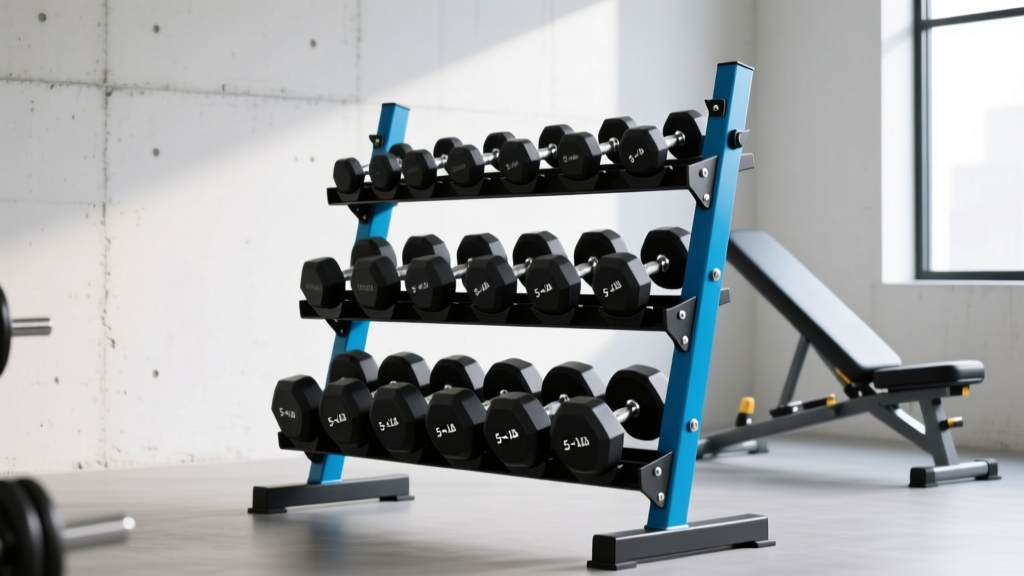
Dumbbell Racks for High Incline Dumbbell Press: 2026 Budget Guide
Analyze the best dumbbell racks for the high incline dumbbell press. Our 2026 budget breakdown compares storage safety, pricing, and ROI for home gyms.

The Hidden Biomechanical Cost of Poor Dumbbell Storage
When building a home gym, the dumbbell rack is often treated as an afterthought—a simple shelving unit to keep the floor clear. However, if your programming heavily features the high incline dumbbell press, your storage solution is actually a critical piece of safety and performance equipment. The high incline dumbbell press, typically performed with the bench backrest set between 60 and 75 degrees, fundamentally alters your spatial relationship to your equipment.
According to biomechanical analyses from ExRx.net, the steep angle heavily recruits the clavicular head of the pectoralis major and the anterior deltoids. Because your torso is nearly upright, your knees are elevated, and your center of gravity is shifted. Retrieving heavy dumbbells (60+ lbs) from a poorly designed rack in this position forces extreme spinal flexion and awkward shoulder internal rotation. This is where budget racks fail, leading to premature rotator cuff fatigue or lower back strain before your working set even begins.
In this 2026 budget breakdown and value analysis, we evaluate dumbbell racks not just by their storage capacity, but by their ergonomic utility for demanding, steep-angle movements like the high incline dumbbell press.
2026 Dumbbell Rack Market: Budget vs. Premium Value Analysis
The fitness equipment market has seen significant price adjustments in 2026 due to stabilized steel and urethane supply chains. Below is a comparative matrix of the most popular rack tiers, analyzing their cost-per-pound of storage and their specific utility for incline press retrieval.
| Rack Model (2026) | Tier / Price | Max Capacity | Incline Retrieval Score | Footprint |
|---|---|---|---|---|
| Yes4All Cast Iron A-Frame | Budget / $89.99 | 400 lbs | 4/10 (Tipping Hazard) | 24 x 26 in |
| Titan Fitness 3-Tier Horizontal | Mid-Tier / $279.99 | 1,000 lbs | 8/10 (Optimal Lip) | 48 x 24 in |
| Rep Fitness 3-Tier Rack | Mid-Tier / $329.00 | 1,200 lbs | 9/10 (Angled Shelves) | 48 x 22 in |
| Rogue Fitness 3-Tier Dumbbell Rack | Premium / $495.00 | 1,500+ lbs | 10/10 (Commercial Grade) | 49 x 25 in |
Tier 1: The Budget A-Frame Trap ($80 - $120)
A-frame racks are ubiquitous in budget home gyms. While they offer a small footprint, they are a liability for the high incline dumbbell press. When your bench is inclined at 70 degrees, your peripheral vision and physical reach are restricted. Grabbing a 70 lb hex dumbbell from the top tier of an A-frame requires a unilateral pulling motion that shifts the rack's center of gravity. The failure mode here is severe: the rack tips toward you, potentially causing a crush injury or tearing a bicep tendon due to the sudden eccentric load.
Value Verdict: Only viable for neoprene or light rubber dumbbells under 25 lbs. Not recommended for heavy incline pressing.
Tier 2: The Mid-Tier 3-Tier Horizontal Sweet Spot ($250 - $350)
The 3-tier horizontal rack is the undisputed champion of value for serious lifters. Models like the Titan Fitness and Rep Fitness racks feature a crucial design element: the retention lip. The Rep Fitness rack, for instance, utilizes a 1.5-inch upward-angled lip on each shelf. When you are seated on a high incline bench, you can reach down, hook your fingers securely around the dumbbell handle in a pronated grip, and lift it vertically without the dumbbell head catching on the shelf edge.
Value Verdict: At roughly $0.25 per pound of storage capacity, this tier offers the best ROI for lifters moving heavy iron on steep inclines.
Tier 3: Commercial Integrated Combos ($450+)
Premium racks from Rogue or Eleiko feature laser-cut steel, UHMW plastic shelf liners to protect urethane dumbbells, and wider 48-to-52-inch spans. The value here is longevity and absolute stability. The 11-gauge steel base prevents any lateral wobble when aggressively racking heavy dumbbells post-failure.
Ergonomics of the High Incline Dumbbell Press Retrieval
The American Council on Exercise (ACE Fitness) emphasizes the importance of proper setup and handling in resistance training to mitigate joint strain. When performing the high incline dumbbell press, the retrieval and racking phases are where 90% of non-impact shoulder injuries occur. Here is the optimal, biomechanically sound retrieval sequence:
- Lateral Placement: Position the 3-tier rack exactly 18 to 24 inches lateral to your bench. This allows you to reach the middle tier without twisting your thoracic spine.
- The Middle-Tier Rule: For heavy incline presses (60+ lbs), always store your working weights on the middle tier. The top tier requires excessive shoulder flexion to clear the lip; the bottom tier requires deep hip hinging while seated.
- The Neutral-Grip Hook: Reach out with a neutral grip (palms facing each other), secure the handle, and pull the dumbbell onto your thigh. Do not attempt to curl the weight up from a bottom shelf while seated at a 75-degree angle.
If you purchase budget rubber-coated dumbbells, you will notice they 'drag' against the steel shelves of a 3-tier rack, making retrieval during a high incline press frustrating and jerky. Urethane dumbbells have a much lower drag coefficient and glide smoothly over the rack's retention lip. If you are on a strict budget, allocate funds toward a mid-tier rack first, and upgrade from rubber to urethane dumbbells progressively to improve retrieval ergonomics.
Calculating the True ROI of Your Storage Setup
To determine the true value of a dumbbell rack, we must look beyond the initial purchase price and calculate the Cost Per Ergonomic Retrieval (CPER). If a budget $90 A-frame rack forces you to spend 30 extra seconds wrestling with heavy dumbbells, disrupts your rest periods, and increases your risk of a labral tear, the hidden cost is astronomical.
- Budget A-Frame ($90): High friction, high injury risk. CPER is negative due to potential physical therapy costs and disrupted workout flow.
- Mid-Tier 3-Tier ($299): Smooth retrieval, secure lip, stable base. Pays for itself by preserving your rest intervals and protecting your rotator cuffs during heavy incline sets.
- Premium Commercial ($495+): Diminishing returns for the average home gym user, unless you are running a commercial facility or own over 1,000 lbs of urethane dumbbells.
Final Verdict: Where to Allocate Your 2026 Budget
If the high incline dumbbell press is a cornerstone of your upper-body hypertrophy programming, your dumbbell rack is not merely a storage accessory; it is an integral part of your lifting apparatus. The steep angle of the incline press demands a storage solution that accommodates a seated, restricted range of motion.
The FitGearPulse Recommendation
Skip the vertical stands and A-frames. Invest the $250 to $350 required for a mid-tier 3-tier horizontal rack with an angled retention lip. Ensure the rack is at least 48 inches wide to accommodate 10 pairs of dumbbells, leaving enough lateral space to safely execute the 'thigh-kick' retrieval method without your elbows striking adjacent weights. This single equipment upgrade will instantly improve the safety, tempo, and overall value of your incline pressing sessions.
For more insights on optimizing your home gym layout and protecting your joints during heavy free-weight movements, consult the resistance training safety guidelines published by the National Strength and Conditioning Association (NSCA). Proper equipment selection is the first line of defense against preventable gym injuries.
More gear to consider
All reviews
Dumbbell Workout at Home for Men vs Olympic Barbells

Bench Press Dumbbells vs Barbell: Rubber Hex vs Urethane Care
Counterfeit Bowflex Dumbbells: 2026 Storage & Rack Safety Trends
Bumper vs Iron Plates: Layouts & CrossFit Exercises with Dumbbells
Barbell Collar vs Clamp Comparison & Dumbbell Exercises With Pictures
