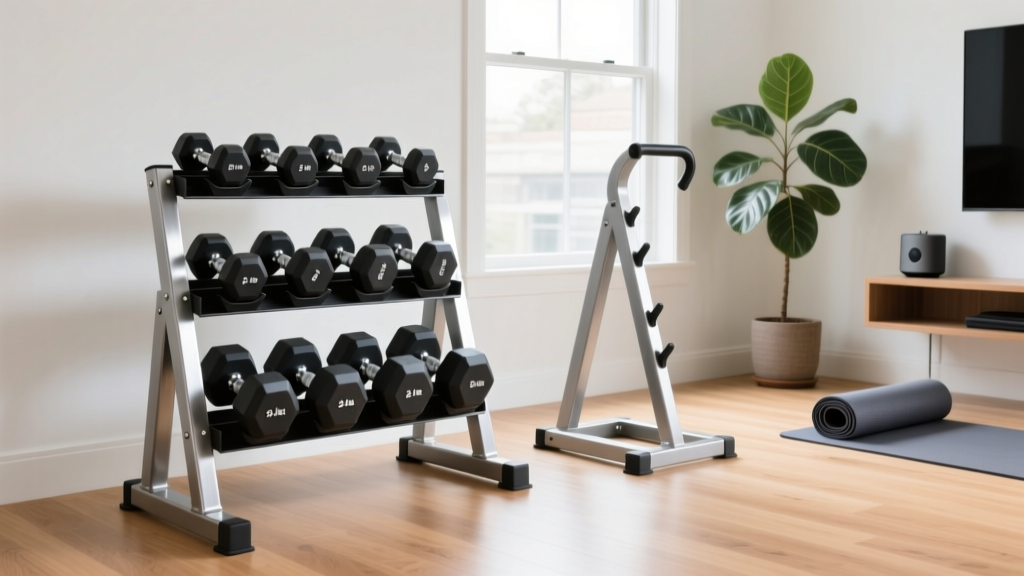
Dumbbell Racks for Lateral Raise Workouts: 2026 Budget Guide
Analyze 2026 dumbbell rack budgets for lateral raise drop sets. Compare A-frames vs 3-tier storage, pricing, and footprint value for home gyms.

The Hidden Cost of Poor Storage for Isolation Movements
When building a home gym, most lifters obsess over the power rack or the barbell, leaving dumbbell storage as an afterthought. But if your programming includes high-volume isolation work—specifically the dumbbell lateral raise—your storage solution directly impacts your workout efficiency and safety. Lateral raises require precise micro-loading and frequent drop sets. Fumbling through a disorganized pile of hex dumbbells while your medial deltoids are burning isn't just frustrating; it disrupts your time-under-tension and increases the risk of dropping a weight on your foot.
In this 2026 budget breakdown, we analyze the true value of dumbbell racks through the lens of isolation training. We will evaluate vertical A-frames, horizontal 3-tier systems, and commercial-grade cradles, calculating the cost-per-pair and footprint efficiency to help you find the exact right storage solution for your budget.
Expert Insight: The Lateral Raise Drop-Set DilemmaA proper lateral raise progression requires 2.5 lb to 5 lb weight jumps (e.g., 10, 12.5, 15, 17.5, and 20 lbs). You need 5 to 10 pairs of light-to-medium dumbbells immediately accessible. Standard heavy-duty racks designed for 50-100 lb dumbbells often waste space on the bottom tiers, whereas isolation-focused storage requires maximizing the 5-30 lb tier real estate.
2026 Dumbbell Rack Budget Matrix
Before diving into specific models, let us look at the current market tiers. Prices reflect early 2026 MSRP data for raw steel and basic coated racks, excluding the cost of the dumbbells themselves.
| Rack Tier | Model Example | MSRP (2026) | Capacity | Footprint | Cost-Per-Pair |
|---|---|---|---|---|---|
| Entry (Vertical) | Yes4All A-Frame | $89 | 5 Pairs (5-25 lbs) | 24" x 24" | $17.80 |
| Mid (Horizontal) | REP Fitness 3-Tier | $299 | 10 Pairs (5-50 lbs) | 48" x 24" | $29.90 |
| Premium (Commercial) | Rogue 3-Tier Rack | $695 | 10 Pairs (5-50 lbs) | 49" x 25" | $69.50 |
Tier 1: The Sub-$150 Vertical A-Frames (High Risk, Low Cost)
For lifters on a strict budget who only own a few pairs of lighter dumbbells for lateral raises and curls, the vertical A-frame is the default choice. The Yes4All Vertical Dumbbell Rack (typically priced around $89) features a compact 24x24 inch footprint, making it ideal for apartment gyms or tight garage corners.
The Value Proposition
At $17.80 per pair stored, the A-frame is mathematically the most efficient use of capital for small collections. It keeps your 10, 15, and 20 lb dumbbells off the floor and vertically stacked, which is excellent for quick visual identification during a lateral raise drop set.
Edge Cases & Failure Modes
- The Tipping Hazard: This is the most critical failure mode of A-frames. If you remove a 25 lb dumbbell from the top right peg, and the bottom left peg is empty, the center of gravity shifts dangerously. According to BarBend's comprehensive rack testing, asymmetrical loading on budget A-frames frequently results in forward tipping, especially on rubber matting that grips the feet and prevents sliding.
- Peg Degradation: Budget A-frames use plastic or thin rubber sleeves over metal pegs. Over 12-18 months of repeated friction from cast iron or rubber hex dumbbells, these sleeves tear, leading to metal-on-metal scraping and damaged dumbbell handles.
Tier 2: The $200–$400 Horizontal 3-Tier (The Value Sweet Spot)
If your dumbbell collection exceeds 5 pairs, or if you utilize fractional plates for micro-loading your lateral raises, a horizontal 3-tier rack is mandatory. The REP Fitness 3-Tier Storage system (MSRP $299) represents the gold standard for home gym value in 2026.
Shelf Geometry: Saddle vs. Flat
When evaluating mid-tier racks, you must match the shelf geometry to your dumbbell type. REP Fitness and similar brands often offer 'saddle' shelves (curved edges) or 'flat' shelves with end-stops.
Warning: Never place hex dumbbells on saddle-style shelves. The angled edges will cause the flat sides of the hex dumbbell to rest unevenly, creating a rolling hazard. Saddle shelves are strictly for round-head or urethane dumbbells. Hex dumbbells require flat shelves with welded lip-stops.Ergonomics for the Fatigued Lifter
Consider the biomechanics of a lateral raise drop set. You start with 25s, fail, and immediately grab the 20s, then the 15s. On a standard 3-tier rack, the bottom tier is often just 6 inches off the floor. Bending over at the waist while holding fatiguing weights to grab the next pair places unnecessary shear force on your lumbar spine.
Pro-Tip: When assembling a 3-tier rack for isolation work, leave the bottom tier empty (use it for kettlebell or plate storage) and stack your lateral raise dumbbells on the middle and top tiers, keeping them between waist and chest height.
Tier 3: The $600+ Commercial Urethane Cradles
Why would a home gym owner spend $695 on the Rogue Fitness 3-Tier Dumbbell Rack? The answer lies in steel gauge, welding precision, and long-term asset protection.
Where the Budget Goes
Premium racks utilize 11-gauge or 7-gauge steel uprights with laser-cut saddles. When you drop a 50 lb rubber-encased dumbbell onto a budget $200 rack, the impact force can bend the horizontal support rails over time, causing a 'smile' deflection in the middle of the shelf. Rogue's commercial racks feature reinforced cross-bracing that eliminates this deflection entirely.
Furthermore, commercial racks feature wider spacing (typically 48 to 52 inches wide) to accommodate larger commercial-grade dumbbells. If you upgrade from cheap Amazon hex dumbbells to premium urethane sets in the future, a budget rack will likely be too narrow to hold the wider heads of high-end urethane bells.
Calculating True Value: Floor Space vs. Budget
In real estate, value is measured in price-per-square-foot. The same logic applies to gym flooring, which costs between $2.50 and $4.00 per square foot to install.
"An A-frame takes up 4 square feet but only holds 5 pairs. A 3-tier rack takes up 8 square feet but holds 10 pairs. While the 3-tier rack costs 3x more upfront, its storage density per square foot of expensive rubber matting is vastly superior for growing home gyms."
If you are renting a commercial space for a boutique studio, floor space is your highest overhead. In that scenario, the vertical A-frame's small footprint justifies its lower capacity and tipping risks, provided it is bolted to a wall stud for safety.
Expert Troubleshooting & Maintenance Checklist
To ensure your rack investment lasts a decade, implement these maintenance protocols:
- Monthly Bolt Torquing: Budget racks use standard hex bolts that vibrate loose when heavy dumbbells are slammed onto the shelves. Check and tighten all structural bolts every 30 days.
- Rubber Off-Gassing Protection: Cheap rubber dumbbells off-gas VOCs and leave a black, oily residue on steel shelves. Wipe down your rack shelves monthly with a mild degreaser to prevent the rubber from chemically bonding to the steel paint.
- Shim the Feet: Most garage floors are sloped for drainage. If your 3-tier rack sits on a slope, the weight distribution shifts to the front two legs. Use steel shims under the rear feet to ensure the rack is perfectly plumb, preventing forward tipping during heavy loading.
Frequently Asked Questions
Can I use a wall-mounted rack for lateral raise dumbbells?
Wall-mounted racks are excellent for saving floor space, but they require mounting directly into wooden studs or masonry. Drywall anchors will fail under the dynamic load of placing a 20 lb dumbbell onto a peg. For light lateral raise dumbbells (5-15 lbs), a stud-mounted wall rack is a highly cost-effective, space-saving solution.
Do I need a rack if I only own adjustable dumbbells?
If you use adjustable dumbbells (like Bowflex or Nuobell), you do not need a traditional multi-pair rack. However, you still need the proprietary storage trays that come with them to protect the internal dial mechanisms from dust and impact. Never store adjustable dumbbells directly on the floor.
More gear to consider
All reviews
Bumper vs Iron Plates & Back Arms Workout with Dumbbells

Best Adjustable Dumbbells for the Dumbbell One Arm Swing (2026)

Skull Crushers One Dumbbell: Beginner Guide & Top Adjustable Picks
Bumper vs Iron Plates: Budgeting for a Dumbbell Weight Routine
EZ Curl Bar vs Straight Bar & Tricep Curls Dumbbell Value Analysis
