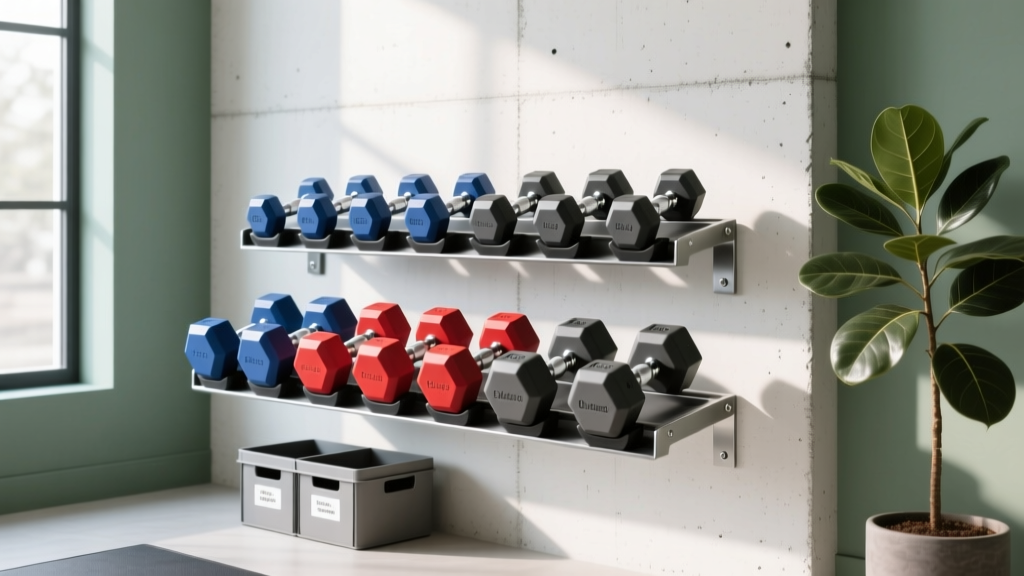
Dumbbell Hypertrophy Program Setup: Rack & Storage Budget Guide
Discover the true cost of equipping a dumbbell hypertrophy program. We break down rack and storage budgets, from adjustable stands to 3-tier hex vaults.

When designing a dedicated dumbbell hypertrophy program, most lifters fixate entirely on the cost of the iron. However, as your strength progresses, the infrastructure required to store those weights becomes a massive, often underestimated line item in your home gym budget. Progressive overload—the absolute cornerstone of muscle growth—demands a wide spectrum of weights. You cannot effectively run a 12-week hypertrophy block with a single pair of 25-pounders. You need a full arsenal, and that arsenal requires heavy-duty, safe, and accessible storage.
Quick Budget Summary
- Tier 1 (Adjustable): $500 - $700 (Best for small spaces & beginners)
- Tier 2 (Fixed Hex 5-50lbs): $1,200 - $1,800 (The hypertrophy sweet spot)
- Tier 3 (Urethane 5-100lbs): $3,500 - $5,000+ (Commercial-grade, requires structural checks)
The Hidden Infrastructure Tax of Progressive Overload
A true hypertrophy program requires you to train close to muscular failure across various rep ranges (typically 5-30 reps). This means you need heavy dumbbells for low-rep mechanical tension and lighter dumbbells for high-rep metabolic stress. Furthermore, advanced hypertrophy techniques like drop sets and rest-pause sets require immediate access to multiple weight increments. If your storage solution forces you to walk across the room, bend down, and fumble with a dial mechanism, you lose the metabolic tension necessary to maximize the training stimulus. Therefore, your rack is not just a shelf; it is an active piece of training equipment that dictates the flow and intensity of your workouts.
Tier 1: The Minimalist Adjustable Setup (Budget: $500 - $700)
For those constrained by space or immediate capital, adjustable dumbbells are the entry point. However, pairing them with the right stand is critical for safety and ergonomics.
The Gear: Nuobell 80lb Set + Core Home Fitness Stand
- Dumbbells: Nuobell 80lb Adjustable Pair (~$429)
- Storage: Core Home Fitness Adjustable Dumbbell Stand (~$139)
- Total Footprint: 22" x 18"
Value Analysis: The Nuobell system uses a smooth twist-handle mechanism that mimics the feel of a fixed dumbbell, which is vastly superior for pressing movements compared to bulky dial-based competitors. The Core Home Fitness stand elevates the weights to roughly 28 inches, saving your lower back from repetitive bending during heavy goblet squats or Romanian deadlifts. However, the limitation for a serious dumbbell hypertrophy program is the 80-pound ceiling. Once your unilateral rowing or chest pressing strength surpasses this, you will be forced to upgrade your entire system.
Tier 2: The Fixed Hex Vault (Budget: $1,200 - $1,800)
If you are committed to long-term muscle growth, fixed rubber hex dumbbells are the gold standard for home gyms. They allow for instantaneous weight changes, facilitating brutal drop sets and supersets without breaking your heart rate or time-under-tension.
The Gear: Rep Fitness 5-50lb Rubber Hex Set + 3-Tier Rack
- Dumbbells: Rep Fitness Rubber Hex Dumbbells (5-50lb set, 10 pairs) (~$900 - $1,100)
- Storage: Rep Fitness 3-Tier Dumbbell Rack (holds 5-50lbs) (~$349)
- Total Weight Capacity: 1,100 lbs
Value Analysis: This is where the bulk of home gym owners should allocate their budget. The Rep Fitness 3-Tier rack is constructed from 11-gauge steel, ensuring zero shelf bowing even when fully loaded. The angled shelves feature a 2-inch lip that prevents the hex heads from rolling off during aggressive racking. From a hypertrophy perspective, having 10 pairs of fixed weights lined up at waist and chest height allows you to execute mechanical drop sets (e.g., moving from 50lb chest presses directly to 35lb flyes) in under three seconds. This efficiency is impossible to replicate with adjustable dumbbells.
Budget Breakdown Matrix: Storage & Iron ROI
To help you visualize the capital allocation required for different stages of a dumbbell hypertrophy program, review the matrix below. Note how the cost per pound decreases as you scale up, but the absolute infrastructure cost rises significantly.
| Setup Tier | Weight Range | Rack Cost | Total Iron + Rack | Hypertrophy Utility |
|---|---|---|---|---|
| Tier 1 (Adjustable) | 5 - 80 lbs | $139 | ~$568 | Moderate (Dial friction limits drop sets) |
| Tier 2 (Fixed Hex) | 5 - 50 lbs | $349 | ~$1,400 | High (Instant transitions, great for 80% of lifters) |
| Tier 3 (Urethane) | 5 - 100 lbs | $450+ | $3,800+ | Elite (Advanced lifters, heavy unilateral pressing) |
Tier 3: Commercial Urethane & The Floor Load Reality (Budget: $3,500+)
For advanced lifters whose unilateral pressing or rowing exceeds 80 pounds, a 5-100lb urethane set is mandatory. Urethane is vastly superior to rubber hex dumbbells because it does not off-gas toxic odors, is highly resistant to UV degradation, and features a tighter, more compact head profile. However, scaling up to 100-pound dumbbells introduces a severe structural variable that most buyers ignore: floor load capacity.
The Structural Engineering Edge Case
A complete 5-100lb set of dumbbells (in 5lb increments) weighs approximately 1,050 pounds. When placed on a standard 4-foot by 2-foot 3-tier rack, you are concentrating over 1,000 pounds into an 8-square-foot footprint. According to building standards referenced by the American Wood Council, standard residential floor joists are typically rated for a live load of 40 PSF (pounds per square foot). Your loaded rack is generating over 131 PSF.
Critical Warning: Placing a 1,000+ lb dumbbell rack in the center of a suspended residential floor span can lead to long-term joist deflection or catastrophic failure. You must position heavy 3-tier racks directly against a load-bearing wall or directly over a primary support beam in the basement below.
If you are investing $3,500+ in Rogue Urethane dumbbells and their corresponding commercial 3-tier shelf, you must factor in the potential cost of structural reinforcement or restrict your rack placement to a concrete slab garage.
Failure Modes: Where Cheap Racks Ruin Your Training
When budgeting for your dumbbell hypertrophy program, it is tempting to buy premium iron and cheap out on the rack from a generic big-box retailer. This is a false economy that leads to specific, frustrating failure modes:
- Shelf Bowing (The 14-Gauge Problem): Budget racks use 14-gauge or 16-gauge steel tubing. When loaded with more than 400 lbs of iron, the horizontal shelves will visibly bow in the center. This alters the angle of the dumbbells, causing them to slide against one another and chip the rubber coating.
- Lip Shearing: Cheap racks rely on spot-welded, thin metal lips to keep weights from rolling off. Repeatedly slamming a 50lb hex dumbbell onto a thin spot-welded lip will eventually cause the weld to snap, creating a severe crush hazard for your feet.
- Base Tipping: A fully loaded rack shifts the center of gravity forward. Budget racks often lack a widened rear footprint or rear gusset plates, making them prone to tipping forward if you aggressively pull a heavy dumbbell from the top tier.
As noted in Mayo Clinic's strength training guidelines, maintaining a safe, uncluttered environment is essential for preventing trips and falls during fatigued states. A failing rack directly compromises this safety baseline.
Final Verdict: Allocating Your Capital
Building the ultimate storage solution for a dumbbell hypertrophy program requires balancing your current strength levels, available space, and structural limitations. If you are just beginning your hypertrophy journey, the Tier 1 Adjustable Setup ($568) offers undeniable value and preserves your floor space. However, if you are an intermediate to advanced lifter utilizing advanced intensity techniques like drop sets and rest-pause, the Tier 2 Fixed Hex Vault ($1,400) is the undisputed champion of ROI. It provides the 11-gauge steel durability required for safety and the ergonomic efficiency required for maximum muscular tension. Always prioritize 11-gauge steel, angled shelves with thick stopper lips, and never ignore the live-load limits of your home's flooring when scaling up your iron collection.
For more insights on programming and equipment standards, refer to the National Strength and Conditioning Association (NSCA) resources on progressive overload and home gym safety protocols.
More gear to consider
All reviews
Bowflex Dumbbells Stuck on One Side? Storage & Rack Layout Fixes

Analyzing Pictures of Dumbbells: 2026 Loadable Market Trends

EZ Bar vs Straight Bar: Bowflex SelectTech 552 Dumbbell Trends
Rubber Hex vs Urethane vs the Bowflex Dumbbell: Expert Review

Olympic vs Standard Plates: Block Dumbbells & Compatibility Mistakes
