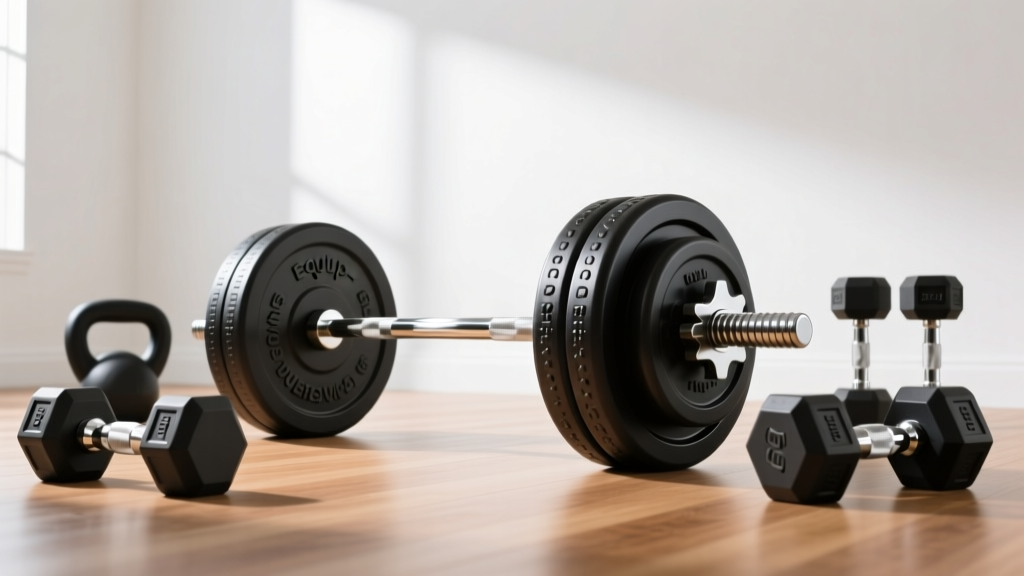
From Dumbbell Exercise App to Barbell: Weight & Knurling Guide
Transitioning from a dumbbell exercise app to barbell training? This step-by-step beginner's guide decodes Olympic barbell weights, shafts, and knurling.

The Graduation: Moving Beyond the Dumbbell Exercise App
If you have spent the last six months diligently following a dumbbell exercise app, you have likely built a fantastic foundation of baseline strength, joint stability, and muscular endurance. Apps are incredible tools for learning movement patterns like the goblet squat, dumbbell Romanian deadlift, and floor press. However, there comes a pivotal moment in every lifter's journey where the 50-pound dumbbells in your living room simply cannot provide the progressive overload required to keep building strength. This is the exact moment you must transition to an Olympic barbell.
But stepping into the world of barbells can be intimidating. Unlike the straightforward weight increments in your favorite fitness app, barbells come with complex specifications: shaft diameters, tensile strength, bushing types, and the highly debated knurling patterns. This step-by-step beginner's guide will decode Olympic barbell weights and knurling, ensuring your first barbell purchase perfectly matches the strength you have built through your app-guided dumbbell training.
Step 1: Map Your App Exercises to Barbell Movements
Before buying a bar, you must understand how you will use it. The transition from dumbbells to a barbell changes the biomechanics of your lifts. According to principles outlined by the National Strength and Conditioning Association (NSCA), moving from unilateral or asymmetrical dumbbell work to bilateral barbell work allows for greater absolute load lifting but requires heightened spinal stabilization.
- Goblet Squats (App) → Barbell Back Squats: Requires a bar with enough 'whip' (flex) to absorb the load out of the hole, but enough rigidity to stabilize heavy weights.
- Dumbbell Floor Press → Barbell Bench Press: Demands a bar with a smooth, less aggressive knurl so it does not tear your chest or hands during high-rep hypertrophy blocks.
- Dumbbell RDLs → Conventional Deadlifts: Requires an aggressive grip surface and high tensile strength to prevent the bar from bending permanently under heavy loads.
Step 2: Decoding Olympic Barbell Weights and Dimensions
When your dumbbell exercise app tells you to 'add 5 lbs,' it is simple. With barbells, the starting weight of the implement itself matters. The international standard for Olympic weightlifting and general powerlifting revolves around specific weight classes and dimensions. As of 2026, manufacturing tolerances for premium bars are incredibly tight, often accurate to within 10 grams of their stated weight.
| Barbell Type | Standard Weight | Shaft Diameter | Total Length | Best For |
|---|---|---|---|---|
| Standard Men's Olympic | 20 kg (44.09 lbs) | 28mm - 29mm | 2200mm (86.6 in) | General strength, Powerlifting, App-based hypertrophy |
| Standard Women's Olympic | 15 kg (33.06 lbs) | 25mm | 2010mm (79.1 in) | Smaller hands, Olympic weightlifting, Technique work |
| Technique / Youth Bar | 15 lbs - 35 lbs | 22mm - 25mm | Varies (Usually 60-72 in) | Absolute beginners, youth athletes, rehab |
Beginner Tip: The 45-Pound Myth
Many beginners assume all barbells weigh exactly 45 lbs. While a standard 20kg bar is close (44.09 lbs), cheaper commercial gym bars or specialized curl bars can weigh anywhere from 30 to 40 lbs. When logging your first barbell workouts, always verify the exact weight of the bar to keep your progressive overload data accurate.
Step 3: The Knurling Deep Dive (Your Grip's Best Friend)
Knurling is the cross-hatched pattern etched into the steel shaft of the barbell. It is arguably the most critical factor in your buying decision, as it directly dictates your grip security and skin integrity. According to BarBend's comprehensive knurling guide, the pattern is created on a CNC lathe using cutting tools that carve diagonal grooves into the steel. The shape of these grooves defines the 'feel' of the bar.
The Three Main Knurl Patterns
- Volcano Knurling (The Gold Standard): This pattern looks like a series of tiny, hollowed-out volcanoes. The rim is sharp enough to bite into your calluses for a secure grip, but the hollow center prevents it from acting like a cheese grater on your skin. Verdict: Perfect for beginners transitioning from dumbbells, as it offers grip without excessive pain.
- Mountain Knurling (Aggressive): The peaks are left sharp and pointed. This provides an incredibly aggressive grip, ideal for heavy, chalk-laden deadlifts. However, it will tear your hands during high-rep bench pressing or front squats. Verdict: Reserve for dedicated powerlifters.
- Hill Knurling (Passive): The peaks are flattened off, creating a smooth, almost dull texture. Often found on cheap, entry-level bars. Verdict: Avoid. Your grip will fail before your muscles do.
Center Knurl: To Have or Not to Have?
Powerlifting bars feature a 'center knurl' patch to help the bar grip your upper back during heavy back squats. Olympic weightlifting bars and multi-purpose bars omit this to prevent the bar from scraping your chest and neck during cleans and front squats. If your dumbbell exercise app focuses heavily on functional fitness, HIIT, and full-body movements, buy a bar without a center knurl.
Step 4: Tensile Strength and Shaft Whip
When you load up 300 lbs on a barbell, the steel bends. This temporary bending is called 'whip.' The measure of a bar's resistance to permanent deformation is its Tensile Strength, measured in PSI (Pounds per Square Inch).
- Under 165,000 PSI: Avoid. These bars will permanently bend if dropped or loaded heavily.
- 165,000 - 180,000 PSI: The sweet spot for multi-purpose bars. Offers enough 'whip' to be comfortable on the joints during dynamic movements.
- 190,000+ PSI: Extremely stiff. Ideal for heavy powerlifting squats and bench presses where bar oscillation is unwanted.
Step 5: 2026 Buying Recommendations for the App-Trained Lifter
Based on current 2026 market pricing and the needs of someone graduating from a dumbbell-focused routine, here are two optimal barbell choices:
1. The Multi-Purpose Champion: Rogue Ohio Bar
As detailed in the Rogue Fitness Ohio Bar specifications, this 20kg bar features a 190,000 PSI tensile strength shaft and a highly refined composite volcano knurl. It lacks a center knurl, making it perfect for the diverse movement library you learned in your dumbbell exercise app. Priced around $295, it is the benchmark for home gyms.
2. The Budget-Conscious Workhorse: REP Fitness AB-1000
Hovering around the $160 mark in 2026, the REP AB-1000 offers a 28.5mm shaft and a surprisingly good volcano knurl for the price point. It uses bronze bushings (which provide a smooth, controlled spin ideal for slow, heavy presses and squats) rather than needle bearings, keeping the cost down without sacrificing durability for a beginner.
Expert Insight on Bushings vs. Bearings: If your app routines involve heavy, slow strength work (squats, presses), you want bushings. If you plan to transition into explosive Olympic lifts (snatches, clean and jerks), you need needle bearings to allow the sleeves to spin rapidly without twisting the shaft and tearing your wrists.
Final Thoughts: Logging Your First Barbell Session
Transitioning from a dumbbell exercise app to free barbell training is a massive milestone. By understanding the 20kg standard, respecting the nuances of volcano knurling, and selecting a bar with appropriate tensile strength, you are setting yourself up for years of safe, progressive overload. Update your tracking app to account for the bar's baseline weight, chalk up your newly knurled grip, and embrace the iron.
More gear to consider
All reviews
Beyond the Free Dumbbell: Olympic Barbell Weight and Knurling Guide
EZ Curl Bar vs Straight Bar and Standing Overhead Dumbbell Presses
Best Dumbbell Lower Back Exercises: Adjustable Dumbbell Mistakes

What Does Bent Over Dumbbell Row Work? 2026 Loadable Trends

Bumper vs Iron Plates & The 65 Pound Dumbbell: Home Gym Guide
