Standard vs Olympic Plates: Sizing for the Single Dumbbell Press
Compare Olympic and standard weight plates to optimize your home gym rack, adjustable handles, and unilateral single dumbbell press mechanics.

Building a functional home gym requires navigating a maze of equipment compatibility, and nowhere is this more apparent than in the weight plate aisle. For decades, lifters have debated the merits of weight plate types Olympic vs standard configurations. While standard plates offer an accessible entry point for beginners, Olympic plates dominate the commercial and serious home gym space. However, this choice extends far beyond your barbell; it fundamentally dictates your entire ecosystem, including the adjustable dumbbell handles you use for isolation movements like the single dumbbell press.
In this 2026 buying guide, we break down the exact dimensional differences, material durabilities, and real-world ecosystem costs of 1-inch versus 2-inch plates. More importantly, we explore how your plate choice impacts unilateral pressing mechanics, rack compatibility, and long-term progressive overload.
The 2-Inch vs 1-Inch Divide: Understanding Plate Anatomy
The most obvious difference between Olympic and standard weight plates is the center hole diameter, but the implications of this single measurement affect every other piece of iron in your gym.
Center Hole & Sleeve Compatibility
- Olympic Plates (2-inch / 50.8mm): Governed by International Weightlifting Federation (IWF) specifications, these plates fit exclusively on Olympic barbells, which feature rotating 2-inch sleeves and heavy-duty needle bearings or bushings.
- Standard Plates (1-inch / 25.4mm): Designed for lighter, fixed-sleeve barbells and basic adjustable dumbbell handles. These bars typically lack rotating sleeves, meaning the torque of the lift transfers directly to the plate and the locking nut.
Because Olympic bars weigh a standardized 20kg (44 lbs) or 45 lbs, they provide a stable baseline for heavy compound lifts. Standard bars often weigh between 5 lbs and 15 lbs, making them unsuitable for heavy squats or bench presses, but seemingly ideal for lighter dumbbell work. However, as we will see, the physical dimensions of standard plates create severe limitations for dumbbell pressing.
The Unilateral Factor: Loading for the Single Dumbbell Press
The single dumbbell press is a premier unilateral exercise. According to strength and conditioning experts, unilateral training not only corrects left-to-right muscle imbalances but also heavily recruits the core's anti-rotational stabilizers to keep the torso flat on the bench (BarBend). To execute this movement safely, the implement in your hand must be balanced and compact.
Expert Biomechanics Note: When performing the single dumbbell press, the lifter must resist rotational torque. If your dumbbell is unbalanced or excessively long, wrist strain increases exponentially as you fight the lever arm of the weight rather than just pressing it.Why Standard Plates Fail the Dumbbell Test
Many budget home gym kits include 1-inch adjustable spinlock dumbbell handles. While they work for bicep curls, they are notoriously poor for the single dumbbell press. A standard 25lb cast iron plate has a massive diameter relative to its weight. To load 50 lbs onto a standard handle, you must stack multiple plates on a sleeve that is usually only 6 to 8 inches long.
This creates two critical failure modes:
- Center of Gravity Shift: The weight sits too far from the handle's grip, creating an unwieldy lever that destabilizes the single dumbbell press at the bottom of the range of motion.
- Spinlock Slippage: Without the rotating sleeves of an Olympic bar, the friction of pressing causes standard plates to grind against the spinlock nut, slowly loosening it mid-set—a major safety hazard when pressing over your face or chest.
Conversely, you cannot fit Olympic plates onto dumbbell handles. Therefore, serious lifters building an Olympic-based gym typically abandon plate-loaded dumbbells entirely, opting instead for fixed hex dumbbells or selectorized models (like PowerBlock or Bowflex) for their single dumbbell press work, reserving their Olympic plates strictly for the barbell and rack.
Rack Compatibility: The Power Rack Bottleneck
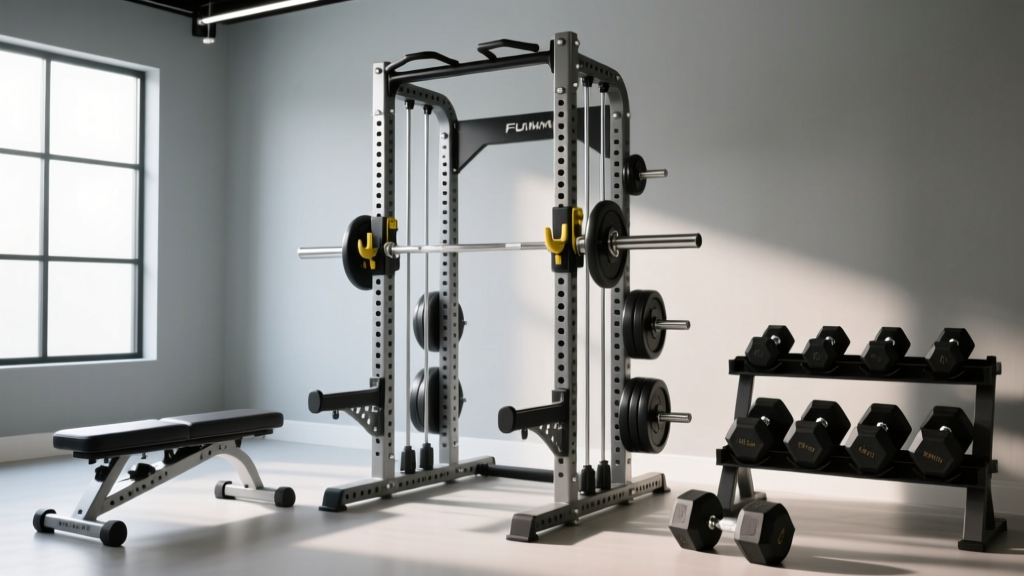
If your home gym includes a power rack or squat stand, the Olympic vs standard debate is instantly settled. Full-size power racks (such as the Titan Fitness T-3 or Rogue S-Series) are engineered with J-cups spaced 43 to 49 inches apart to accommodate the 7-foot shaft of an Olympic barbell.
Standard 5-foot or 6-foot bars are physically too short to rest safely on standard power rack J-cups. Attempting to bench press a standard barbell inside a power rack is a catastrophic safety risk. Therefore, if you want to utilize a rack for safety spotting, you must invest in the Olympic weight plate ecosystem.
Material Showdown: Cast Iron, Rubber, and Urethane
Once you commit to a plate size, you must choose a material. The market in 2026 offers distinct tiers based on noise reduction, durability, and calibration.
1. Bare Cast Iron (Standard & Olympic)
The traditional choice. Models like the CAP Barbell Cast Iron Standard Plates are cheap but prone to rust, chipping, and loud impacts. Olympic deep-dish cast iron plates offer excellent durability and a classic aesthetic but require regular maintenance to prevent oxidation.
2. Virgin Rubber Bumpers (Olympic Only)
Rubber bumpers, like the highly rated Rogue Echo Bumper Plates, feature a stainless steel insert and a dead-bounce rubber shell. They are essential for Olympic weightlifting drops but are generally too thick for heavy barbell bench pressing or loading onto adjustable dumbbell bars, as the thick rubber housing eats up valuable sleeve space.
3. Urethane (Olympic & Commercial Standard)
Urethane is the gold standard for modern home and commercial gyms. Brands like Eleiko and REP Fitness produce urethane-coated plates that resist UV degradation, emit zero odor, and feature precise weight calibration (often within 1% of the stated weight). Urethane grip plates are vastly superior for loading and unloading bars for heavy unilateral and bilateral pressing movements.
Comparison Matrix: Olympic vs Standard Ecosystems
| Feature | Olympic (2-Inch) | Standard (1-Inch) |
|---|---|---|
| Center Hole | 50.8mm (2 inches) | 25.4mm (1 inch) |
| Barbell Weight | 45 lbs / 20kg | 5 lbs - 15 lbs |
| Power Rack Compatible? | Yes (7ft bars) | No (bars too short) |
| Dumbbell Press Utility | N/A (Requires fixed/selectorized DBs) | Poor (Bulkiness ruins single-arm balance) |
| Max Plate Weight | 55 lbs / 25 kg | 50 lbs (rare/unsafe) |
Real-World 2026 Pricing & Ecosystem Costs
When budgeting for your gym, look past the initial plate cost and calculate the 'ecosystem cost'—the total price of the plates, the required barbell, and the necessary storage or rack equipment.
- Standard Cast Iron Ecosystem: Standard plates average $1.00 to $1.50 per pound. A 300lb set costs roughly $300-$450. Add a $40 standard barbell and $50 spinlock dumbbell handles. Total entry cost is under $550. However, you are locked out of power rack usage and forced into sub-optimal dumbbell mechanics.
- Olympic Cast Iron Ecosystem: Olympic iron plates average $1.50 to $2.20 per pound. A 300lb set costs $450-$660. You must add a $150-$250 Olympic barbell and a $300+ squat stand or power rack. Total entry cost easily exceeds $1,000, but the equipment is commercial-grade, safe, and infinitely scalable.
The Final Verdict: Designing Your Hybrid Setup
The debate between weight plate types Olympic vs standard ultimately comes down to your long-term strength goals. Standard plates are a false economy; they restrict your barbell lifts to unsafe, rack-less environments and create biomechanical nightmares for unilateral movements like the single dumbbell press due to handle limitations and plate bulk.
Our Expert Recommendation: Invest entirely in the Olympic 2-inch ecosystem for your barbell, power rack, and weight storage. To perform the single dumbbell press and other unilateral movements safely and effectively, bypass plate-loaded dumbbell handles altogether. Reallocate the money you would have spent on standard plates toward a high-quality pair of fixed hex urethane dumbbells or a premium selectorized set. This hybrid approach guarantees structural safety in the rack while providing the perfectly balanced implements required for optimal unilateral chest hypertrophy.
More gear to consider
All reviews
Barbell Knurling Guide: Grip Fixes & Cable Flyes with Dumbbells
Olympic vs Standard Plates: Shoulder Workouts with Dumbbells Women

Cast Iron vs Competition Kettlebells & Twisting Dumbbell Curls

Upper Body Dumbbell Workout Men: Hex vs Urethane Gym Layout Guide

EZ Bar vs Straight Bar vs Women's Dumbbell Exercises for Arms