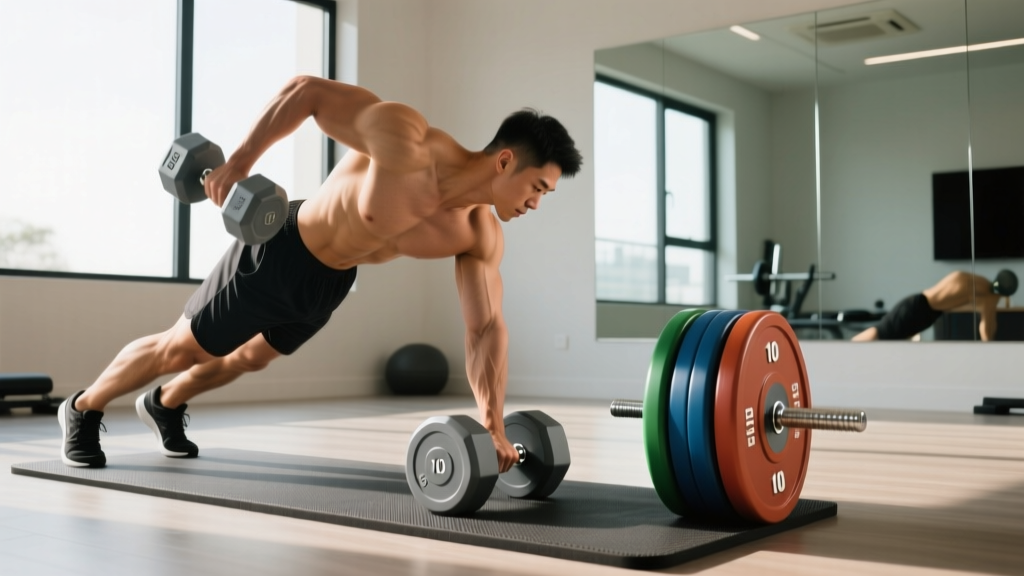
Dumbbell Bent Row Troubleshooting: Standard vs Olympic Plates
Fix your dumbbell bent row form and equipment mismatches. We troubleshoot common mistakes and compare standard vs Olympic weight plates for optimal rows.

The dumbbell bent row is a foundational unilateral back exercise, critical for building latissimus dorsi thickness, correcting muscular imbalances, and improving overall pulling strength. However, for home gym owners utilizing adjustable loadable dumbbells, the execution of this movement is frequently sabotaged by a hidden variable: weight plate types. The ongoing debate of Olympic vs standard weight plates isn't just about barbell compatibility; it profoundly impacts the biomechanics, range of motion (ROM), and safety of your dumbbell bent row.
If you have ever felt your wrist twist mid-rep, noticed your dumbbell hitting the floor before your lats fully stretched, or struggled with loose collars, you are experiencing equipment-induced form breakdown. In this comprehensive troubleshooting guide, we dissect the most common dumbbell bent row mistakes caused by plate selection and provide exact, actionable solutions to optimize your back training in 2026.
The Biomechanics of the Row: Why Plate Diameter Dictates Form
According to exercise kinesiology databases like ExRx, the dumbbell bent row requires a full eccentric stretch involving scapular protraction at the bottom of the movement, followed by forceful retraction and elbow drive at the top. To achieve this, the dumbbell must travel through a vertical path of roughly 20 to 24 inches, depending on your arm length and torso angle.
This is where plate diameter becomes a critical failure point. If the physical width or diameter of your loaded plates interferes with the floor or your bench, your central nervous system will subconsciously restrict your range of motion to avoid impact. You lose the most hypertrophic portion of the lift: the deep stretch under load.
Mistake #1: The 'Bottom-Out' ROM Killer (Olympic Bumper Plates)
Many lifters upgrade to 2-inch Olympic loadable dumbbell handles—such as the highly rated Rogue Loadable Dumbbells—to accommodate heavier weights. However, a common troubleshooting nightmare occurs when users load these handles with lightweight Olympic bumper plates to achieve a specific weight (e.g., 55 lbs using a 45-lb plate and two 5-lb bumpers).
⚠️ The Bumper Plate Clearance Problem:All standard Olympic bumper plates, regardless of whether they weigh 10 lbs or 45 lbs, share a uniform diameter of 17.7 inches (450mm). When performing a dumbbell bent row from a standing bent-over position, a 17.7-inch plate will strike the floor when your arm is only at a 45-degree angle to your torso. This completely eliminates the bottom stretch, turning a full-ROM back builder into a subpar partial-rep movement.
The Troubleshooting Fix:
- Switch to Cast Iron: Use Olympic cast iron or urethane grip plates. A 10-lb Olympic cast iron plate has a diameter of roughly 9 inches, providing over 8 extra inches of floor clearance.
- Elevate Your Stance: If you only own bumper plates, stand on a pair of 45-lb bumper plates or a low plyo box to artificially increase the distance between the dumbbell and the floor.
Mistake #2: The Standard Sleeve Wobble and Collar Failure
On the opposite end of the spectrum, budget-conscious home gyms often rely on 1-inch standard dumbbell handles. While standard plates are incredibly cost-effective in 2026 (averaging $1.20 to $1.50 per pound), they introduce severe mechanical instability during heavy dumbbell bent rows.
A standard 14-inch dumbbell handle typically features a sleeve length of only 4.5 inches. If you are rowing 65 lbs per hand, you might need to stack three 20-lb standard plates and one 5-lb plate per side. Standard plates are notoriously thick. By the time you stack them, the threaded portion of the handle is entirely consumed, leaving the spin-lock collar with only one or two threads to bite into.
Failure Mode: Mid-Rep Asymmetry
During the concentric phase of the dumbbell bent row, torque is applied to the handle. If a spin-lock collar is under-threaded, it will back off by a fraction of a millimeter. The plates shift outward, altering the center of mass. Your wrist is forced to compensate for the sudden lateral weight shift, frequently resulting in extensor strain or a dropped weight. Furthermore, as noted in comprehensive technique guides by BarBend, any asymmetrical loading forces the torso to rotate, shifting the load away from the lats and onto the lumbar erectors.
The Troubleshooting Fix:
- Use Spring Collars on Standard Handles: If your standard handle has a smooth, non-threaded sleeve end, abandon spin-locks entirely and use heavy-duty metal spring collars.
- Upgrade to 2-Inch Handles: If you regularly row over 50 lbs per arm, 1-inch standard handles are mechanically obsolete for your needs. Transition to Olympic loadable handles.
Equipment Comparison Matrix: Standard vs. Olympic for Rows
| Feature | Standard (1-Inch) | Olympic (2-Inch) |
|---|---|---|
| Sleeve Capacity | Low (Max ~60 lbs before crowding) | High (100+ lbs easily accommodated) |
| Collar Security | Poor (Spin-locks loosen under torque) | Excellent (Spring/Clamp collars lock tight) |
| Plate Diameter Variance | High (Varies wildly by weight) | Low (Bumpers are uniform; Iron scales) |
| ROM Interference | Minimal (Smaller overall profile) | High (If using lightweight bumpers) |
| Ideal User | Beginners, Light Rehab, Strict Isolation | Intermediate/Advanced, Heavy Hypertrophy |
Step-by-Step Troubleshooting Protocol for Your Next Back Day
If your dumbbell bent row feels 'off' or your lats aren't firing, run through this rapid diagnostic checklist before your next working set:
- Check the Floor Clearance: Stand in your hinged position and let the dumbbell hang. Is the plate less than 2 inches from the floor? If yes, swap large-diameter bumpers for compact cast iron, or elevate your feet.
- Inspect the Collar Bite: Grab the plates and try to slide them laterally. If there is more than 1mm of lateral play, your collar is failing. Re-seat the collar or switch to a clamp-style collar (like the Rogue HG 2.0 Collars).
- Verify Grip Centering: Olympic loadable dumbbells often have thick, knurled handles. Ensure your hand is perfectly centered on the knurling. An off-center grip combined with heavy plates creates a lever-arm effect that will prematurely fatigue your forearms before your back muscles reach failure.
- Monitor Torso Rotation: Record your set from a rear angle. If your shoulders are twisting toward the working arm at the top of the row, your weight is likely too heavy for your unilateral core stability, or your plates are shifting on the sleeve, forcing you to over-grip and rotate.
2026 Gear Recommendations for the Home Gym
To eliminate equipment-based troubleshooting entirely, investing in the right loadable handles and plate pairings is essential. Here are the top-tier setups dominating the home gym market this year:
1. The Premium Heavy-Row Setup
Handles: Rogue Loadable Dumbbells (approx. $195/pair). Featuring a 6.5-inch sleeve and aggressive knurling, these handle heavy Olympic iron plates without flex.
Plates: Rogue Urethane Grip Plates. The cutout handles make loading and unloading between sets of rows significantly faster, and the urethane coating prevents the 'clank' that disrupts focus.
2. The Budget-Conscious Standard Setup
Handles: CAP Barbell 14-Inch Standard Dumbbell Handles (approx. $25/pair).
Plates: CAP Barbell Cast Iron Standard Plates. While limited in total weight capacity, pairing these with micro-collars instead of the included star-locks will vastly improve sleeve security during the eccentric phase of the row.
Final Thoughts on Pulling Mechanics
The dumbbell bent row is an exercise where millimeters matter. A full lat stretch, a stable wrist, and a rigid torso are the non-negotiable pillars of back hypertrophy. By understanding the physical dimensions of your weight plates—specifically the hidden traps of Olympic bumper diameters and standard sleeve limitations—you can troubleshoot your equipment and reclaim your range of motion. Stop letting your plates dictate your form; curate your loadable dumbbell setup to serve the biomechanics of the lift, and watch your back development transform.
More gear to consider
All reviews
Sam's Club Dumbbells: Rubber Hex vs Urethane Space Guide

Best Rack for Low Incline Dumbbell Fly: Power vs Squat Rack vs Stand

Rubber Hex vs Urethane: Gear for Dumbbell Exercises to Build Muscle

Bumper vs Iron Plates: Gear for the Swinging Dumbbell Exercise

How to Store Weights for Dumbbell Exercises for Whole Body Routines
