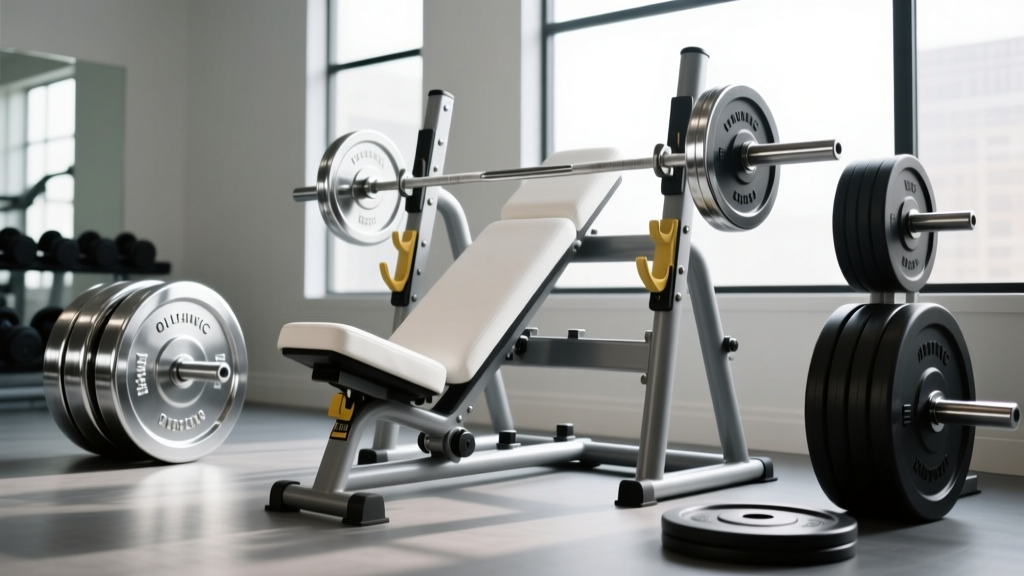
Olympic vs Standard Plates & Decline Dumbbell Press Machine Mistakes
Troubleshoot Olympic vs standard weight plate mistakes, compatibility errors, and the decline dumbbell press machine setup myth for your home gym.

The Core Conflict: Olympic vs. Standard Plate Dimensions
Building a home gym or upgrading a commercial facility in 2026 requires a meticulous understanding of equipment compatibility. One of the most frequent and costly errors fitness enthusiasts make is misunderstanding the fundamental differences between Olympic and standard weight plates. While they may look similar to the untrained eye, their dimensional disparities dictate entirely different equipment ecosystems, safety profiles, and biomechanical applications.
CRITICAL SAFETY WARNING: Never attempt to force a standard plate (1-inch center hole) onto an Olympic barbell or machine sleeve (2-inch diameter) without a machined steel adapter. Improvised DIY adapters routinely fail under shear stress, leading to catastrophic drops and severe injuries.Standard weight plates feature a center hole measuring exactly 1 inch (25.4 mm). These are typically paired with lighter, solid steel or chrome-plated barbells designed for casual home use. Olympic plates, governed by the International Weightlifting Federation (IWF) specifications, feature a 2-inch (50.6 mm) center hole. According to BarBend's comprehensive guide on plate dimensions, the 2-inch hub is engineered to accommodate the thicker sleeves of Olympic barbells, which are necessary to support the high-tensile steel shafts capable of withstanding 1,000+ lb static loads without permanent deformation.
Troubleshooting the 'Decline Dumbbell Press Machine' Myth
When auditing home gym setups and troubleshooting equipment purchases, our team frequently encounters a highly specific search intent and terminology error: the quest for a decline dumbbell press machine. This phrase represents a fundamental conflation of two entirely distinct pieces of strength equipment, leading to massive compatibility and purchasing mistakes.
Deconstructing the Terminology Error
- The Plate-Loaded Decline Press Machine: This is a leverage-based machine (e.g., the Hammer Strength ISO-Lateral Decline Press or Prime Fitness Sterling series) where the user loads Olympic weight plates onto horizontal or angled storage horns. It requires 2-inch Olympic plates. These machines typically cost between $3,500 and $5,500 in 2026.
- The Decline Utility Bench + Dumbbells: This is a free-weight setup utilizing an adjustable decline bench (like the Rogue Adjustable Bench 3.0) paired with independent hex or urethane dumbbells. No machine leverage arms or plate-loading horns are involved.
The Troubleshooting Fix: If you have purchased a plate-loaded decline press machine and are trying to load standard 1-inch cast iron plates onto the machine's 2-inch leverage horns, you are creating a severe safety hazard. The 1-inch hole will not fit the machine's loading pins. Conversely, if you are looking to perform decline dumbbell presses, you do not need a 'machine' at all; you need a heavy-duty decline bench with a secure foot-roller lockdown system and a set of adjustable or fixed dumbbells. Recognizing this distinction saves consumers thousands of dollars and prevents dangerous equipment rigging.
Common Mistakes When Mixing Plate Types
Beyond the machine terminology mix-ups, mixing Olympic and standard gear introduces several mechanical and calibration failures. Here is a troubleshooting matrix of the most common errors we see in the field.
| Mistake / Failure Mode | Why It Happens | Troubleshooting Solution |
|---|---|---|
| Barbell Sleeve Overload | Standard bars have shorter, thinner sleeves. Stacking multiple 45lb standard plates exceeds the physical sleeve length. | Upgrade to a 7-foot Olympic bar with 16-inch loadable sleeves (e.g., Rogue Ohio Bar). |
| Calibration Inaccuracy | Standard plates are often cement-filled or cheaply cast iron, deviating 10-15% from their stated weight. | Switch to calibrated Olympic steel plates (accurate to within 10 grams) for progressive overload tracking. |
| Rack Safety Strap Mismatch | Standard bars flex excessively under loads >250 lbs, causing the bar to slip off standard 1-inch rack pegs. | Use Olympic bars with high-tensile steel (190k+ PSI) on racks with UHMW plastic-lined J-cups. |
Step-by-Step Troubleshooting: Upgrading from Standard to Olympic
If you are currently trapped in a standard weight plate ecosystem and experiencing the limitations listed above, follow this systematic upgrade protocol to transition to Olympic standards safely and cost-effectively.
Pro-Tip for 2026 Budgets: You do not need to buy brand-new urethane Olympic plates to upgrade. The secondary market for used cast-iron Olympic plates is robust. Expect to pay $1.00 to $1.50 per pound for used Olympic iron, compared to $2.50+ per pound for new virgin rubber or urethane plates like the Rogue 6-Shooter Olympic Plates.- Audit Your Current Inventory: Weigh your standard plates on a digital floor scale. Note the exact weight deviations. Sell the standard plates and the 1-inch barbell on local marketplace forums to recoup capital.
- Invest in the Barbell First: The barbell is the single point of contact with your body. Purchase a 20kg (44lb) Olympic barbell with a 28.5mm shaft diameter and dual knurl marks. Do not compromise here.
- Acquire 2-Inch Adapters for Legacy Machines: If you own a legacy cable crossover or plate-loaded leg press that inexplicably uses 1-inch loading pins (common in early 2000s commercial gear), purchase solid steel 1-inch to 2-inch sleeve adapters. Ensure they feature a locking collar mechanism to prevent the adapter from sliding off the pin during a drop.
- Verify Rack Compatibility: Ensure your power rack or squat stand utilizes 2-inchx2-inch or 3-inchx3-inch uprights with 5/8-inch or 1-inch hardware, which is the modern standard for supporting Olympic barbell loads safely.
The Biomechanical Advantage of Olympic Hubs
Why did the industry standardize on the 2-inch Olympic hub? It is not merely a matter of the hole size; it is about the bearing interface. Olympic barbells utilize needle bearings or bronze bushings housed inside the rotating sleeve. This rotation is critical during dynamic movements like the clean and jerk or snatch. Standard barbells are typically solid, one-piece steel constructions with no rotating sleeves. Attempting heavy Olympic lifts with standard plates and a fixed-sleeve barbell will result in severe wrist and elbow torque injuries due to the inertial drag of the plates. The National Strength and Conditioning Association (NSCA) strictly mandates rotating Olympic sleeves for any dynamic, explosive lifting protocols.
FAQ: Plate Compatibility and Machine Loading
Can I use bumper plates on a standard 1-inch bar?
No. True bumper plates are manufactured exclusively with 2-inch Olympic hubs to accommodate the stainless steel inserts required to survive repeated drops from overhead. If you find a 'bumper' with a 1-inch hole, it is likely a low-density vinyl shell filled with sand or cement, which will degrade and split upon impact. Always use Olympic bars for drop-based training.
My plate-loaded machine has 1-inch pegs. Is it safe to use Olympic plates with adapters?
Yes, provided you use high-quality, machined steel adapters that lock securely to the 1-inch peg. However, be aware that adding the length of the adapter reduces the total loadable sleeve space. A standard 1-inch machine peg might only hold three 45lb Olympic plates once the adapter is installed, limiting your maximum resistance.
"The transition from standard to Olympic equipment is the single most important inflection point in a home gym's lifecycle. Standard gear caps your progressive overload potential at roughly 300 pounds due to sleeve length limitations, while Olympic ecosystems scale seamlessly to 1,000+ pounds, matching your lifelong strength potential."
Final Verdict: Standardize on Olympic
While standard weight plates and 1-inch barbells still hold a niche for ultra-budget, space-constrained environments or light rehabilitation work, they are fundamentally obsolete for serious strength training. The confusion surrounding terms like the 'decline dumbbell press machine' highlights a broader need for equipment literacy. By understanding the exact dimensional requirements of your benches, racks, and plate-loaded leverage machines, you eliminate dangerous compatibility hacks and build a 2026-ready home gym that prioritizes safety, precision, and limitless scalability.
More gear to consider
All reviews
2026 Kettlebell Guide: Cast Iron vs Competition & Dumbbell Side Curl

Exercise With Dumbbells For Stomach: Rubber Hex vs Urethane Layouts

Neoprene Sets for a Shoulder Workout With Dumbbells for Women
Olympic vs Standard Plates Setup & Seated Dumbbell Side Raises

Olympic vs Standard Plates: Head-to-Head (Beyond Dumbbell Curls GIF)
