Optimizing Space for Double Dumbbell Squats: Rubber vs Urethane
Optimize your home gym layout for double dumbbell squats by comparing the spatial, storage, and clearance profiles of rubber hex versus urethane dumbbells.

The Spatial Demands of Double Dumbbell Squats
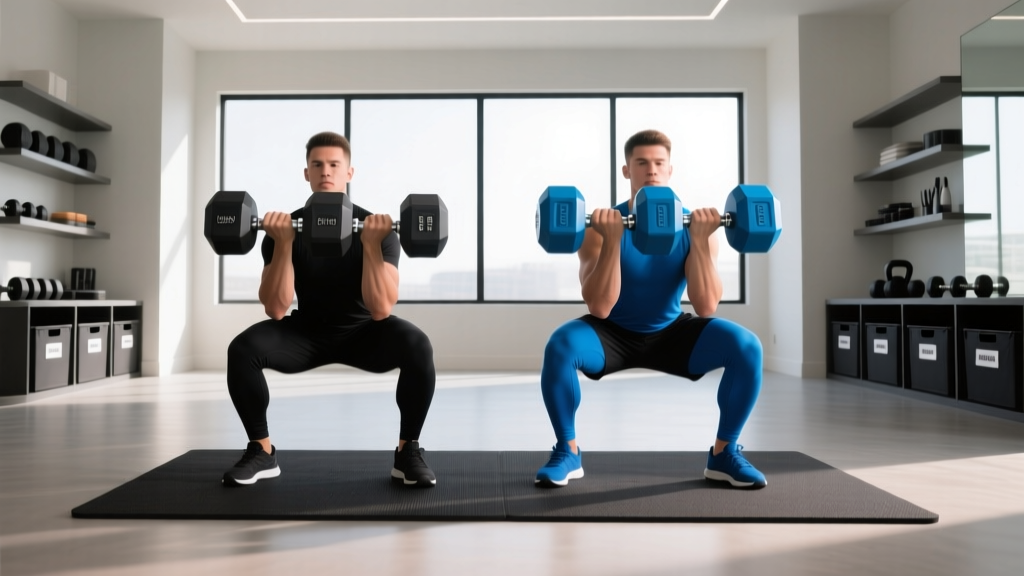
Designing a functional home gym in 2026 requires more than just buying equipment; it demands a rigorous analysis of biomechanical clearance and spatial geometry. The double dumbbell squat is a premier lower-body compound movement, but it is notoriously unforgiving in tight spaces. Whether you are performing them in a farmer's hold (at the sides) or a front-racked position (at the shoulders), the physical footprint of the dumbbells dictates your stance width, knee tracking, and proximity to walls or storage racks.
When space is at a premium, the choice between rubber hex dumbbells and urethane dumbbells transcends mere aesthetics or budget. It becomes a critical layout decision. The material density, head geometry, and storage requirements of each type directly impact how safely and effectively you can execute high-clearance movements in a confined footprint.
Material Density and Spatial Efficiency: Rubber Hex vs. Urethane
The most significant spatial difference between rubber and urethane lies in material density. Rubber is less dense than urethane, meaning that as the weight increases, the physical volume of a rubber hex dumbbell expands disproportionately. Urethane, a high-density polyurethane elastomer, allows for a much more compact head profile at heavier weight increments.
Why does this matter for double dumbbell squats? If you are squatting with 80 lb or 100 lb dumbbells in a narrow 5-foot wide lifting corridor, the lateral bulk of the dumbbell heads becomes a primary constraint.
Real-World Dimensional Comparison
Below is a comparative analysis of standard commercial-grade dumbbells (e.g., REP Fitness Rubber Hex vs. Rogue Urethane) to illustrate the spatial divergence at heavier loads:
| Weight | Rubber Hex Head Width (Approx) | Urethane Head Width (Approx) | Total Length Difference | Spatial Impact on Squat Stance |
|---|---|---|---|---|
| 40 lbs | 6.5 inches | 5.8 inches | +1.4 inches | Negligible |
| 70 lbs | 8.2 inches | 6.9 inches | +2.6 inches | Moderate lateral clearance loss |
| 100 lbs | 10.5 inches | 8.1 inches | +4.8 inches | High risk of knee/wall interference |
At 100 lbs, a rubber hex dumbbell can be nearly 5 inches longer in total length than its urethane counterpart. During a double dumbbell squat, this extra bulk forces the lifter to adopt a wider stance, potentially altering the biomechanics of the hip hinge and increasing the risk of the dumbbell heads clipping the knees or grazing adjacent equipment racks.
Storage Footprint: A-Frames vs. Wall-Mounted Shelves
Optimizing your gym layout requires matching the dumbbell geometry to the correct storage solution. The National Strength and Conditioning Association (NSCA) emphasizes that equipment storage must not encroach on the primary lifting envelope, yet in home gyms, storage and lifting zones often overlap.
Layout Callout: The Hex Advantage on Flat ShelvesRubber hex dumbbells feature flat edges that allow them to sit flush against one another on flat wall-mounted shelves or tiered racks without rolling. If your layout utilizes shallow 18-inch deep wall shelves to maximize floor space, rubber hex is superior. Urethane dumbbells, which are frequently round or 12-sided, require specialized cradle trays or deeper 24-inch shelves to prevent rolling hazards, consuming an extra 6 inches of valuable aisle clearance.
The A-Frame Compromise
If you opt for urethane for its compact lifting profile, you will likely need an A-frame rack (such as the Rogue A-Frame Dumbbell Rack). While an A-frame holds 10 pairs efficiently, its footprint is typically 28 x 30 inches, and it requires a 360-degree clearance radius for safe loading and unloading. In a tight 8x10 foot room, an A-frame can consume up to 15% of your usable floor space, directly infringing on the drop zone required for heavy double dumbbell squats.
Acoustic Management and Drop Zone Engineering
Space optimization is not just about square footage; it is also about acoustic and vibrational space, especially in multi-family homes or apartments with shared walls. Double dumbbell squats frequently end with a controlled drop to the floor.
- Rubber Hex: Harder rubber compounds (like those found in budget-friendly imports) have a higher durometer rating. When dropped from shoulder height after a grueling set of squats, they produce a sharp, high-decibel acoustic crack and exhibit a moderate bounce, requiring a larger safety radius around the lifter.
- Urethane: High-grade urethane has exceptional shock-absorbing properties. It yields a dull thud rather than a crack and features near-zero bounce. This 'dead-drop' characteristic allows you to shrink your safety perimeter, enabling you to position your squat zone closer to walls or mirrors without fear of ricocheting equipment.
'When analyzing joint kinetics and spatial awareness during loaded squats, environmental constraints and equipment bounce can subtly alter a lifter's deceleration phase, leading to compromised form in confined spaces.' — Biomechanical Analysis of the Squat (NIH)
The 8x10 Foot Layout Blueprint (2026 Edition)
To synthesize these concepts, here is a practical, actionable layout framework for an 8x10 foot (80 sq ft) home gym optimized specifically for heavy double dumbbell squats, utilizing urethane dumbbells for lifting clearance and strategic spatial zoning.
Zone 1: The Lift Envelope (5x5 Feet)
Reserve the center-left of the room for the primary lift. Use 3/4-inch thick horse stall mats (typically 4x6 feet, cut to fit) to create a dedicated drop zone. Because urethane deadens impact, you can safely position this zone just 12 inches away from a mirrored wall, creating the illusion of depth while maintaining safe clearance for the 100 lb urethane heads.
Zone 2: High-Density Wall Storage (8x2 Feet)
Instead of a floor-standing A-frame, install a 3-tier wall-mounted rack with urethane-specific cradle trays on the 8-foot back wall. Mount it at a base height of 18 inches. This keeps the heaviest dumbbells (70-100 lbs) at knee level, reducing the ergonomic strain of picking them up for farmer's holds, while keeping the floor entirely clear for footwork and stance adjustments.
Zone 3: The Transition Corner (3x3 Feet)
Place an adjustable FID (Flat/Incline/Decline) bench in the opposite corner. By keeping the bench folded flat and tucked into the corner when not in use, you preserve the 5x5 foot lift envelope required for the lateral sway and depth of heavy double dumbbell squats.
Final Verdict: Budget vs. Spatial Luxury
If your home gym is a sprawling 2-car garage where floor space is abundant, rubber hex dumbbells (averaging $1.50 to $2.00 per pound in 2026) remain the undisputed champion of budget-friendly, flat-shelf storage. However, if you are engineering a compact, high-performance space under 150 square feet where every inch of lateral clearance dictates the safety and biomechanics of your double dumbbell squats, the investment in urethane dumbbells ($3.50 to $5.00 per pound) is a non-negotiable spatial upgrade. The reduced head volume, superior acoustic dampening, and dead-drop characteristics fundamentally change how you interact with a confined room, turning a cramped layout into a precision lifting environment.
More gear to consider
All reviews
Neoprene Dumbbells Compared: Best for Arms and Chest Exercises
What Does Dumbbell Squat Work? Rubber Hex vs Urethane Care
Cast Iron vs Competition Kettlebells vs Back Routine with Dumbbells

Power Rack vs Squat Rack vs Stand: Alternating Dumbbell Shoulder Press
Dumbbell Rack Trends 2026: Fueling the Dumbbells Only Workout Boom
