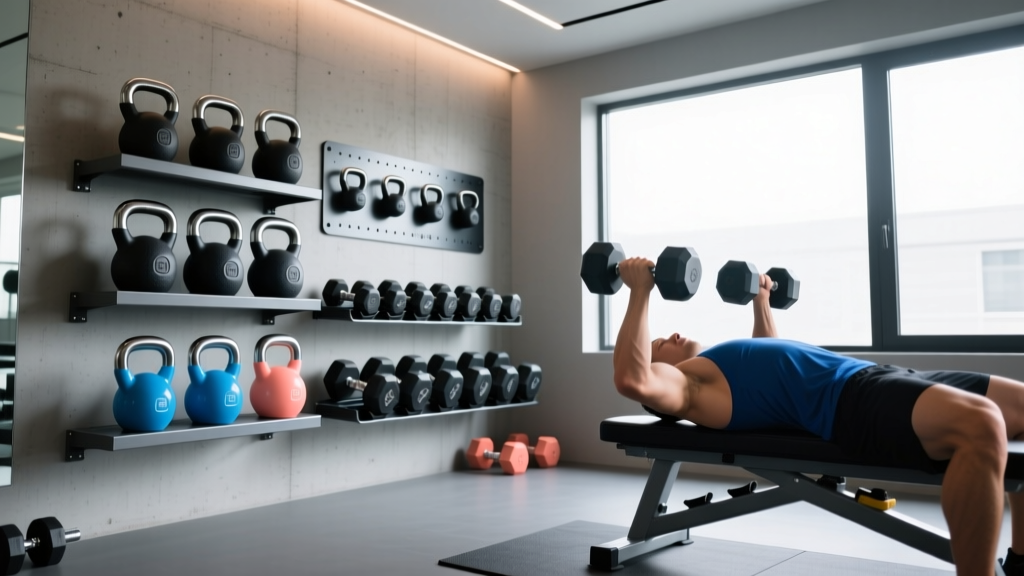
Compact Gym Layouts: Kettlebells & Good Chest Workouts at Home With Dumbbells
Maximize your home gym footprint. Compare cast iron vs. competition kettlebells for storage and design spaces for good chest workouts at home with dumbbells.

The Spatial Reality of Home Gyms in 2026
As urban living spaces shrink and real estate premiums rise, the 2026 home gym paradigm has shifted entirely from 'garage mega-builds' to high-density micro-gyms. Space optimization is no longer just about buying foldable equipment; it is about understanding the precise geometric footprints of free weights and how human biomechanics interact with room dimensions. According to recent data on home-based resistance training environments published by the National Institutes of Health (NIH), spatial constraints are the leading cause of equipment abandonment. To build a functional, long-lasting setup, you must treat your floor plan like an engineer. This guide breaks down the exact spatial mathematics of selecting kettlebells and designing zones for upper body training.
Cast Iron vs. Competition Kettlebells: A Footprint Analysis
When researching a kettlebell buying guide cast iron vs competition models, most fitness guides focus solely on grip feel or sport-specific utility. From a layout and space optimization perspective, the differences are far more structural. Cast iron bells (like the Rogue Powder Coat series) feature variable dimensions that scale with weight. A 12kg bell is physically smaller than a 24kg bell. Competition bells (like Kettlebell Kings Competition line) are uniformly sized at exactly 8.3 x 8.3 x 11 inches, regardless of weight.
Why Uniformity Matters for Shelving: If you build a custom tiered storage rack for cast iron bells, you must leave enough vertical and horizontal clearance for your largest bell (e.g., 32kg), resulting in massive wasted airspace for the smaller bells. Competition bells allow for exact, high-density shelf spacing (8.5 inches vertical clearance), maximizing vertical storage in tight closets or alcoves.| Feature | Cast Iron (e.g., Rogue Powder Coat 16kg) | Competition (e.g., Kettlebell Kings 16kg) |
|---|---|---|
| Base Diameter | ~5.5 inches (Variable) | 8.3 inches (Uniform) |
| Total Height | ~8.5 inches (Variable) | 11 inches (Uniform) |
| Horn Clearance | Tighter, varies by brand | Standardized for two-handed swings |
| Storage Efficiency | Low (Requires custom variable spacing) | High (Perfect for uniform tiered racks) |
| Avg. Price (16kg) | $45.00 | $82.00 |
For the space-constrained athlete, cast iron bells are better suited for under-bench storage or sliding under low-clearance bed frames due to their shorter height. Competition bells are superior for dedicated wall-mounted or freestanding vertical racks where uniform geometry allows for flush, predictable alignment. For more on the biomechanical benefits of standardized kettlebell training, refer to the American Council on Exercise (ACE).
Engineering the Zone: Good Chest Workouts at Home With Dumbbells
Executing good chest workouts at home with dumbbells requires more than just a pair of weights and a bench; it requires calculated lateral clearance. The most common mistake in compact gym design is placing the weight bench parallel to a long wall without accounting for the user's wingspan plus the length of the dumbbells during deep eccentric stretches like chest flyes.
The Wingspan Clearance Formula
To safely perform dumbbell chest flyes without your hands striking the drywall or nearby equipment racks, use this spatial formula:
- Average Male Wingspan: 70 to 74 inches
- Dumbbell Length Added: 12 to 15 inches (depending on model)
- Total Required Lateral Width: 82 to 89 inches
If your room is 8 feet wide (96 inches), placing the bench dead center leaves you with roughly 3.5 to 7 inches of margin on each side. This is the bare minimum for safe execution. If your room is narrower, you must orient the bench parallel to the longer wall and perform floor presses or limit your flye range of motion to avoid drywall damage and joint impingement.
Adjustable Dumbbell Geometry: Nuobell vs. PowerBlock
The physical shape of your adjustable dumbbells directly impacts your spatial requirements and movement mechanics.
- Nuobell 80lb ($399): Features a traditional 14.5-inch length. This allows for a natural, deep stretch during chest flyes and presses, mimicking standard gym dumbbells. However, the longer profile demands the maximum lateral clearance calculated above.
- PowerBlock Elite ($359): Features a blocky, cubic geometry measuring roughly 12 x 6.5 x 6.5 inches. The compact length saves 2.5 inches of lateral space per hand, making it the superior choice for narrow rooms (under 8 feet wide). The trade-off is that the cage-like handle restricts the deep eccentric stretch required for optimal hypertrophy during flyes, forcing you to rely more on floor presses and close-grip variations.
Strategic Storage Solutions for Small Footprints
Free weights must be stored off the primary movement pathways to prevent tripping hazards and maximize usable square footage. Wall-mounted racks are the gold standard for 2026 micro-gyms, but they require structural awareness.
Always mount heavy free weight racks directly into wooden wall studs spaced 16 inches on-center (OC). Standard drywall anchors will fail under the dynamic load of racking 50+ lb kettlebells or dumbbells, leading to catastrophic wall damage and equipment loss.
Consider the Fringe Fitness 3-Tier Wall Mount Dumbbell Rack ($129). Its angled tier design reduces the horizontal protrusion into the room to just 14 inches, compared to the 22-inch protrusion of standard flat shelf racks. By mounting this at a height of 36 inches, you maintain the floor space below for yoga mats, stretching, or storing low-profile cast iron kettlebells.
Sample 8x10 Room Blueprint
For an 8x10 foot spare bedroom (80 square feet), here is the optimal layout to accommodate both kettlebell swings and good chest workouts at home with dumbbells:
- The Anchor Point: Place a foldable bench (like the Rep Fitness AB-3100 2.0, 17.7-inch width, $199) in the exact center of the room, oriented parallel to the 10-foot walls. This provides 48 inches of clearance on the head and foot ends, and 31 inches on the sides—enough for PowerBlock dumbbell presses.
- The Kettlebell Zone: Dedicate the 4x4 foot corner nearest the door as your ballistic zone. Use interlocking 3/4-inch horse stall mats ($55 per 4x6 sheet) to protect the subfloor from dropped cast iron bells.
- Vertical Storage: Mount a uniform competition kettlebell rack on the 8-foot wall opposite the window. Keep the dumbbell wall-rack on the adjacent 10-foot wall, positioned behind the user's head when lying on the bench, ensuring weights are never suspended over the training zone.
By treating your equipment dimensions and biomechanical clearances as rigid architectural constraints, you can build a high-performance training environment that never feels cramped, ensuring consistency and safety in your daily routines.
More gear to consider
All reviews
Setup Guide: Adjustable Dumbbells for Workouts With One Dumbbell

Best Neoprene Dumbbells for a Back Fat Workout: 2026 Matchup

2026 Rack Market Trends for the Ultimate Dumbbell Thrusters Workout
Power Rack vs Squat Rack: Incline Dumbbell Press Alternative Mistakes

Dumbbell Rack Care: Organizing Weights for Women's Lateral Raises
