
Compact Gym: EZ vs Straight Bar & Workout Pecs with Dumbbells
Optimize your home gym layout. We compare EZ curl bar vs straight bar storage and show you how to effectively workout pecs with dumbbells in tight spaces.

The Spatial Dilemma: Barbell Footprints in Compact Gyms
Designing a highly functional home gym in a restricted footprint—such as a 10x10 spare bedroom or a single-car garage corner—requires ruthless prioritization of equipment dimensions. Lifters often face a clash between their arm training needs and their chest training requirements. The traditional approach involves hoarding multiple specialized bars and bulky machines, which quickly devours usable floor space. In 2026, the prevailing philosophy in space optimization is modularity and vertical storage. To build an efficient layout, we must critically analyze the spatial demands of your primary arm implements and your chest training modalities.
When evaluating upper-body equipment, the debate between an EZ curl bar vs straight bar comparison usually centers on wrist ergonomics. However, from a layout design perspective, the physical footprint, sleeve clearance, and storage requirements of these bars are equally critical. Furthermore, when you lack the 12-foot lateral wingspan required for a cable crossover machine, the most biomechanically sound strategy is to workout pecs with dumbbells using an adjustable bench and a compact vertical rack.
EZ Curl Bar vs. Straight Bar: Dimensions and Storage Metrics
To understand how these bars impact your gym layout, we must look at the exact measurements of standard Olympic variations. According to equipment specifications detailed by Rogue Fitness, the dimensional differences dictate entirely different storage solutions.
| Feature | Olympic Straight Bar | Olympic EZ Curl Bar |
|---|---|---|
| Total Length | 72 inches (6 feet) | 47 to 52 inches |
| Shaft Diameter | 28mm - 29mm | 25mm - 28mm |
| Lateral Clearance Needed | ~84 inches (for wide curls) | ~60 inches |
| Optimal Storage | Horizontal J-Cups or 3-Bar Wall Hanger | Vertical Barbell Tree or 2-Bar Hanger |
| Approximate Weight | 44 - 45 lbs | 18 - 35 lbs |
The Clearance Reality Check
A 72-inch straight bar requires a minimum of 6 feet of clear lateral space just to exist parallel to a wall. If you are performing wide-grip reverse curls or drag curls, you need an additional 12 inches on each side to avoid striking a wall or power rack upright. In an 8-foot wide room, a straight bar dominates the entire horizontal plane. Conversely, a 47-inch EZ curl bar can be manipulated comfortably in a 5-foot corridor, making it the superior choice for narrow galley-style garage gyms.
Biomechanics Meets Floor Plan: Choosing Your Arm Implement
The choice between these bars isn't solely about spatial convenience; it heavily influences your training longevity. The ExRx exercise biomechanics database notes that the angled grips of an EZ bar place the wrists in a semi-supinated position, reducing valgus stress on the medial epicondyle. If your compact layout forces you to train in tight quarters where you cannot perfectly control a 45lb straight bar's momentum during strict wall curls, the lighter, ergonomic EZ bar minimizes the risk of connective tissue strain.
Layout Pro Tip: If you must own both bars, do not use a floor-standing A-frame barbell holder. These consume up to 6 square feet of prime floor space. Instead, install a heavy-duty horizontal wall hanger on a load-bearing stud. This elevates the straight bar above head height (approx. 78 inches from the floor), reclaiming the floor space beneath it for your adjustable bench.
Transitioning to Chest: How to Workout Pecs with Dumbbells in Tight Spaces
Once you have optimized your arm training footprint, you must address the pectorals. Cable crossovers and pec deck machines require a minimum 10x10 foot dedicated zone, which is impossible in compact layouts. Therefore, you must workout pecs with dumbbells to achieve full sternal and clavicular fiber recruitment without sacrificing your room's walkways.
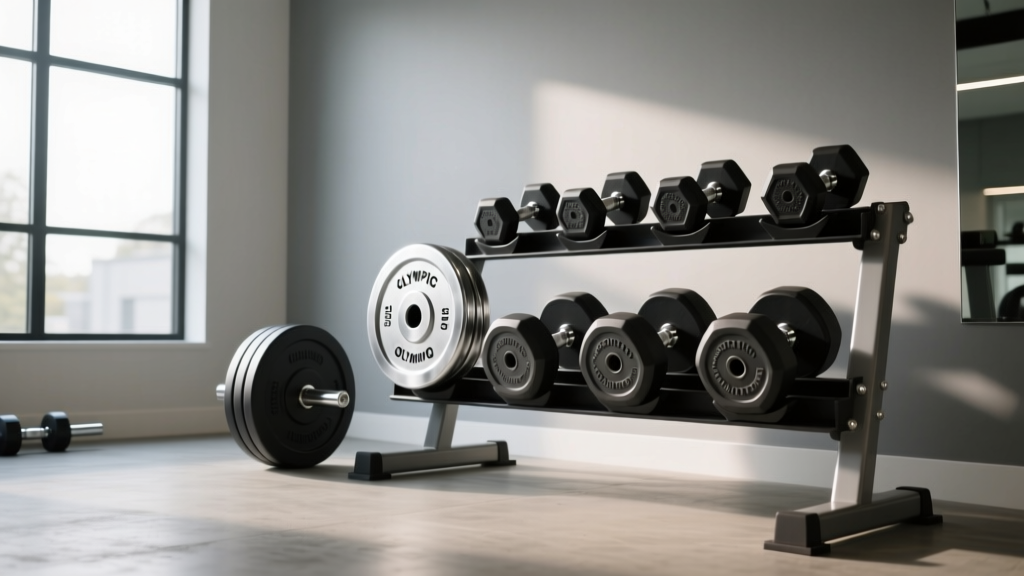
The key to spatial chest training lies in the intersection of adjustable dumbbells and a foldable utility bench. Fixed hex dumbbell racks require a 6-foot horizontal footprint to house a full 5-50 lb set. By switching to a premium adjustable dumbbell set (such as the Nuobell 80lb or PowerBlock Elite), you condense 15 pairs of weights into a single 16-inch by 8-inch footprint, freeing up over 20 square feet of floor space.
Spatially Efficient Pec Exercises
When your bench is positioned just 24 inches from a wall, traditional wide-wing dumbbell flyes become a hazard. To effectively target the pecs without lateral clearance, utilize these space-saving variations:
- The Neutral-Grip Hex Press: Pressing the dumbbells together with palms facing inward eliminates the lateral wingspan of a flye while maintaining constant tension on the sternal head of the pectoralis major.
- Incline Floor Presses: If your adjustable bench is folded and stored against the wall, you can perform floor presses. By elevating your upper back on a thick yoga block or wedge, you mimic a 15-degree incline, targeting the clavicular (upper) pecs with zero bench footprint.
- Single-Arm Dumbbell Crossovers: Anchor a resistance band to the base of your power rack or vertical plate tree. Lie on your bench and perform single-arm crossovers. This requires only 3 feet of lateral clearance compared to the 7 feet needed for dual dumbbell flyes.
The 8x10 Foot 'Arm & Chest' Layout Blueprint
To visualize how these concepts come together, here is a step-by-step layout blueprint for an 8x10 foot room, prioritizing flow, safety, and equipment density.
- Wall A (The 10-Foot Wall - Heavy Storage): Mount a flat-fold power rack or a pair of heavy-duty squat stands. Store your 72-inch straight bar horizontally on the J-cups when not in use. Mount a vertical 3-tier dumbbell rack on the far left corner to hold your adjustable dumbbell cradles and kettlebells.
- Wall B (The 8-Foot Wall - Specialty Bars): Install a 2-bar horizontal wall hanger at 72 inches high. Store the EZ curl bar and a lightweight tricep V-bar here. Directly beneath, place a vertical Olympic plate tree (approx. 18-inch diameter base) to keep 45lb bumper plates out of the walking path.
- Center Zone (The Active Matrix): Position a foldable adjustable bench (like the Rogue Adjustable Bench 3.0) in the center. Ensure there is a minimum 30-inch walking clearance on all sides of the bench to allow for safe dismounts during heavy incline presses.
⚠️ Critical Structural Warning: Wall Mounting
When hanging a 45lb straight bar and 35lb EZ bar on a wall hanger, the dynamic load (taking the bars on and off) generates significant shear force. Do not rely on drywall anchors. You must locate 16-inch on-center wooden studs and use 3/8-inch x 3-inch structural lag screws. If your wall has metal studs, you must install a 3/4-inch plywood backing board spanning multiple studs to distribute the load, as advised by standard construction guidelines and the American Council on Exercise (ACE) facility safety recommendations.
Frequently Asked Questions
Can I use a straight bar for chest exercises to save space?
While the barbell bench press is a staple, it requires a dedicated rack and a 7-foot lateral clearance. In a truly compact, space-optimized layout, relying solely on a straight bar limits your chest development to the mid-pec region and restricts your range of motion. Dumbbells allow for independent limb movement, deeper stretches, and unilateral corrections that a straight bar cannot provide.
Is an EZ curl bar worth the storage space if I already have dumbbells?
Yes. While dumbbell hammer curls and supinated curls are excellent, they do not perfectly replicate the continuous tension curve and bilateral stabilization required by an EZ bar. Because an EZ bar is roughly 4 feet long and weighs under 30 lbs, it can easily be stored vertically in a 12-inch corner tube or hung flat on a wall, making its spatial 'cost' incredibly low compared to the training value it provides.
What is the best adjustable bench for tight spaces?
Look for a bench with a fold-flat profile and integrated transport wheels. Benches that fold completely flat (reducing their height to under 10 inches) can be slid under a raised power rack or stood vertically against a wall, instantly reclaiming 8 square feet of floor space for stretching or kettlebell work.
More gear to consider
All reviews
T Bar Row with Dumbbells: Beginner Guide for Home Gyms

Barbell Buying Guide: Weight, Knurling & Bent Over Dumbbell Laterals

One Arm Dumbbell Thrusters Setup: Neoprene Home Gym Guide

Stability Ball Dumbbell Bench Press vs Kettlebell Budget Breakdown
Olympic vs Standard Plates: Mistakes for Dumbbell Kickbacks & Lifts
