Power Rack vs Squat Rack vs Stand: The Dumbbell Halo Space Test
Troubleshoot your home gym layout. Compare power racks, squat racks, and stands using the dumbbell halo clearance test to avoid spatial mistakes.

When building a home gym, most lifters obsess over pull-up bar thickness, J-cup UHMW plastic liners, and weight plate calibration. However, the most common—and costly—mistake in equipment selection is ignoring the 'negative space' required for dynamic movement. You might have the budget for a commercial-grade enclosure, but if your layout restricts your mobility workflow, your training efficiency will suffer.
To troubleshoot this spatial blind spot, fitness professionals and ergonomics experts increasingly rely on a practical diagnostic metric: The Dumbbell Halo Clearance Test. By analyzing how power racks, squat racks, and squat stands accommodate the dumbbell halo—a foundational shoulder mobility and thoracic warm-up drill—you can instantly identify which rack type fits your biomechanical and spatial needs.
The Biomechanics of the Halo and the 43-Inch Bottleneck
The dumbbell halo involves circling a weight around your head to mobilize the glenohumeral joint and thoracic spine. According to the American Council on Exercise (ACE), dynamic movements like halos are critical for preparing the central nervous system and joint capsules for heavy axial loading (like squats).
Here is where the math exposes poor gym design:
- A standard 25lb hex dumbbell is approximately 14.5 inches long.
- The average adult arm span from the center of the chest to the wrist is about 28 inches.
- When performing a halo, the weight extends past the hand, requiring a total lateral clearance of roughly 42 to 44 inches to complete a full rotation without clipping an obstacle.
Troubleshooting the Big Three: Rack vs. Rack vs. Stand
Understanding how different rack configurations handle this lateral clearance test is the key to troubleshooting your home gym layout.
1. Power Racks (The Enclosed Fortress)
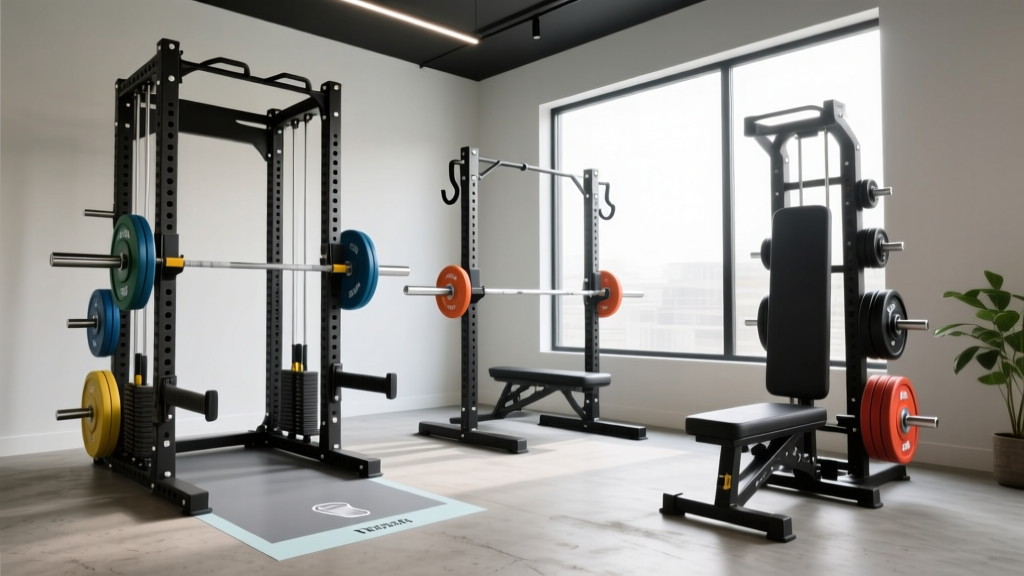
Power racks (e.g., REP Fitness PR-4000, Rogue RML-390F) feature four uprights and a fully enclosed safety system. They are the gold standard for heavy, unspotted lifting.
- The Halo Test Result: Fail (for standard depths). The 43-inch inside width restricts lateral arm extension. Furthermore, standard 41-inch to 43-inch depths mean the front uprights are always in your peripheral vision, creating a psychological barrier during dynamic kettlebell or dumbbell flows.
- The Fix: If you must buy a power rack, opt for a 'fold-back' or open-front design, or commit to performing all mobility work outside the cage. Alternatively, look for specialized 30-inch deep power racks with open fronts, though these are rare and often require bolting to a concrete subfloor.
- 2026 Pricing Reality: Expect to pay $850 to $1,300 for a high-quality 3x3 enclosed rack.
2. Squat Racks (The Open-Front Compromise)
Squat racks (e.g., Rogue SML-2C, Titan T-3) feature two main uprights with a rear crossmember for stability, leaving the front completely open.
- The Halo Test Result: Pass. Because the front is unobstructed, you can stand inside the rack to unrack the barbell, but step forward six inches to perform your dumbbell halos, kettlebell swings, and lateral lunges without any risk of clipping the steel.
- The Fix: Ensure you purchase a rack with a deep enough footprint (at least 48 inches from front to back) so that when you step forward to do mobility work, you don't accidentally trip over the front stabilizer feet.
- 2026 Pricing Reality: Highly affordable, typically ranging from $450 to $650.
3. Squat Stands (The Minimalist Trap)
Squat stands (e.g., Rogue S-2, REP A-Frame) consist of two independent uprights. They offer zero lateral obstruction.
- The Halo Test Result: Perfect Pass. You have 360 degrees of unobstructed space. You can perform halos, Turkish get-ups, and dynamic flows seamlessly.
- The Hidden Failure Mode: While spatial clearance is infinite, safety is compromised. Many lifters perform dynamic warm-ups near the stands, accidentally kicking the base plates. If the stands are not bolted down or loaded with heavy spotter arms acting as counterweights, a stray kick during a dynamic movement can tip a 100lb steel upright onto your foot.
- 2026 Pricing Reality: $250 to $400, but requires additional investment in heavy-duty spotter arms ($100+).
Spatial & Safety Comparison Matrix
Use this troubleshooting matrix to align your equipment choice with your movement profile.
| Feature | Power Rack (Enclosed) | Squat Rack (Open-Front) | Squat Stands |
|---|---|---|---|
| Inside Width | 43 inches | 43 inches | Infinite (Adjustable) |
| Halo Clearance | Poor (Clipping Hazard) | Excellent (Step Forward) | Perfect (360° Open) |
| Tipping Risk | Near Zero | Low (Rear Stabilizer) | High (Requires Bolting) |
| Avg. 2026 Cost | $850 - $1,300 | $450 - $650 | $250 - $400 |
Common Installation & Layout Mistakes (And How to Fix Them)
Even if you choose the right rack type based on the halo test, poor installation can ruin your spatial flow. Troubleshoot these common errors:
- The 'Wall-Hugger' Mistake: Placing a rack flush against a wall. You need a minimum of 12 to 18 inches of clearance behind the uprights to load bumper plates and perform banded halo variations. Fix: Pull the rack out and use the rear space for weight storage.
- Ignoring the Overhead Pull-Up Bar: Many lifters use the pull-up bar to anchor resistance bands for assisted mobility work. If your ceiling is standard 8-foot (96 inches) height, a 90-inch power rack leaves only 6 inches of overhead clearance. Fix: If you have low ceilings, buy a squat stand or an open squat rack without an overhead crossmember to allow unrestricted overhead reaching during warm-ups.
- Flooring Transitions: Performing dynamic movements like halos or lunges on the edge of a 3/4-inch horse stall mat where it meets a hardwood floor creates a severe trip hazard. Fix: Create a flush 'plywood platform + mat' island that extends at least 3 feet beyond the front of your rack.
Expert Verdict: Matching Your Rack to Your Movement Profile
The debate between a power rack, squat rack, and squat stand is rarely about which is 'best' in a vacuum; it is about which accommodates your specific training ecology. If your programming relies heavily on Olympic lifting variations, dynamic kettlebell flows, and extensive mobility routines like the dumbbell halo, an open-front squat rack or heavily anchored squat stands will provide the spatial freedom you need. However, if your primary focus is heavy, unspotted powerlifting and you don't mind stepping outside the cage for your warm-ups, the enclosed power rack remains the undisputed king of safety.
By applying the Dumbbell Halo Clearance Test before you click 'checkout,' you transition from simply buying gym equipment to engineering a functional, frictionless training environment.
More gear to consider
All reviews
Adjustable Dumbbell Review: Dumbbell Core Workout Women Setup Guide
Beyond a Dumbbell Only Workout: Cast Iron vs Competition Kettlebells

Dumbbell Chest Press Workout Mistakes: Neoprene Home Gym Fixes
PPL Dumbbell Workout Mistakes: Adjustable Dumbbell Troubleshooting

Rubber Hex vs Urethane: 2026 Trends & the Dumbbell Lawnmower Pull