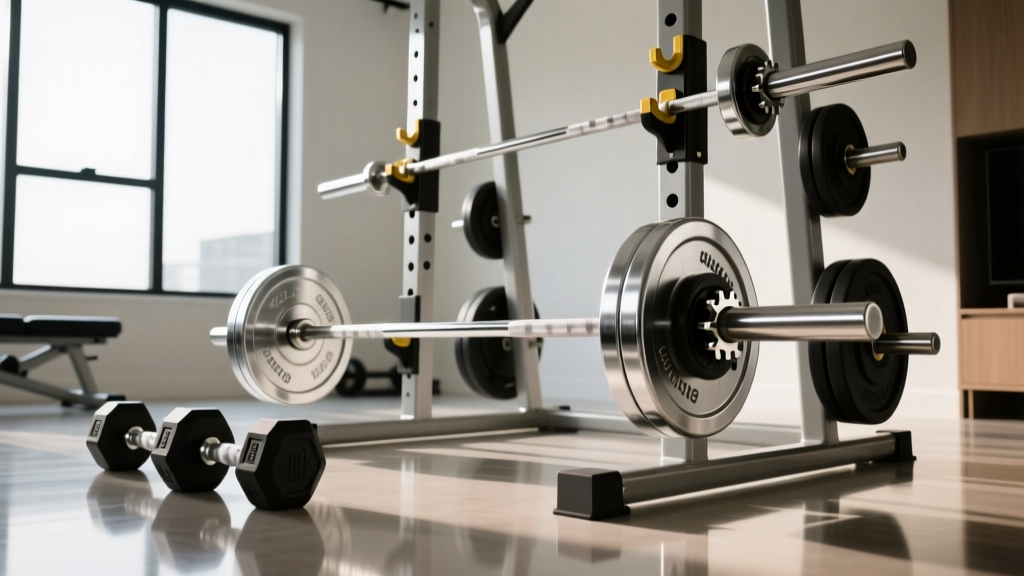
Securing Compound Lifts with Dumbbells and Barbells: Collar & Clamp Comparison
Compare the best barbell collars and dumbbell clamps. Discover which locking mechanisms secure your plates during heavy compound lifts with dumbbells.

Most lifters treat plate collars as an afterthought—a cheap plastic accessory tossed into the gym bag. But as home gym setups evolve in 2026, the rise of heavy-duty loadable dumbbell handles has exposed a critical safety gap. When you transition to heavy loading, especially when executing compound lifts with dumbbells (like heavy Romanian deadlifts, floor presses, or goblet squats), a failed clamp doesn't just ruin a set; it can result in a shattered wrist or a catastrophic drop.
While standard barbell collars are engineered for the long, rotating sleeves of an Olympic bar, dumbbell sleeves present an entirely different mechanical challenge. Shorter sleeve lengths, fixed bushings, and extreme rotational torque mean that a collar that works perfectly on a barbell might fail dangerously on a dumbbell. In this head-to-head comparison, we test the four dominant collar and clamp types on the market to determine which locking mechanism actually secures your gear when it matters most.
⚠️ SAFETY CALLOUT: According to strength and conditioning guidelines from ACE Fitness, failing to secure plates on free weights is a leading cause of preventable impact injuries in non-commercial gym environments. Never attempt heavy unilateral or bilateral dumbbell work without flush-fitting clamps.The Biomechanical Reality: Why Dumbbell Sleeves Are Different
To understand why certain clamps fail, we have to look at the physics of the lift. Research published in the Journal of Sports Science & Medicine highlights that dumbbell variations of pressing and pulling movements require significantly higher stabilizer muscle activation compared to barbells. This stabilization translates directly into rotational torque on the dumbbell sleeve.
Unlike high-end Olympic barbells that utilize needle bearings to allow the sleeve to spin independently of the shaft, most loadable dumbbell handles feature fixed sleeves or rudimentary bronze bushings. When you perform compound lifts with dumbbells, your wrist and forearm naturally rotate to maintain a neutral grip. If the sleeve doesn't spin, that rotational force is transferred directly into the plates, creating immense outward lateral pressure against the collar. A clamp that relies solely on friction will slowly walk off the sleeve mid-set.
Head-to-Head: 4 Locking Mechanisms Tested
We evaluated the industry standards based on grip strength, sleeve clearance, durability, and suitability for both barbell and loadable dumbbell applications.
1. Traditional Spring Collars (The Baseline)
The standard chrome spring clip is the ubiquitous $10 gym staple. It relies on the outward tension of a steel wire to grip the sleeve.
- Max Lateral Grip: ~15 lbs of force.
- Best For: Light accessory work, barbell curls, and quick plate changes on the barbell.
- The Dumbbell Problem: Spring collars are virtually useless for heavy compound lifts with dumbbells. The short sleeve of a dumbbell leaves the spring handles protruding at awkward angles, often digging into the lifter's forearms during a heavy dumbbell bench press. Furthermore, the tension springs lose elasticity over time, leading to silent plate shifts.
- Price: $8.00 - $12.00 per pair.
2. Polymer Jaw Clamps (e.g., Lock-Jaw LITE)
The Lock-Jaw LITE ($34.95) uses a glass-reinforced polycarbonate resin jaw that clamps down via a lever mechanism. It is a favorite among CrossFit athletes for rapid barbell plate changes.
- Max Lateral Grip: ~350 lbs of clamping force.
- Best For: Olympic weightlifting and high-rep barbell touch-and-go sets.
- The Dumbbell Problem: While the grip is strong, polymer jaws struggle on the knurled or aggressively machined sleeves of premium loadable dumbbells (like the Rogue Loadable Dumbbell Handle). During heavy dumbbell RDLs, the rotational torque can cause the plastic teeth to skip across the steel sleeve. Additionally, the bulk of the clamp body often exceeds the width of a standard 10-inch dumbbell sleeve, preventing you from loading maximum plate capacity.
- Price: $34.95 per pair.
3. Heavy-Duty Cam-Lever Collars (e.g., Rogue AH-1)
Machined from 6061 aircraft aluminum, the Rogue AH-1 Collars ($45.00) represent the gold standard for barbell security. They use a cam-lever action that bites into the sleeve with an vice-like grip.
- Max Lateral Grip: 600+ lbs of force.
- Best For: Heavy barbell squats, deadlifts, and dropping bumpers.
- The Dumbbell Problem: The AH-1 is a masterpiece for barbells, but a hazard for dumbbells. The lever mechanism requires a 2.5-inch swing radius to lock. On a short dumbbell sleeve, the lever will physically collide with the loaded plates before it can fully engage. Even if you manage to lock it, the protruding aluminum lever acts as a fulcrum; if you set the dumbbell down hard on the floor, the lever catches the ground and pries the collar open.
- Price: $45.00 per pair.
4. Threaded Screw Clamps (e.g., Ironmaster Quick-Lock)
Designed specifically for loadable dumbbell handles, the Ironmaster Quick-Lock system ($59.00) utilizes a machined steel threaded rod and a heavy-duty screw-on cap.
- Max Lateral Grip: Virtually infinite (limited only by the shear strength of the steel threads).
- Best For: Heavy compound lifts with dumbbells, floor presses, and drop-sets.
- The Advantage: Because it threads directly onto the handle, rotational torque is irrelevant. The clamp sits perfectly flush with the outermost plate, meaning you can drop the dumbbell from a bench press without the clamp catching the floor and popping off. It takes roughly 4 seconds to secure, making it highly efficient for home gym warriors.
- Price: $59.00 per pair (often included with handle purchases).
Comparison Matrix: Which Clamp Wins Where?
| Clamp Type | Primary Use Case | Dumbbell Suitability | Avg. Cost | Primary Failure Mode |
|---|---|---|---|---|
| Spring Collar | Light Barbell Accessories | Poor | $10 | Spring fatigue & lateral slip |
| Polymer Jaw | Olympic Lifts / WODs | Fair | $35 | Teeth skipping on knurled sleeves |
| Cam-Lever (Aluminum) | Heavy Barbell Powerlifting | Poor | $45 | Lever clearance & floor-catch prying |
| Threaded Screw | Heavy Loadable Dumbbells | Excellent | $59 | Thread stripping (rare) |
Failure Modes During Compound Lifts with Dumbbells
When analyzing equipment failures in the gym, we must look at edge cases. The most dangerous moment during compound lifts with dumbbells is the eccentric (lowering) phase and the subsequent drop.
"During a heavy dumbbell floor press, the inertia of the plates pushes outward against the collar at the exact moment the dumbbell strikes the ground. If your collar has a protruding lever or a loose friction fit, the floor acts as a wedge, instantly popping the collar off and dumping 80 lbs of iron onto the lifter's chest." — Equipment Testing Notes, BarBend
This is why flush-fitting designs are non-negotiable for dumbbells. Friction-based collars (like polymer jaws) can handle the static weight of the plates, but they cannot handle the dynamic shockwave of a dropped dumbbell. Only mechanical locking—achieved via threading or specialized flush-pin systems—can withstand the kinetic energy transfer of heavy dumbbell drops.
The 2026 Buyer's Decision Framework
Do not buy a single type of collar and expect it to work across your entire free weight arsenal. To build a safe, efficient home or commercial gym, use this decision framework:
- For the Barbell Station: Invest in the Rogue AH-1 or a similar high-quality cam-lever aluminum collar. The independent spin of the barbell sleeve negates rotational torque, allowing the cam-lever to bite down with 600+ lbs of force without slipping.
- For Loadable Dumbbell Handles: Exclusively use Threaded Screw Clamps (like the Ironmaster Quick-Lock or equivalent OEM threaded caps). The flush profile and mechanical thread guarantee safety during heavy pressing and pulling movements.
- For Kettlebells & Plate-Loaded Machines: Standard Polymer Jaw Clamps are perfectly adequate here, as the sleeves are typically smooth, short, and not subjected to extreme rotational forces.
Ultimately, treating your locking mechanisms as critical safety gear rather than mere accessories is the hallmark of an experienced lifter. By matching the clamp type to the specific biomechanical demands of the implement, you ensure that your focus remains on the muscle, not on the shifting iron.
More gear to consider
All reviews
Pull Day Dumbbells & Plates: Olympic vs Standard Mistakes
Power Rack vs Squat Rack vs Stand: Dumbbell Deadlift for Back

EZ vs Straight Bar: Upgrading Upper Arm Workouts With Dumbbells

How to Hit Back with Dumbbells & Barbell Collar Guide
Barbell Collar Clamps & Behind the Head Dumbbell Raise Mistakes
