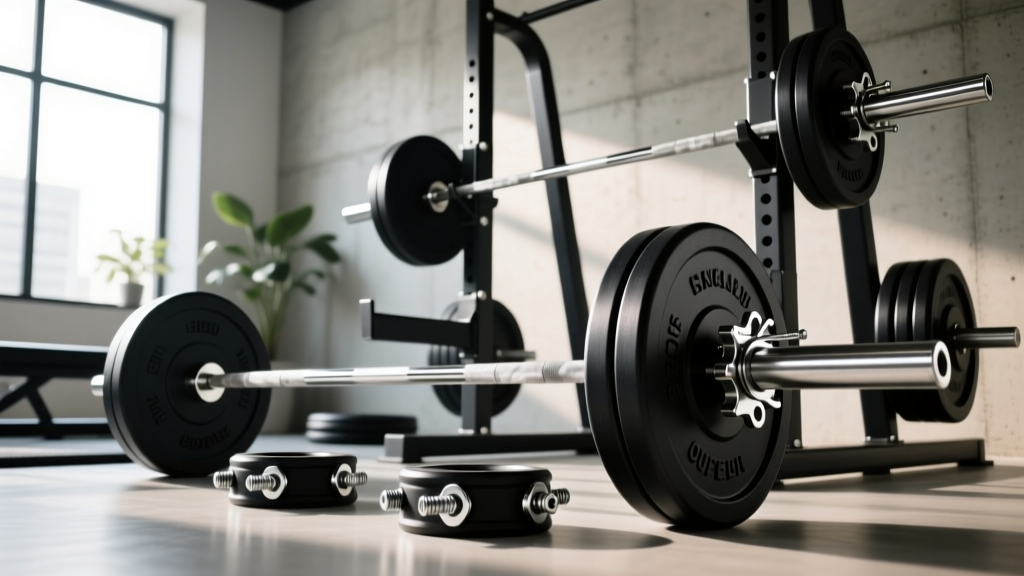
Barbell Collar Types: Safety Beyond a Biceps Workout Using Dumbbells
Troubleshoot gym safety with our barbell collar and clamp comparison. Learn to secure weights as you progress from a biceps workout using dumbbells.

The Transition: From Dumbbells to Barbell Loading
When you first begin strength training, a standard biceps workout using dumbbells feels incredibly safe and intuitive. If you reach muscular failure during a set of hammer curls, you simply lower the dumbbells to your sides or drop them onto rubber matting. The center of gravity is isolated to each hand, and the risk of a catastrophic imbalance is virtually zero. However, as you progress to heavy barbell movements—like barbell curls, squats, deadlifts, and Olympic lifts—the physics of your equipment change dramatically. A 45-pound Olympic barbell loaded with multiple plates introduces kinetic energy, barbell whip, and rotational torque that dumbbells simply do not possess.
This transition is where many home gym owners make their first critical safety error: underestimating the necessity of high-quality barbell collars. In this troubleshooting guide, we will diagnose the most common plate-shifting issues, compare the primary collar and clamp types available in 2026, and provide actionable solutions to keep your lifts safe and your equipment secure.
Troubleshooting the 'Shifting Plate' Phenomenon
Have you ever unracked a barbell for squats, only to hear a loud metallic clank and feel the bar tilt slightly to the left? This is the shifting plate phenomenon, and it is a major troubleshooting red flag.
⚠️ Troubleshooting Alert: Asymmetrical LoadingWhen plates shift outward on one side of the barbell, the center of mass moves away from the lifter's midline. On a heavy squat or deadlift, even a half-inch shift of a 45lb plate can generate enough asymmetrical torque to cause a spinal twist or a missed lift. If your plates are sliding, your collar's clamping force is insufficient for the kinetic energy generated by your movement.
Why do plates shift? The primary culprit is 'barbell whip'—the elastic deformation of the steel shaft during heavy or dynamic lifts. When the bar bends and snaps back, the inertia forces the plates outward. Standard spring clips, which rely on minimal radial tension, cannot counteract this force. To troubleshoot this, you must upgrade from basic spring clips to collars that utilize mechanical leverage or high-tension polymer clamps.
Barbell Collar and Clamp Types: A 2026 Comparison Matrix
Not all collars are created equal. The market is currently dominated by four distinct mechanisms. Below is a comparison matrix to help you diagnose which type fits your specific training style.
| Collar Type | Mechanism | Clamping Force | Speed of Use | Best Application |
|---|---|---|---|---|
| Spring Clips | Steel coil tension | Low (~20 lbs) | Slow (Requires hand strength) | Light pressing, bench press |
| Clamp (Polymer) | Nylon resin snap-lock | Medium (~60 lbs) | Very Fast | High-volume hypertrophy, CrossFit |
| Lever (Aluminum) | Cam-lever mechanical pinch | Extreme (~150+ lbs) | Fast (1-second flip) | Heavy squats, deadlifts, drops |
| Spinlock (Threaded) | Threaded steel nut | High (Depends on tightness) | Very Slow | Standard 1-inch home bars |
Deep Dive: Top Collar Models and Real-World Pricing
To provide actionable troubleshooting, let us look at the exact models dominating the 2026 market, their pricing, and their specific failure points.
- Rogue AH-1 Aluminum Collars ($45.00/pair): The gold standard for heavy lifting. Weighing in at 0.68 lbs each, the AH-1 uses a cam-lever system that bites aggressively into the steel sleeve. Troubleshooting tip: The internal rubber pad can wear down after 3-4 years of heavy dropping, requiring replacement to maintain peak clamping force. You can verify their engineering specs on the Rogue Fitness AH-1 Collars product page.
- Lockjaw Pro Olympic Clamps ($28.50/pair): Made from glass-reinforced nylon resin, these are the go-to for fast-paced workouts. They snap on in less than a second. Failure mode: If dropped repeatedly on concrete from overhead, the nylon hinge can develop micro-fractures over time. Inspect the hinge joint every 6 months.
- Eleiko Olympic Training Collars ($115.00/pair): Precision-machined for competitive weightlifting. These feature an internal locking mechanism that prevents the collar from accidentally popping open during the violent rotation of a snatch or clean and jerk.
3 Critical Mistakes Lifters Make with Collars
Even with the right equipment, user error can compromise safety. Here are the most common mistakes and how to fix them.
- Using Spring Clips on Dynamic Lifts: Spring clips are fine for a controlled bench press, but using them for deadlifts or power cleans is a recipe for disaster. The barbell whip will easily overcome the spring tension. Fix: Banish spring clips to the accessory rack and use lever collars for all floor-based or dynamic pulls.
- Ignoring Collar Weight in Micro-Loading: High-end lever collars like the Rogue AH-1 or competition IWF collars have significant mass. According to the USAPL Rulebook and international standards, competition collars weigh exactly 2.5 kg (5.5 lbs) each. If you are tracking your progressive overload down to the pound, failing to account for the 1.36 lbs (combined) of standard aluminum collars can skew your data over a 12-week mesocycle.
- Misaligning the Lever Mechanism: When applying a lever collar, the handle must be flipped to the exact 180-degree lockout position. Stopping at 160 degrees leaves the cam-lobe partially disengaged, meaning a heavy squat could vibrate the lever open. Fix: Always push the lever until you hear and feel the definitive mechanical 'click' against the collar body.
"Safety in the gym isn't just about having a spotter; it is about respecting the physics of the implements you use. A loose plate is an unpredictable variable in an environment that demands absolute control."
Step-by-Step Troubleshooting: What to Do If Plates Slip Mid-Set
If you are in the middle of a heavy set of Romanian Deadlifts and you feel the plates slide outward on the right sleeve, do not panic, but do not ignore it.
Emergency Protocol for Asymmetrical Shifting
Step 1: Safely rack the weight or drop it straight down (if on a platform). Do not attempt to 'correct' the bar path while it is in motion.
Step 2: Unload the plates on the shifted side to relieve pressure on the collar.
Step 3: Inspect the barbell sleeve. If it is heavily chalked or dusty, wipe it down with a microfiber cloth. Chalk acts as a dry lubricant, reducing the friction between the steel sleeve and the collar's internal rubber pad.
Step 4: Re-seat the collar flush against the inner plate, ensuring no gap exists, and re-engage the locking mechanism.
Final Thoughts on Gym Safety
Upgrading your home gym is a journey that extends far beyond the plates themselves. While mastering your form during a biceps workout using dumbbells builds a fantastic foundation, transitioning to the barbell requires a new level of respect for equipment maintenance and safety protocols. Investing $45 to $100 in a premium set of lever or high-tension clamp collars is not just a purchase; it is an insurance policy for your spine, your joints, and your home gym flooring. Audit your collar setup today, replace worn-out spring clips, and lift with the confidence that your equipment is as locked in as you are.
More gear to consider
All reviews
Cast Iron vs Competition: Good Full Body Dumbbell Workout Swap

Neoprene Dumbbell Setup & Dumbbell Shoulder Press for Women
Ethos Rubber Hex Dumbbell vs Neoprene: Beginner Guide

Beyond Dumbbell Training for Beginners: Barbell Collars vs Clamps

Single Dumbbell Overhead Press: Beginner Guide for Neoprene Weights
