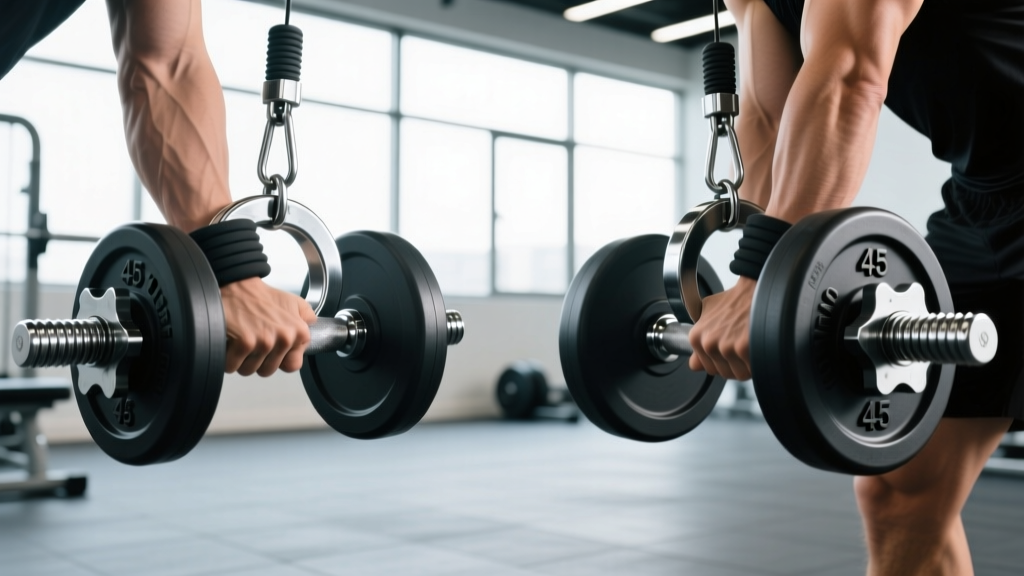
Collar and Clamp Comparison: Safety for Dumbbell Exercises for Lats
Compare barbell collars and clamp types to secure plate-loaded dumbbells. Ensure safety during heavy dumbbell exercises for lats with our expert guide.

The Hidden Hazard in Heavy Unilateral Pulling
When building a massive, wide back, lifters naturally gravitate toward heavy, unilateral pulling movements. While fixed-weight hex and urethane dumbbells are staples in most commercial gyms, many serious home gym owners and powerbuilders rely on plate-loaded dumbbell handles. These allow for precise micro-loading and extreme overload sets that fixed dumbbells simply cannot accommodate. However, performing intense dumbbell exercises for lats—such as heavy Kroc rows, chest-supported T-bar rows, or Meadows rows—introduces severe rotational torque to the handle. If you are using inferior collars or clamps, this torque can cause the securing mechanism to fail mid-rep, resulting in a catastrophic plate shift, ruined leverage, or severe wrist and shoulder injuries.
In this comprehensive buying guide, we break down the material science, failure modes, and real-world performance of the most popular barbell and dumbbell collar types. Whether you are using 2-inch Olympic dumbbell handles or traditional 1-inch threaded spinlock handles, securing your plates is non-negotiable for safe lat development.
The Physics of Plate Shift During Lat Rows
To understand why collar selection matters, we must look at the biomechanics of the lift. According to ExRx.net's kinesiology breakdown of the one-arm dumbbell row, the latissimus dorsi acts as the primary mover during the concentric phase of a row, requiring explosive acceleration from the bottom position. When you row a 120 lb plate-loaded dumbbell, the rapid acceleration of the handle causes the iron plates to lag behind due to rotational inertia.
This lag applies a violent twisting force (torsional shear) against the collar. Cheap spring clips, which rely on mere friction and weak tensile steel, will instantly spin loose under this load. The plates slide outward, shifting the center of gravity away from your hand. This sudden leverage change mid-rep places extreme, uncalculated shear stress on the distal radioulnar joint in your wrist and the rotator cuff, frequently leading to acute strains.
⚠️ Safety Warning: Never use standard wire spring clips for heavy unilateral pulling. The rotational inertia generated during dumbbell exercises for lats easily overcomes the 15-20 lbs of clamping force provided by standard wire springs, leading to near-guaranteed slippage on smooth Olympic sleeves.Comprehensive Collar & Clamp Comparison Matrix
Below is a data-driven comparison of the four primary collar types used in modern free weight training, evaluated specifically for their performance on plate-loaded dumbbell handles.
| Collar Type | Mechanism | Primary Material | Torque Resistance | Avg Price (Pair) |
|---|---|---|---|---|
| Cam-Lever Clamp (e.g., HG 2.0) | Over-center cam lever | Glass-filled nylon resin | Excellent | $22 - $28 |
| Quick-Release Clamp (e.g., Lock-Jaw) | Dual-button snap lock | ABS Plastic / Steel spring | Good | $30 - $38 |
| Spinlock (Star Pattern) | Threaded screw | Cast Iron / Zinc-plated steel | Superior (if intact) | $15 - $45 |
| Bull Clamp / Set-Screw | Hex set-screw | Aircraft Aluminum | Superior | $20 - $30 |
Deep Dive: Top Collar Models for Plate-Loaded Dumbbells
When outfitting your gym, understanding the exact specifications and edge cases of market-leading collars will save you from equipment failure. Here is an expert breakdown of the most popular models on the market.
1. Rogue HG 2.0 Barbell Collars (The Standard)
The Rogue Fitness HG 2.0 specifications set the benchmark for modern cam-lever collars. Priced at $22.00 per pair, they are constructed from a proprietary glass-filled nylon resin that provides immense rigidity without scratching your Olympic dumbbell sleeves. The over-center cam lever generates approximately 250 lbs of clamping force when fully engaged.
- Pros: Incredibly fast to apply; highly resistant to rotational torque during heavy Kroc rows; lightweight (0.6 lbs per collar).
- Cons: The nylon resin is susceptible to 'nylon creep' if left clamped under tension for weeks, which can reduce clamping force by up to 15% over time. Not compatible with standard 1-inch dumbbell handles without an adapter sleeve.
2. Lock-Jaw Pro Olympic Clamps
Retailing around $34.99 per pair, the Lock-Jaw Pro utilizes a dual-button quick-release mechanism made from high-impact ABS plastic. According to BarBend's comprehensive collar testing methodology, the Lock-Jaw excels in environments where rapid weight changes are required, such as drop-set lat routines.
- Pros: The internal steel spring and plastic teeth grip the sleeve tightly, preventing lateral movement during explosive concentric pulling.
- Cons: The ABS plastic teeth can wear down after 18 to 24 months of heavy daily use, requiring replacement. The bulky profile can sometimes interfere with your grip if your hand slides down the sleeve during wide-grip dumbbell rows.
3. Iron Grip Spinlock & Bull Clamps for 1-Inch Handles
For traditional 1-inch plate-loaded dumbbells, Olympic collars are useless. You must rely on spinlock or bull clamps. High-quality cast-iron spinlock collars (typically $18 to $40) use a star-pattern thread that physically binds the collar to the handle. Alternatively, aluminum Bull Clamps ($20 to $30) slide onto a smooth 1-inch shaft and are secured via a steel set-screw tightened with an Allen key or integrated knob.
Expert Insight: If you are performing high-volume dumbbell exercises for lats using 1-inch handles, avoid cheap zinc-plated spinlocks. The sweat from your hands (which has an average pH of 4.5) will cause the zinc threads to corrode and gall within months, making the collars impossible to remove without a pipe wrench. Opt for bare cast iron or stainless steel threads.
Failure Modes: When Collars Slip During Dumbbell Exercises for Lats
Understanding how and why collars fail allows you to inspect your gear before a heavy working set. Here are the three most common failure modes observed in home and commercial gyms:
- Cam Lever Loosening (Vibrational Back-out): During repetitive, high-rep lat rows, the micro-vibrations of the iron plates clanking together can slowly walk the cam lever backward. Solution: Always ensure the lever is pushed completely flush against the collar body, and visually check it every 5 reps.
- Thread Galling (Spinlocks): When cross-threaded or exposed to rust, the metal threads fuse together. When a lifter tries to force them off, the threads strip entirely, rendering the collar useless and leaving the dumbbell plates trapped on the handle.
- Spring Fatigue (Wire Clips): Standard wire springs lose their tensile memory over time. A clip that once provided 20 lbs of friction may drop to 5 lbs after a year of use, making it highly dangerous for any rotational movement like lat pullovers or heavy rows.
Expert Buying Framework: Matching the Clamp to the Lift
To finalize your purchasing decision, use this practical framework based on your specific training style and equipment:
- For Heavy, Low-Rep Overload Rows (1-5 reps): Invest in Bull Clamps or high-end Spinlocks. The mechanical lock of a set-screw or deep thread is the only way to guarantee zero plate shift under maximal 100+ lb unilateral loads.
- For Hypertrophy & Drop Sets (8-15 reps): Choose the Rogue HG 2.0 (if using Olympic handles). The speed of the cam lever allows you to strip a 25lb plate in under 3 seconds to immediately continue your lat isolation set without losing your muscle pump.
- For Travel & Light Pump Work: The Lock-Jaw Pro is ideal. It is lightweight, fits easily into a gym bag, and provides more than enough security for moderate-weight chest-supported rows and straight-arm pullovers.
Securing your weights is not just about protecting your floor from dropped iron; it is about maintaining the biomechanical integrity of the lift. By matching the correct collar to your specific dumbbell handle and training style, you ensure that every ounce of force is directed squarely into your latissimus dorsi, maximizing growth while minimizing injury risk.
More gear to consider
All reviews
Troubleshooting Dumbbell Grip Issues on Neoprene Weights

Dumbbells vs Barbells: Rubber Hex vs Urethane Dumbbell Care
Budget Loadable Dumbbells for Tricep Dumbbell Exercises at Home

Rubber Hex vs Urethane Care: Longevity & Bicep Curls GIF Guide

Barbell Collar Types Compared: Securing Dumbbell Rear Shoulder Raises
