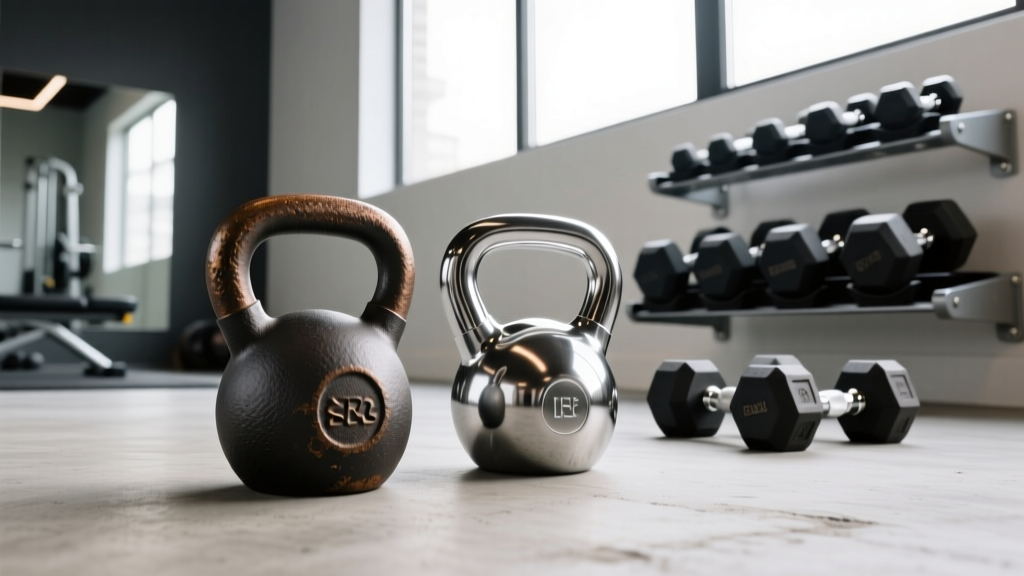
Cast Iron vs Competition Kettlebells & Standing Chest Flys With Dumbbells
Compare cast iron vs competition kettlebells with a 2026 budget breakdown, plus a value analysis of standing chest flys with dumbbells for your home gym.

The 2026 Free Weight Market: Bridging Ballistics and Isolation
Building a comprehensive home gym in 2026 requires navigating a fragmented market where raw material costs, shipping surcharges, and manufacturing precision dictate the final price tag. For athletes focused on functional strength, the kettlebell remains a non-negotiable staple. Yet, the debate between cast iron and competition steel kettlebells often derails budgets. Furthermore, an over-reliance on kettlebells exposes a critical gap in horizontal upper-body isolation—a gap best solved by integrating standing chest flys with dumbbells into your training arsenal.
This value analysis breaks down the exact metallurgy, pricing per pound, and geometric failure modes of modern kettlebells, while providing a budget framework to ensure your pec development doesn't suffer from a lack of proper isolation tools.
The Economics of Iron vs. Steel: 2026 Pricing Breakdown
When evaluating a kettlebell buying guide, cast iron vs competition steel is fundamentally a question of manufacturing tolerance versus raw material cost. Cast iron kettlebells are produced using sand-casting molds, making them relatively inexpensive to mass-produce. Competition kettlebells, however, are machined from solid steel or feature a steel shell with a precise internal ballast, demanding strict adherence to International Kettlebell Sport Federation (IKSF) dimensions.
According to comprehensive equipment testing by Garage Gym Reviews, the price disparity between these two categories has widened in 2026 due to global steel tariffs and precision machining costs.
| Kettlebell Type | Reference Model (16kg / 35.2 lbs) | Approx. 2026 Price | Cost Per Pound | Primary Use Case |
|---|---|---|---|---|
| Standard Cast Iron | Rogue Fitness Cast Iron (E-Coat) | $75.00 | $2.13 / lb | General fitness, grind lifts, home gyms |
| Premium Cast Iron | Onnit Primal Kettlebell | $115.00 | $3.26 / lb | Aesthetics, grip variety, commercial gyms |
| Competition Steel | Kettlebell Kings Steel Competition | $139.95 | $3.97 / lb | Girevoy sport, high-rep snatches, jerks |
| Elite Competition | Eleiko Sport Competition | $185.00 | $5.25 / lb | Olympic-level sport, precision lifting |
Geometric Failure Modes: Handle Scaling and Horn Width
The most overlooked aspect of the cast iron vs competition debate is handle geometry. Because cast iron bells are molded individually for each weight, the handle diameter and the distance between the horns scale with the bell's size. A 12kg cast iron bell might feature a narrow 32mm handle and tight horns, while a 32kg bell jumps to a thick 40mm handle with wide horns.
⚠️ Real-World Edge Case: If you are buying cast iron kettlebells for two-handed swings, be highly cautious of weights between 20kg and 24kg. Many manufacturers scale the handle thickness aggressively in this range, and the horn width often fails to accommodate a standard two-hand grip, leading to crushed pinky fingers during high-velocity hip snaps.Competition kettlebells eliminate this variable. Whether you are lifting an 8kg or a 32kg bell, the handle diameter is locked at exactly 35mm, and the window dimensions remain identical. This uniformity is crucial for muscle memory in sport-specific lifts like the snatch and clean-and-jerk, where a millimeter shift in grip placement can cause severe forearm bruising or missed reps.
The Isolation Deficit: Why Standing Chest Flys With Dumbbells Remain Essential
While kettlebells are unparalleled for ballistic hinge movements and unilateral pressing, they are biomechanically hostile to horizontal adduction. The offset center of mass in a kettlebell makes performing a chest fly awkward, placing undue shear stress on the rotator cuff and anterior deltoid rather than isolating the pectoralis major.
This is where the value of standing chest flys with dumbbells becomes a critical component of any free-weight arsenal. According to the biomechanical databases at ExRx.net, the dumbbell fly effectively targets the sternal head of the pectoralis major through a full range of motion. Performing this movement while standing, rather than supine on a bench, introduces a massive core stabilization demand.
Biomechanical Value of the Standing Variation
- Kinetic Chain Integration: Standing chest flys with dumbbells force the glutes, obliques, and erector spinae to act as anti-extension stabilizers, preventing the torso from collapsing backward as the dumbbells reach maximum eccentric stretch.
- Joint-Friendly Arc: Unlike barbell bench presses that lock the scapulae into a fixed path, standing flys allow the humerus to move freely, accommodating individual acromion shapes and reducing impingement risks.
- Asymmetry Correction: Dumbbells prevent the dominant side from compensating during the concentric squeeze, a common failure mode in machine-based pec decks.
Equipment Budgeting: The $1,200 Home Gym Allocation Matrix
How do you balance the premium cost of competition kettlebells with the necessity of dumbbells for isolation work? Below is a practical decision framework for a $1,200 free-weight budget in 2026, tailored to different training modalities.
Profile A: The Ballistic & Sport Athlete
Focus: Kettlebell sport, endurance, and explosive power.
- Competition Kettlebells (16kg & 24kg): $320.00 (Uniform 35mm handles protect the wrists during high-rep cleans).
- Adjustable Dumbbells (Nuobell 5-50lb Pair): $349.00. Essential for executing standing chest flys with dumbbells and lateral raises without buying a full rack of fixed hex bells.
- Remaining Budget ($531): Allocated to a heavy-duty pull-up rig and competition-grade flooring.
Profile B: The Hypertrophy & General Strength Athlete
Focus: Muscle building, traditional powerlifting accessories, and aesthetics.
- Cast Iron Kettlebells (16kg, 24kg, 32kg): $265.00. The budget saved here allows for a wider weight spread, which is more valuable for heavy goblet squats and farmer carries.
- Fixed Rubber Hex Dumbbells (20lb - 50lb pairs): $450.00. Fixed dumbbells offer superior knurling and balance for heavy standing chest flys with dumbbells and floor presses.
- Remaining Budget ($485): Allocated to an adjustable FID bench and a dedicated dumbbell storage rack.
Maintenance and Longevity: Protecting Your Investment
The value of your equipment degrades rapidly if environmental factors are ignored. Cast iron kettlebells, particularly those with basic powder-coat finishes, are highly susceptible to oxidation. If you train in a garage gym with fluctuating humidity, a $75 cast iron bell can develop surface rust within six months. Wiping down the handles with a light coat of 3-in-One oil or mineral oil monthly is mandatory.
Competition steel bells are generally finished with high-grade automotive paint or bare polished steel. While they resist rust better, their hardened steel bases will aggressively dent and scar hardwood floors or crack standard rubber puzzle mats. Dropping a 24kg competition bell from overhead requires a dedicated 3/4-inch horse-stall mat or a specialized dropping platform.
💡 Expert Tip for Dumbbell Flys: When performing standing chest flys with dumbbells, avoid the ego-lifting trap of using momentum. The American Council on Exercise (ACE) emphasizes that the eccentric (lowering) phase of the fly should take a full 2-3 seconds to maximize micro-tearing in the pectoral fascia. Use a weight that allows you to pause for one second at the bottom of the arc before initiating the concentric squeeze.Final Verdict: Synthesizing Your Free Weight Arsenal
The choice between cast iron and competition kettlebells should not be driven by brand prestige, but by your specific grip requirements and rep schemes. If your training involves high-volume snatches where handle consistency prevents forearm bruising, the 80% price premium for competition steel is a justifiable investment. If your training is rooted in heavy grinds, carries, and general conditioning, cast iron offers superior cost-per-pound value.
However, no kettlebell-centric gym is complete without addressing horizontal adduction. By strategically allocating your budget to include a quality set of adjustable or fixed dumbbells, you unlock the ability to perform standing chest flys with dumbbells—ensuring your upper body development remains balanced, joint-friendly, and highly functional. In 2026, the smartest home gyms aren't built on dogma; they are built on biomechanical completeness and ruthless budget efficiency.
More gear to consider
All reviews
Home Gym Setup for a Dumbbell Leg Workout Women Can Master

EZ Curl vs Straight Bar: Space Layouts for Dumbbell Workout Routines

Cast Iron vs Competition Kettlebells & Bowflex SelectTech 1090 Dumbbell
Bumper Plate vs Iron Plate: Specs, Costs & Dumbbell Push Ups

2026 Bumper vs Iron Plate Budget & One Arm Dumbbell Row GIF Guide