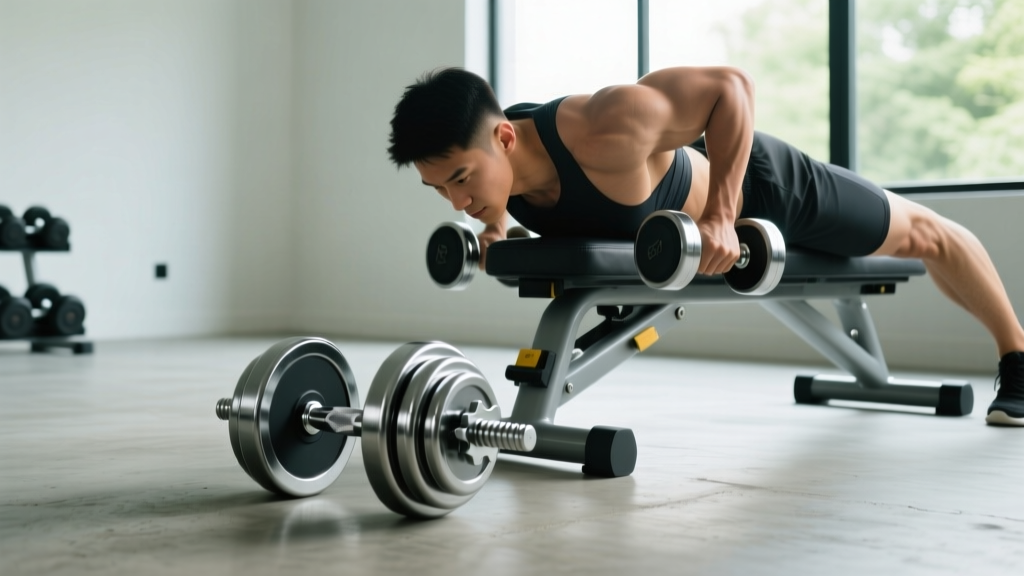
Loadable Dumbbell Value: Chest Supported Dumbbell Row Muscles Worked
Discover if loadable dumbbells with interchangeable plates offer the best value for back training, including a deep dive into chest supported row mechanics.

The Financial Case for Loadable Dumbbells in 2026
Building a hypertrophy-focused home gym often collides with a harsh financial reality: the exorbitant cost of fixed-weight dumbbells. As fitness equipment prices have stabilized in 2026, commercial-grade urethane hex dumbbells still command a premium of $2.00 to $3.00 per pound. For lifters prioritizing back development, this pricing model is incredibly inefficient. Enter the loadable dumbbell—a heavy-duty steel handle that accepts interchangeable weight plates. By decoupling the handle from the mass, lifters can achieve a massive weight range for a fraction of the cost. But does this budget-friendly approach hold up under the strict biomechanical demands of targeted back training? To answer this, we must examine the intersection of equipment economics and exercise kinesiology.
Biomechanics & Budget: Why the Chest Supported Row Dictates Your Gear
If you have ever mapped out the chest supported dumbbell row muscles worked, you already understand the biomechanical dilemma that makes fixed dumbbell sets so financially draining. When you lay prone on a 30-to-45-degree incline bench and row, you eliminate the lower back (erector spinae) and hip hinge momentum from the equation. This strict isolation forces the primary movers and synergists to absorb 100% of the concentric and eccentric load.
According to kinesiology data cataloged by ExRx.net's exercise directory, the primary muscles targeted in this movement include:
- Latissimus Dorsi: Capable of moving heavy loads (often 50–90 lbs per arm for intermediate lifters).
- Rhomboids (Major/Minor) & Middle Trapezius: Responsible for scapular retraction; typically max out at moderate loads (30–50 lbs).
- Posterior Deltoids & Teres Minor: Smaller synergists that assist in transverse extension; easily overwhelmed by loads exceeding 15–25 lbs.
The Micro-Progression Advantage for Hypertrophy
Progressive overload is the undisputed driver of muscle growth, a principle heavily emphasized by the National Strength and Conditioning Association (NSCA). When targeting the smaller synergists of the upper back, a 10-lb jump between fixed dumbbell pairs (e.g., moving from 20 lbs to 30 lbs) represents a 50% increase in load. This inevitably leads to form breakdown, momentum cheating, or failure to hit the target rep range. Loadable dumbbells paired with fractional change plates (0.5 lb to 2.5 lbs) allow for exact, incremental overload, maximizing the value of every training session.
2026 Cost Breakdown: Loadable Handles vs. Fixed Hex Sets
To quantify the exact value proposition, let us compare three distinct equipment setups capable of handling a 10-to-60 lb range per hand. Pricing reflects early 2026 market averages for reputable fitness brands.
| Equipment Setup | Components Included | Total Cost | Cost Per Pound (Effective) |
|---|---|---|---|
| Fixed Urethane Set (5-50 lbs) | 10 Pairs (550 lbs total) + A-Frame Rack | $1,550.00 | $2.81 / lb |
| Titan Fitness 1' Standard Loadable | 2 Handles + 200 lbs Standard Cast Iron Plates | $310.00 | $1.55 / lb |
| Rogue 2' Olympic Loadable | 2 Handles + 210 lbs Echo Bumpers & Change Plates | $515.00 | $2.45 / lb |
Value Analysis: The Titan Fitness 1-inch standard loadable setup offers an 80% cost reduction compared to the fixed urethane set. However, the Rogue Olympic setup, while more expensive than Titan, provides the distinct advantage of accepting high-quality, calibrated steel fractional plates that are widely available in the 2-inch Olympic format.
Hidden Costs and Edge Cases of Interchangeable Plates
While the upfront savings of loadable dumbbells are undeniable, a rigorous value analysis must account for physical limitations and hidden friction costs in the gym environment.
1. Sleeve Diameter and Range of Motion Interference
Olympic loadable handles (2-inch sleeves) are incredibly robust and can hold upwards of 150 lbs per hand. However, the bulky nature of 2-inch plates and thick steel sleeves creates a spatial problem. During the chest supported dumbbell row, the bottom position requires the dumbbell to travel close to your torso and the bench pad. If you load 45-pound bumpers or wide steel plates onto an Olympic handle, the plates will physically collide with the incline bench or your own ribcage before your lats reach a full eccentric stretch. Solution: For Olympic handles, restrict your loading to 10 lb and 25 lb compact steel plates or thin urethane grip plates to preserve your range of motion.
2. The Collar Slippage Factor
Standard 1-inch handles often rely on basic spin-lock collars or cheap spring clips. During a unilateral row, the rotational torque applied to the handle can cause spring collars to inch outward, leading to plate rattle and shifted center of gravity. To maintain the integrity of the movement, you must budget an extra $30 to $40 for a pair of high-tension lock-jaw collars or precision machined spin-locks.
'The center of mass on a loadable dumbbell shifts depending on how you arrange the plates. Always load your heaviest plates closest to the handle knurling to maintain a balanced moment arm during strict isolation rows.'
Strategic Purchasing Framework for Back Hypertrophy
If your primary goal is building a dense, detailed upper back without financing a commercial gym's equipment lease, follow this step-by-step purchasing framework:
- Assess Your Bench Geometry: Measure the width of your adjustable incline bench. If the seat pad and back pad create a tight 'T' junction, opt for 1-inch standard loadable handles to minimize plate-to-bench collision.
- Purchase the Handles: Invest in handles with aggressive knurling and a minimum 1.25-inch grip diameter. (e.g., Rogue Loadable Handles or Ivanko Standard Threaded Handles).
- Acquire 'Anchor' Plates: Buy enough 10 lb and 25 lb plates to reach your heavy lat rowing weights (e.g., four 25s and four 10s).
- Invest in Fractional Change Plates: Allocate $40-$60 for a set of 0.5 lb, 1 lb, and 2.5 lb micro-plates. These are the true value-drivers for targeting the rhomboids and rear delts during high-rep chest-supported burnout sets.
Frequently Asked Questions
Can I use loadable dumbbells for drop sets?
Yes, but they require planning. Unlike fixed dumbbells where you simply grab the next lightest pair, loadable dumbbells require you to physically strip collars and plates. For drop sets on the chest supported row, pre-load a secondary set of handles with lighter weights, or utilize 'strip-and-go' bumper plates that slide off the sleeve rapidly without needing to unclamp a collar.
Are loadable dumbbells safe for heavy chest-supported rows?
Absolutely, provided you use secure collars. The chest-supported position actually makes loadable dumbbells safer than standing bent-over rows; if a collar fails and a plate slides, the bench catches the falling weight rather than it dropping onto your lower back or heels.
Final Verdict: For lifters who understand the specific load requirements of the muscles worked during chest-supported rows, loadable dumbbells represent the highest ROI in home gym equipment. By sacrificing the convenience of fixed racks, you gain unparalleled micro-progression capabilities and save over $1,000 in 2026 market conditions.More gear to consider
All reviews
Market Trend: Loadable Dumbbells for Dumbbell Shoulder Rotation

Olympic vs Standard Plates for Your Full Body Dumbbell Routine
Power Rack vs Squat Rack vs Stand: Setup Errors and Dumbbell Flys
EZ Curl Bar vs Straight Bar: Man Full Body Dumbbell Workout PDF Care

Barbell Collar Guide: Beyond Back Workouts with Dumbbells and Bench
